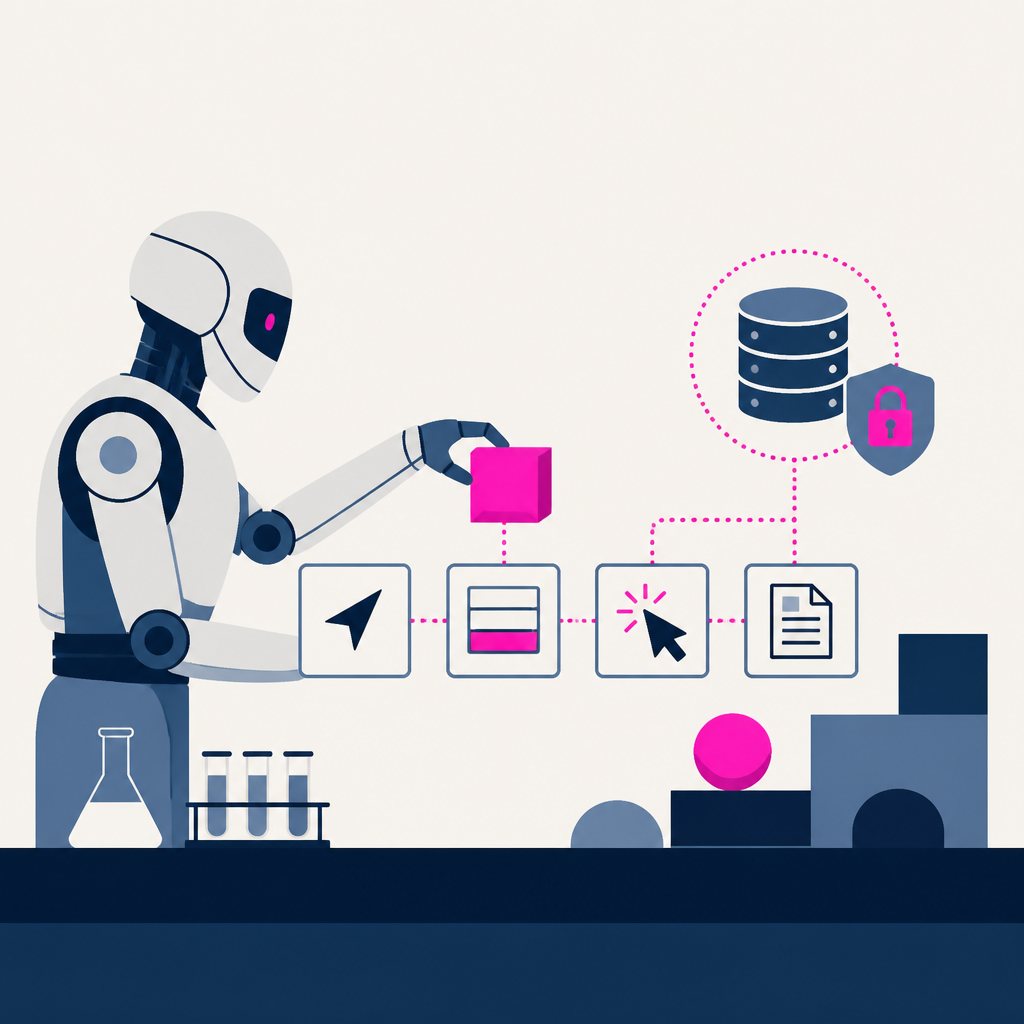
UiPath updated its automation platform with new workflow automation and software testing features at FUSION in Las Vegas. Cartographer automates the data collection step of mapping how employees perform manual tasks, taking the process that can take weeks. UiPath will also roll out enhancements including Autonomous Exploration for Test Cloud and a new UiPath Delegate agent for test administration tasks.
ZooWork was launched as a no-code platform to build, deploy, and deliver AI agents for teams or clients. It is listed as launching today with 340 followers. Users can start building in a Builder UI or integrate via a Managed Agent API.
HEMA’s engineers replaced portal-hopping through disconnected wikis and IT catalogs with HAL, an internal assistant that provides instant answers from a structured knowledge layer built on Amazon Bedrock AgentCore. The project was validated with a one-month staging rollout for engineers and business users before going to production. The result is that teams can find procedural IT and API guidance in seconds from chat or the IDE instead of spending an afternoon navigating multiple portals, and the architecture is set up to evolve from read-only answers to actions using MCP.
An AWS-based agentic video intelligence system lets users ask natural-language questions about uploaded videos and receive answers using a runtime-orchestrated mix of AWS services. Initial analysis of new videos takes 5–10 minutes, while previously analyzed content returns in under a second and one media customer reported about an 80 percent reduction in manual review time across a backlog of 200+ multi-hour recordings. Manual review work shifts from watching hours of video to querying results via chat, with caching and follow-up questions reusing prior analysis instead of rebuilding fixed pipelines per question type.
OpenCode, an open-source terminal-native AI coding agent, was set up to run with open weight models via Amazon Bedrock so inference stays in an AWS account. The setup supports three specific models on Bedrock, including Moonshot AI Kimi K3 with a 1M-token context window. As a result, developers can switch models per coding task without per-seat fees or sending proprietary data to third-party APIs.
Amazon blocked Meta’s Muse from browsing and buying on Amazon.com after Muse sessions appeared to browse without identifying itself and while seeming to access/store credentials. The block went live roughly two weeks after Muse launched on September 8, and Amazon’s pop-up cites an unauthorized AI agent violating its Conditions of Use. Shopify then enabled agentic checkout with Shop Pay across Shopify stores on September 21, routing agent purchases through a declared payment path with single-use credentials instead of an anonymous browser session.
YouTube released new creator tools in YouTube Studio, adding AI-powered analysis and drafting features alongside thumbnail and title generation. One change expands Ask Studio to iOS and Android. As a result, creators can get draft feedback on pacing and storytelling, generate multiple thumbnail/title options in their style, run up to three video-cut tests, and receive more explanatory analytics.
Floot Connector was introduced to connect Floot with Claude or ChatGPT so app builds can be generated inside the same chat interface. It supports ChatGPT 4.3. It outputs a deployable full-stack app (database, user logins, hosting, and a live URL) and lets the same project be published to iOS and Android without extra configuration while Floot itself doesn’t charge for AI credits.
ZeroDrift launched Anchor 3.0, a family of small language models for real-time compliance checking of AI-agent messages before they are sent. The company says its flagship Anchor 3.0 model detected more than 90% of violations on a benchmark based on FINRA rules. The release makes its Enforcement API and broader compliance platform capable of flagging, rewriting, blocking, or routing messages in real time, with the three new model versions covering high-volume traffic and long documents.
Invofox launched a self-serve document parsing API that converts documents into structured JSON for developers. The launch promises 99%+ accurate extraction with SLAs and makes customers not pay for documents where it makes a mistake. It shifts the product to a self-serve flow by bundling parsing, extraction, validation, and monitoring behind one endpoint and using user feedback to improve results.
Gemini 3.8 text-to-speech models were launched for generating custom character voices and directing scene dialogue in Google’s platforms.
The models are identified as “Gemini 3.8.”
This adds new text-to-speech capability across Google AI Studio, the Gemini API, Gemini Enterprise, Gemini Notebook, and Google Vids.
Anthropic cut Claude Opus 5.5’s token prices and published a migration guide after noting that four Opus 5-dependent request behaviors can break. It reduced input pricing from $5 to $4 per million input tokens and output pricing from $25 to $20 per million output tokens. As a result, agents may need updated thinking, tool-choice, router/fallback, conversation-history, and computer-use toolset handling to avoid 400 errors and altered response rendering.
Harness Manager launched on Mac as an App Store-style control center for AI coding harnesses. It launched today. It consolidates discovering, installing, updating, and diagnosing tools like Claude Code and related configuration via version and path checks and MCP server management.
OpenRouter launched a batch API that lets providers schedule batch processing within a 24-hour window at a reduced per-token rate. The beta on 230k+ completed batches saw a median completion time of 7 minutes, with 90% finishing within 1 hour. Jobs can now be run asynchronously and waited on later, with up to 30-day retention for inputs and results and per-request results returned together in a completed batch response.
Kimi Browser Extension added browser automation for AI Agents, enabling it to open pages, click buttons, fill forms, and extract information. It pairs a local service with the extension using the Chrome DevTools Protocol to navigate, take screenshots, and read pages. Everything runs locally, so login sessions and page content stay on your device, and users must sign in for the sidebar entry and connection flow changes from the earlier Kimi WebBridge naming.
OpenAI released GPT-6 Sol and GPT-6 Luna as deployable, API-only additions to its GPT-6 model lineup. GPT-6 Sol and GPT-6 Luna API pricing was cut by 50% versus GPT-5.6 promotional pricing, with Sol at $2/$10 and Luna at $0.10/$0.50 per 1M tokens for input/output. The change lowers inference costs and adds improved prompt caching controls that can discount cached input up to 90% and reduce prompt tokens needing fresh processing by more than 50%.
ColdIQ launched an AI SDR Slack app that can build GTM systems in Slack threads with edit, reply, and iteration. It highlights access to 40+ data providers and 100+ GTM skills. The result is that users can go from text prompts to campaign outputs inside Slack while pulling from ColdIQ’s bundled data and GTM content.
Airbnb is expanding access to GPT-6 Astra and OpenAI frontier models for engineering teams. The key detail is support for GPT-6 Astra. This will let teams use those models to find bugs, create design systems, and ship faster.
Every AI story that matters,
in your inbox by 8am.
TLDRocket reads all relevant sources, removes duplicate coverage, and summarises the
day in two minutes. Follow companies and topics for alerts, or get the
briefing in Slack. Free, no spam, unsubscribe anytime.
Reading TLDRocket needs no cookies, and the readership counts we rely on come from
our own cookieless analytics. Google Analytics is the exception: it sets cookies and
reports to Google, so it stays switched off until you allow it. You can change your
mind any time from “Cookie settings” in the footer.
Strictly necessary
Session security and form protection (tldrocket-session,
XSRF-TOKEN, 2 hours). The site cannot work without them,
so they need no consent.
Always on
Google Analytics 4 (_ga,
_ga_<id>, up to 2 years). Measures which
stories and sections readers use. Google acts as a third-party processor and may
store the data outside the EU. No advertising, no profiling, no data sold.