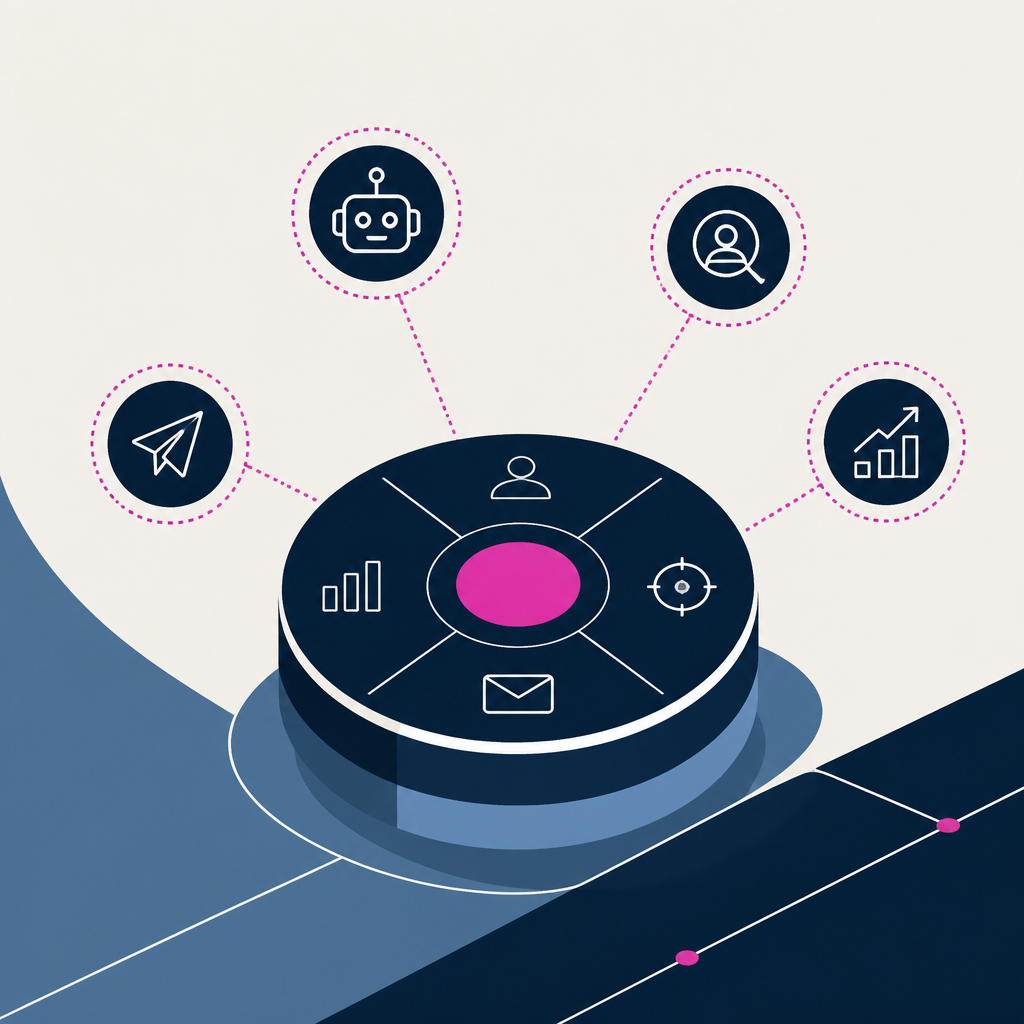
Knocket launched a website script that shows a chat bubble so visitors can message the maker without creating an account. The service is free and went live today. Messages route to Telegram, email visitors when you’re away, and use an AI agent to answer from the maker’s docs before handing off to the maker when needed.
TechCrunch revealed the agenda for its Founder Summit taking place in Boston at SoWa Power Station on November 4. One session spotlights adding AI features versus building an AI-native company with Lior Div of 7AI. The event lineup expands founders’ planning beyond fundraising and hiring to include AI strategy, investor selection, category-evaluation frameworks, early hiring, and product-market-fit validation.
LaterOn.email launched LaterOn v2, a comprehensive email platform with agentic workflows for sending and receiving emails. It is launching today. The update adds an agent that monitors relevant messages, drafts context-aware replies, follows up on non-responses, and closes threads when goals are met.
Qualcomm announced the Snapdragon 8 Elite Gen 6 and Snapdragon 8 Elite Extreme Gen 6 smartphone chips with an emphasis on on-device AI features. The Extreme model can run a 30-billion-parameter mixture-of-experts model locally while activating only part of the parameters for each task. As a result, phones can support locally run personal voice agents and sensing hubs that enable speaker differentiation, task automation suggestions, and higher-end camera/video capabilities.
Meta acknowledged that its Muse AI app was heavily inspired by OpenClaw while also saying Muse was built from scratch. The company’s product head, Nat Friedman, credited using OpenClaw in January and said Meta aimed to scale Muse to billions of people. This confirmation redirects the debate from “coincidence” to deliberate product inspiration, while Meta adds no further details beyond the statement.
Coverage Cat launched as a licensed insurance brokerage that compares umbrella and home coverage using AI-guided intake alongside a broker, and lets users route the shopping flow through personal AI agents via an Agent API/MCP. The service’s umbrella liability policies typically start at $1 million in additional liability coverage. As a result, insurance shopping shifts toward more automated, side-by-side pricing and carrier comparisons with fewer lead-generation steps and more agent-enabled workflows.
Reactiv built an AI Scheduler for Shopify merchants that automates native iOS and Android app updates using Amazon Bedrock AgentCore. It reduced merchant configuration time by 80 percent and cut time to production by 33 percent. By unifying interactive and scheduled agents on one AgentCore stack with shared memory, tools, and UI protocol, Reactiv enabled bidirectional learning so scheduled updates get better as merchants use the dashboard.
Trane Technologies built an AI-powered, agentic diagnostic assistant on Amazon Bedrock AgentCore to turn multi-screen HVAC troubleshooting into a conversational workflow. The team reduced a 20-minute diagnostic process to a 20-second natural language interaction in 3–4 weeks, based on internal technician benchmarking. This changes operations by speeding time-to-insight 60x and shifting staff from reactive work toward more proactive, data-driven optimization.
Kelam launched an AI voice agent product that gives an assistant its own phone number to dial and to receive calls. The page says it is launching today and shows 12 followers. As a result, users can install the service into Claude, Muse, a coding agent, or a terminal using one sentence.
Andreessen Horowitz is launching the Horowitz Andreessen Academy as a startup pipeline for young people, with classes and company “co-ops.” It launched with 10 partner companies and $42 million in funding. The academy offers short classes and work placements instead of degrees or accreditation.
Kantata unveiled Agent Studio, a tool that lets services firms build custom AI agents by describing the job in plain language instead of writing code. Agent Studio is available now and is in use by customers. It shifts agent creation to conversation-based builds within Kantata’s platform, with standard formats and governance applied once to reduce repeated prompt drafting and reformatting.
xAI introduced Grok 4.7, a new model for coding and knowledge work, and benchmarked it against prior and competing systems. Grok 4.7 is priced starting at $2 per million input tokens and $6 per million output tokens. It adds a larger base model, longer reinforcement learning training, better self-verification and longer context handling, a new safeguard stack, and is offered in Cursor and Grok Build via API and third-party platforms.
Primo raised $8 million in a funding round to build an AI platform that lets autonomous agents manage corporate IT end to end. The round was led by Headline and Global Founders Capital. Primo plans to use the money to hire, expand internationally, and further develop its AI capabilities so customers can deploy AI agents with traceability and control.
Zeliq raised a €7 million seed extension to grow its sales prospecting platform and AI-native “Agentic Revenue Workspace.” The round brings Zeliq’s total funding to €21 million in less than three years. It will accelerate development of its AI infrastructure, expand its suite of AI sales agents, and double product and technology headcount while continuing European growth and CRM partnerships.
A whistleblower dispute and later lawsuits show Mark Zuckerberg privately pushed back on making child-safety messaging his top focus while steering discussion toward building the metaverse and future AI efforts. In Q2 2026, IDC estimated Meta holds 69.2% of the smart glasses and headset market. That focus results in Meta pivoting its AR/glasses push toward “AI glasses” and releasing Muse, while facing growing public backlash over privacy and misuse.
Spott, an AI-native ATS and CRM platform for recruitment agencies, raised a $21 million Series A to expand its product and operations. The funding round was led by Balderton Capital. The company will use the money for international expansion, added enterprise functionality, and more agentic AI features while keeping key candidate and client decisions under human control.
NVIDIA, NTU, and MIT released SoL-Pi, an MIT-licensed extension for the open-source Pi coding agent that uses auto-research loops to tune a harness for efficiency. On the 51-task EdgeBench benchmark, SoL-Pi cut recorded token traffic by 44.7% to 49.0% versus Pi and reduced API cost by about 33%. SoL-Pi ships on GitHub and is deployable on an unmodified Pi release (tested with Pi 0.85.1 and Node.js 22.19+), with efficiency improvements carried through to closely matched scores.
Every AI story that matters,
in your inbox by 8am.
TLDRocket reads all relevant sources, removes duplicate coverage, and summarises the
day in two minutes. Follow companies and topics for alerts, or get the
briefing in Slack. Free, no spam, unsubscribe anytime.
Reading TLDRocket needs no cookies, and the readership counts we rely on come from
our own cookieless analytics. Google Analytics is the exception: it sets cookies and
reports to Google, so it stays switched off until you allow it. You can change your
mind any time from “Cookie settings” in the footer.
Strictly necessary
Session security and form protection (tldrocket-session,
XSRF-TOKEN, 2 hours). The site cannot work without them,
so they need no consent.
Always on
Google Analytics 4 (_ga,
_ga_<id>, up to 2 years). Measures which
stories and sections readers use. Google acts as a third-party processor and may
store the data outside the EU. No advertising, no profiling, no data sold.