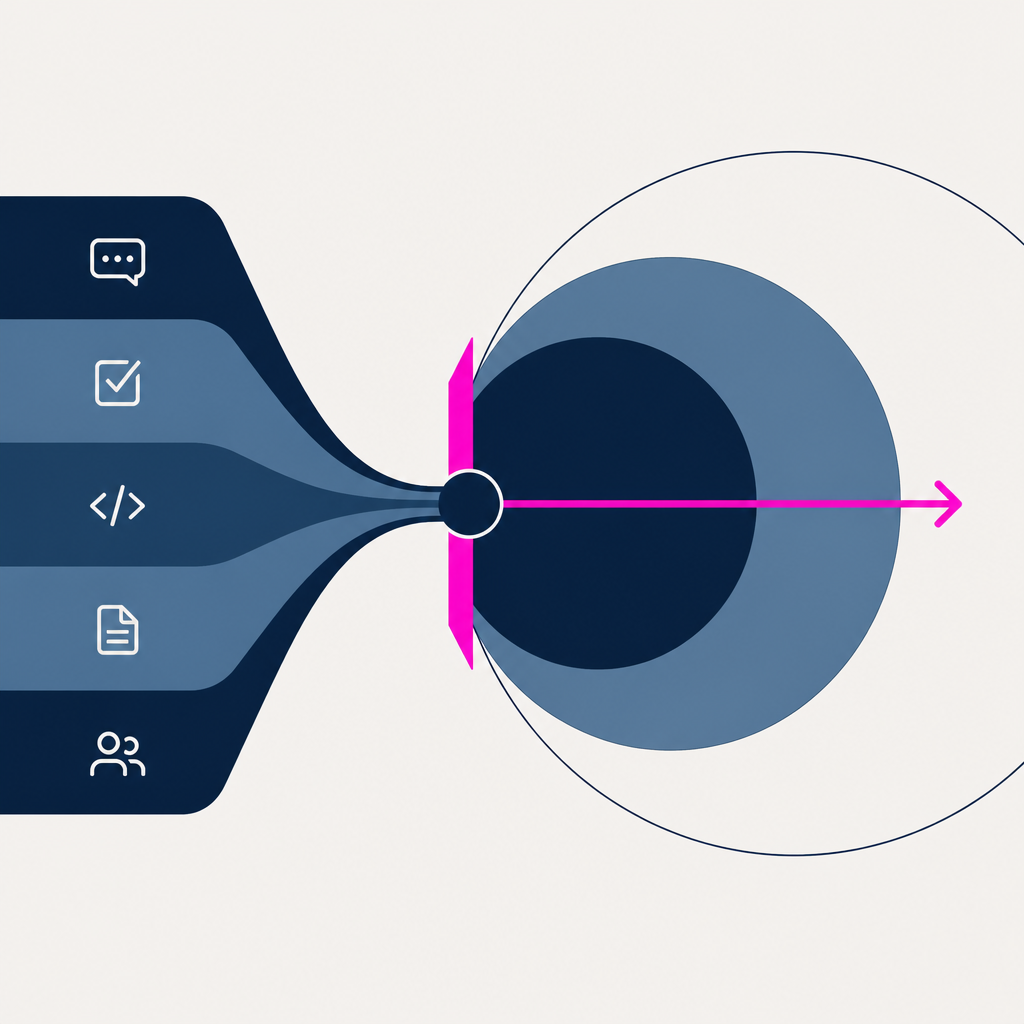
Ambiguous Workspace launched 18 productivity apps intended to let work flow between teams and AI agents. The launch is dated “today” and includes 18 apps. Users can interact with each agent using email, messages, task assignments, or comments instead of dealing with access errors or agent logins.
Fortune’s AIQ Summit coverage argues that big companies getting value from AI depend more on people than on models, stressing training, hiring, and adaptability. In ServiceNow’s AI maturity data, 57% of “Pacesetter” companies invest in upskilling employees on AI versus 4% for those outside the top tier. As a result, the recommended shift is toward HR and workforce mechanisms—like AI skill assessments and incentives—so organizations can implement AI at scale and keep adjusting as tools change.
Musubi announced PolicyLM-1.7B, an open-weights decision model for real-time content moderation that applies plain-English policies to messages.
It is designed to make moderation judgments in under 50 milliseconds.
With policy updates requiring no new training, platform teams can iterate and label content more quickly and at scale.
OpenClaw and Amazon Bedrock AgentCore were used to build an AI assistant that retains user context by storing and retrieving both chat events and extracted long-term memory instead of starting each conversation from zero.
FamRelay launches as a neutral relay layer that shares specific facts between AI assistants only after user approval. It begins today. This lets users connect two or more assistants and stop being the messenger by automatically passing approved details between them.
Hark launched Hark Pro, a personal AI meant to automate tasks across the web like email, calendars, shopping, travel, and bills. The launch is happening today. As a result, users can use the assistant while viewing it in action, with credentials encrypted and the company saying it will not sell data or share it with advertisers.
SAP is rolling out Joule AI assistants to put its enterprise AI agents directly in front of finance, spend management, HR, customer experience, and supply chain workers at Connect in Las Vegas. It says the International Trade Assistant can cut product-classification work by as much as half in early deployments. From early adopter programs, SAP will expand assistant availability through general releases between now and Q1 2027 and add AI governance and payments capabilities to manage those agents across workflows.
Palo Alto Networks CEO Nikesh Arora is portrayed as the mentor Sam Altman goes to for direct, actionable advice. Altman says it can be hard to get that kind of advice from most people, who may be busy or unwilling to spend enough time. As AI reshapes cybersecurity, the profile ties Arora’s strict approach to the need to avoid errors in high-stakes AI and security work.
Strawberry launched its 3rd release of an AI browser that lets teams run AI agents inside a web browser interface. The update is positioned as a “3rd launch” and is offered alongside “Free Options.” The company says agents can be built and shared across teams to handle tasks like research, drafting outreach, and updating CRMs or sheets within logged-in apps.
Project management software “Kitbar” was launched on Product Hunt as a dev tool status bar for macOS and Windows. It shows limits and checks including Claude Code and Codex limits alongside Vercel and Cloudflare deploy status and GitHub/GitLab checks. It adds an at-a-glance dashboard for development work across these services, with no further substantive details provided in the page.
Atlassian and OpenAI expanded their partnership to connect frontier models with enterprise knowledge so teams can plan, build, and deliver work. The article provides no date, price, or measurable benchmark. The change is that the collaboration will further focus on turning enterprise knowledge into actionable outcomes for teams.
Amazon SageMaker Studio can now create and manage SageMaker Spaces running on Amazon SageMaker HyperPod EKS clusters directly from a new IDE and Notebooks tab. Startup time can drop from 5–7 minutes to around 30–40 seconds using node over-provisioning. This shifts day-to-day Space operations from HyperPod CLI/kubectl to a browser-based workflow with options to create, start/stop, and open Spaces (JupyterLab or Code Editor) or connect to them via remote VS Code.
SAP is acquiring Belgian AI startup TechWolf to use its workforce skills and work understanding for its talent strategy. The company was founded in 2018, and TechWolf has raised more than $50m in total. The acquisition is expected to close in Q4 this year, expanding SAP’s AI-driven HR and workforce planning capabilities via TechWolf’s technology.
Thoughts from San Francisco reflects on how different groups use AI and argues that personal AI agents are not yet ready, even as the author cites new agent-related product updates. The article highlights a rollout in the next two weeks for Google Docs opening Markdown files without converting them. It shifts emphasis toward building blocks (speed, interfaces, side threads, visible memory) and expecting more devices/surfaces plus shared “factories” rather than personal agents as the end goal.
Gamma Tech Inc. released Gamma 5, a rebuilt presentation and visual-content platform that uses a redesigned editor, a stronger AI agent, and a larger set of visual styles linked to internal company tools. It claims its visual-accuracy benchmark for imported materials improved from roughly 30% early in development to over 97%. The update gives users more layout freedom, adds safeguards and connectors for importing company information, and aims to reduce repetition and generic “AI smell” by producing more distinctive, illustration-focused outputs.
Telecom operators are shifting their AI strategies toward open models to better trust, control, and customize AI for network and customer workloads. 89% of respondents in NVIDIA’s State of AI in Telecommunications report said open source models and software are important to their company’s AI strategy. This leads operators to reserve closed models for high-value tasks while fine-tuning open models with telco data and deploying them across public, private, and edge environments under governance requirements.
Anaconda Inc. is upgrading its enterprise AI platform to coordinate agent swarms and add AI security testing so customers can move applications into production. It says Enkrypt research found vulnerabilities in 73% of the agent tools examined across more than 25,000 Model Context Protocol (MCP) servers. The update introduces features like a shared message board with audit logs, autonomous agent red-teaming with least-privilege controls, and a larger curated model catalog, while retiring some legacy workbench and package-security products.
Jump Trading is using OpenAI to expand its quantitative research workflows. The article says Jump Trading integrates ChatGPT with longer-running AI workflows that pull in multiple data sources and then uses human review. As a result, research work can run across more data while remaining under human oversight for validation.
IronBee Express demoed a browser agent built around Jev that completed a checkout in 6.7 seconds using 9 actions and $0.00054 decision cost, with no LLM in the loop for the steps. The recorded run happened on a real iPhone 15 Pro checkout and finished in 6.7 seconds (9 actions). The system shifts from LLM-based step generation to Jev’s typed-choice decisions plus tighter latency/cost controls and smarter option text, with LLM help only when Jev can’t proceed.
Vocca, a healthcare voice AI startup, raised a Series A to help medical practices automate patient phone calls. The funding round totaled $20m. As a result, Vocca will expand its voice assistant service for handling those calls.
Procuros raised a €20 million Series A funding round to develop its AI-native supply-chain connectivity platform for B2B data exchange. The round is €20 million, led by XAnge with participation from Point Nine, Creandum, and b2venture. The company plans to scale its go-to-market, expand internationally, and build a shared data layer that replaces point-to-point integrations and helps AI agents automate trade workflows.
Cleavr raised an €8M seed round to automate late invoice collections across multiple European markets. The company says it cut days sales outstanding by 37% for customers shortly after rollout. It will expand its sales team and keep developing an AI agent that handles reminders, contact discovery, and disputes with humans only stepping in when needed.
HeyPi launched today as an AI meeting tool that tracks conversations in real time and uses past meeting context to surface key information and start follow-up work during the meeting. It follows what was said and can generate outputs like landing pages, apps, social media content, and ad campaigns live within the meeting. The result is less AI meeting notes and more automated execution after ideas are discussed.
SunSed launched its third AI-native app platform release that builds production apps from sealed, battle-tested components rather than generating large amounts of new code. Up to 20x fewer credits are claimed for app builds. The change is that subscriptions now bundle managed hosting, a private database, transactional email, user authentication, file storage, and automatic backups under the new framework.
Every AI story that matters,
in your inbox by 8am.
TLDRocket reads all relevant sources, removes duplicate coverage, and summarises the
day in two minutes. Follow companies and topics for alerts, or get the
briefing in Slack. Free, no spam, unsubscribe anytime.
Reading TLDRocket needs no cookies, and the readership counts we rely on come from
our own cookieless analytics. Google Analytics is the exception: it sets cookies and
reports to Google, so it stays switched off until you allow it. You can change your
mind any time from “Cookie settings” in the footer.
Strictly necessary
Session security and form protection (tldrocket-session,
XSRF-TOKEN, 2 hours). The site cannot work without them,
so they need no consent.
Always on
Google Analytics 4 (_ga,
_ga_<id>, up to 2 years). Measures which
stories and sections readers use. Google acts as a third-party processor and may
store the data outside the EU. No advertising, no profiling, no data sold.