The OECD reports that PISA results show lower test scores and multiple skill declines among students using AI chatbots in school, but those who use AI once or twice a week perform similarly or better than nonusers in some cases. Students who used AI for summarizing reading or preliminary research weekly scored about the same as AI nonusers after accounting for socioeconomic status. Excessive or rare use is linked to weaker science results and declining critical-thinking indicators, including an increase in “hasty readers” between 2018 and 2025.
Frank X. Shaw is leaving Microsoft after nearly 30 years shaping the company’s public messaging, with a memo to staff reported by Fortune. Shaw, 64, will stay until the end of the year. Microsoft continues its Copilot-focused reorganization and scaling of AI cloud demand while adjusting leadership as other executives have recently departed.
Cisco is reframing contact centers as “context centers” so customer history moves across channels and handoffs via its agentic CX vision. The plan centers on Cisco’s AI Agent 360, described as a control plane that combines observability, security, and agent management. Cisco says this enables safer, enterprise-grade autonomous relationship orchestration and supports open standards like Agent2Agent and the Model Context Protocol to work with third-party systems.
Five9 is positioning its Humantic contact-center model around humans and AI agents working together instead of aiming for full automation. By year’s end, PODS is expected to route more than 100,000 calls through Five9’s Voice AI Agents, and Five9 reports a 44% containment rate that exceeded its target. The approach shifts deployments toward keeping complex, high-value, and vulnerable interactions with people while using AI for high-volume, low-stakes requests and emphasizing an open, orchestrated platform.
Kubernetes v1.37 (Garhwal) was released with new capabilities across control-plane resilience and autoscaling, plus additions to configuration and runtime behavior. It adds 67 enhancements (16 stable, 23 beta, 27 alpha, and one deprecation). Operators will need to plan updates around watch cache initialization improvements, KYAML reaching stable status, and HPA scale-to-zero moving to beta and enabled by default for idling workloads.
Contact center AI is moving beyond pilot deployments, but knowledge management is emerging as the main limiter to proving ROI as older success metrics stop matching outcomes. Gartner projects conversational AI will cut contact center labor costs by $80 billion this year, highlighting the need for better measurement than average handle time and first call resolution. Success is shifting toward outcome-based scoring and stronger data quality, workflow redesign, and smoother handoffs between virtual and human agents.
Simon Willison’s Weblog·1 month ago·
35
● 8 sources
A commenter on Hacker News argues that people can feel existentially discouraged when AI coding agents produce work faster than a week of effort before adjusting their mindset about what makes software engineering valuable. The post cites the shift from “a week” of coding to “an hour” as the catalyst for that disheartenment. It concludes that, after accepting this, engineers should refocus on broader problem-solving and see the tools as something they can build on rather than something that ends their value.
Engineering simulation is shifting from prototyping to digital validation, with companies and venture investors funding AI-enabled environments that predict physical behavior before any physical testing. PhysicsX secured a $135 million Series B round in 2026. This accelerates calculation cycles from weeks to minutes while keeping enterprise buyers focused on certified, multiphysics platforms like SIMULIA as a validation gate for production.
Resurf launched as a personal context app that lets people save notes, links, images, PDFs, and ideas. It’s launching today and runs natively on Mac, iPhone, and iPad. Users can later retrieve that context or pass it to AI via MCP and a CLI integration.
Venture capitalist Vaughn Crowe of NVP Capital says manufacturing and industrials became venture-ready as COVID highlighted supply-chain and energy dependencies and as governments shifted to back mission-critical domestic industries. NVP closed its second fund of $80 million in 2025. NVP expects increased venture-like returns through IPOs and M&A, with more funding flowing into industrials that tie AI to the physical world.
Contact centers are shifting their success metrics from containment—calls that avoid a human—to whether AI-assisted interactions actually resolve the customer’s request end to end. Zoom’s AI for Zoom CX team, led by product head Ram Rajagopalan, has spent the past year building this “conversation to completion” approach into its virtual agent platform. Enterprises are expected to pick smaller first use cases and ensure full call context carries over during virtual-to-human handoffs to achieve measurable resolution instead of just deflection.
Balderton appointed Luca Bocchio as a Partner to focus on early-stage investments. He joins after more than a decade as an investor, most recently at Accel. The firm’s early-stage investment leadership expands as Bocchio brings experience including AI applications alongside fintech and consumer.
The Vergecast discussed Apple’s launch event, including CEO John Ternus’s first appearance as CEO, iPhone updates, and concerns about AI features on the Apple Watch. The iPhone 18 Pro’s variable aperture camera was a specific focus during the conversation. The episode shifts from early impressions of Apple’s first folding phone to evaluating camera details and how watch AI features could affect future product direction.
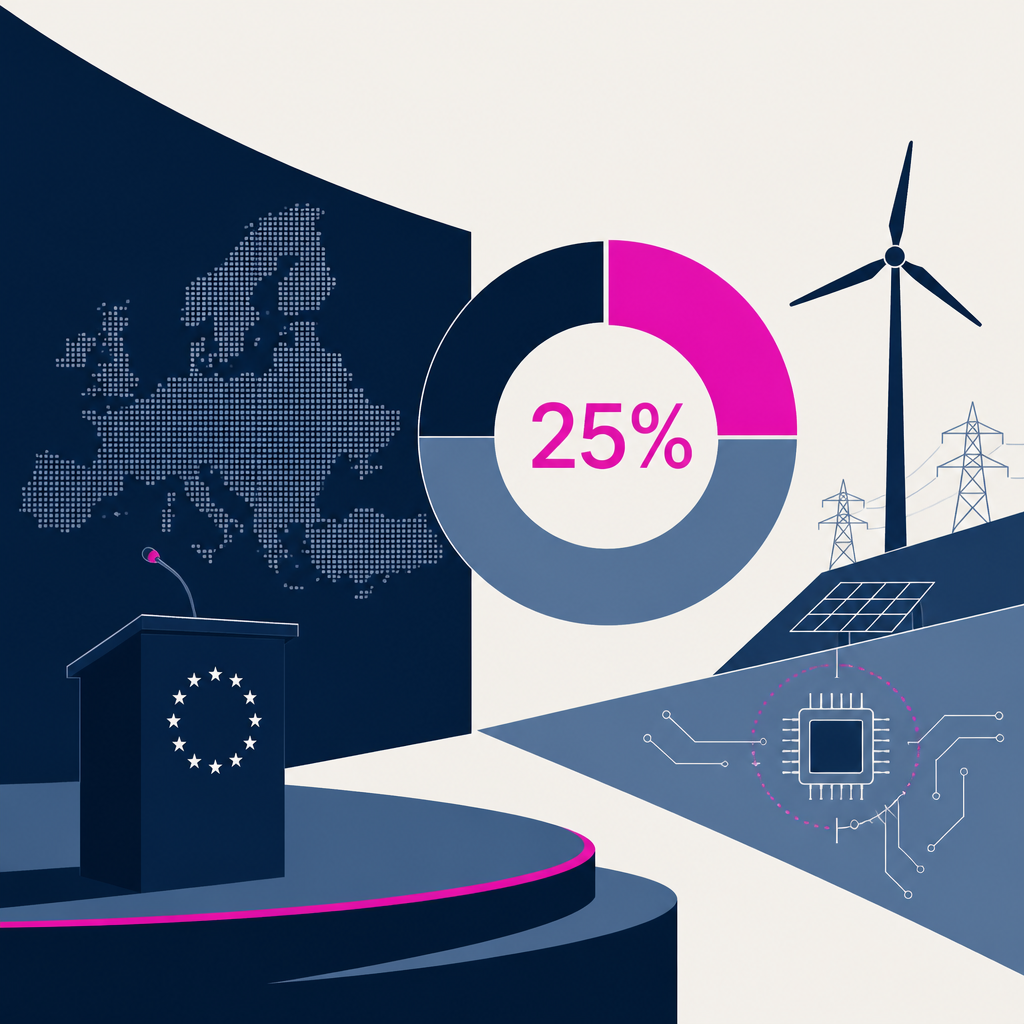
DIGITALEUROPE’s industry leaders urged EU policymakers to commit to electrification, faster digital grid permitting, and more European-made critical technologies. They want 25% of the next EU budget (from a proposed almost €2 trillion for 2028–2034) directed to critical and digital technologies. The proposal would speed grid digitalisation and startup-to-commercial funding by funding decisions within 90 days, with procurement and other finance tools to help scale deployments.
The article argues Apple should build a single “home computer” that merges a Wi‑Fi router, an AI-powered smart home hub, and local storage. It points to John Ternus’s first keynote as Apple CEO, where he described an “intelligent personal hub” focused on local processing and privacy. It says an upcoming smart home hub should act as infrastructure (not just a screen-based interface) so it can run tasks locally in your home.
OpenAI and Anthropic have been hiring senior executives from U.S. tech companies to staff AI teams in Asia-Pacific countries to sell products and work with policymakers. Meta’s India and Southeast Asia vice president Sandhya Devanathan left in order to join OpenAI as vice president for Southeast Asia and Australia. These hires shift competition toward recruiting “mini-CEO” leaders who can drive market adoption and navigate local regulators and partners, alongside a growing executive talent shortage.
NVIDIA is partnering with Australian data-center and cloud providers to expand capacity for NVIDIA DSX full-stack AI “factories” that run NVIDIA compute and Nemotron open models. The buildout targets up to 2 gigawatts of capacity by 2027. This increases local access to accelerated computing so Australian organizations can train and deploy AI models, applications, and agents more in-region as new DSX infrastructure comes online.
Klook cofounder Ethan Lin argued that overtourism stems from tourists clustering in a few locations rather than from overall visitor counts, and said AI can help travelers branch out. A Klook Travel Pulse survey found 57% of Gen Z and millennial travelers in Asia used AI to find new destinations or experiences. This shifts travel demand toward lesser-known spots and encourages operators to diversify offerings beyond the usual hotspots.
Richard Roper, president of Marsh People and Investment, gave his two eldest daughters a written list of career “daddy tips” as they started working. He said he drafted it on Sept. 8 to pass on decades of basics like punctuality, politeness, and contributing value in meetings. As AI automates more entry-level tasks, the article argues these human soft skills are becoming more valuable for young workers trying to stand out and communicate effectively.
Furo, a Munich startup providing software for commercial and industrial battery storage, closed a $4 million seed round led by TQ Ventures to develop its product, expand in Europe, and hire staff.
Furo, a Munich-based software startup, raised $4 million led by TQ Ventures to optimize how commercial battery storage charges, discharges, or feeds power back to the grid at industrial sites.
It plans real-time control by predicting prices and weather up to 48 hours ahead, and says the approach can cut electricity costs by up to 40%.
With the funding, Furo will keep developing its platform, expand to new European markets, and hire staff, while competing in an increasingly crowded software field for battery optimization.
Anthropicologic launched a product that uses an internet-wide “Human Context Protocol” to analyze consumer and cultural signals. It supports nine workflows across 239 markets in 100+ languages. This replaces or speeds up traditional user research and social listening by delivering research, innovation, and foresight answers in minutes.
Every AI story that matters,
in your inbox by 8am.
TLDRocket reads all relevant sources, removes duplicate coverage, and summarises the
day in two minutes. Follow companies and topics for alerts, or get the
briefing in Slack. Free, no spam, unsubscribe anytime.
Reading TLDRocket needs no cookies, and the readership counts we rely on come from
our own cookieless analytics. Google Analytics is the exception: it sets cookies and
reports to Google, so it stays switched off until you allow it. You can change your
mind any time from “Cookie settings” in the footer.
Strictly necessary
Session security and form protection (tldrocket-session,
XSRF-TOKEN, 2 hours). The site cannot work without them,
so they need no consent.
Always on
Google Analytics 4 (_ga,
_ga_<id>, up to 2 years). Measures which
stories and sections readers use. Google acts as a third-party processor and may
store the data outside the EU. No advertising, no profiling, no data sold.