Every AI story that matters — and the intelligence behind it.
TLDRocket reads all relevant sources, removes duplicate coverage, and publishes a short neutral
summary of every story, linking back to the original. Free, no spam, unsubscribe anytime.
The article examines how AI tools can undermine human cognitive development when used as shortcuts but can enhance learning when used intentionally, citing research showing students using ChatGPT for homework performed worse on tests while those guided by AI tutors improved by 0.15 standard deviations. The author argues that the design of AI systems prioritizing frictionless use encourages cognitive surrender, similar to how 758 consultants at Boston Consulting Group using GPT-4 failed to catch errors the AI made on unfamiliar problems. The piece urges conscious choice about which cognitive tasks to delegate to AI versus keep for human development, warning that defaults being set now by AI companies and institutions may be difficult to reverse.
Open-weight models have not yet reached the agentic capability level demonstrated by Claude's Opus 4.5 in December 2025, with the gap likely persisting for 12+ months despite steady benchmark improvements. Google's Gemini 3.5 Flash lacks a meaningful competitor to Claude Code and Codex, suggesting Chinese labs face similar resource constraints and will specialize in automated enterprise agents rather than competing directly with U.S. frontier models. Existing power structures including governments and the Pope are beginning to assert control over AI development, while social and political resistance to data center expansion in the U.S. is creating potential conflict over who shapes the technology's future.
Researchers introduced a method for training large language models on multiple diverse reasoning paths for the same problem, using global forking tokens and set-supervised fine-tuning to prevent mode collapse where different tokens produce identical outputs. Performance improved 5% to 7% on standard benchmarks (with gains of 6.84% on AIME 2025 Pass@1 compared to baseline methods), demonstrating that enabling models to learn distinct reasoning strategies and select the appropriate one per question directly improves accuracy. This approach enables LLMs to solve problems through multiple qualitatively different strategies like algebraic manipulation or geometric reasoning, rather than collapsing to a single solution method.
OpenRouter, an AI model routing platform, raised $113M in Series B funding at a $1.3B valuation after growing to 8M developers. The company now processes approximately 1.5 quadrillion tokens annually, representing 15-30% of Google's token run rate and 20-40% of OpenAI's run rate. OpenRouter enables developers and enterprises to access 400+ AI models through a single interface with unified billing, improved reliability, and cost optimization features.
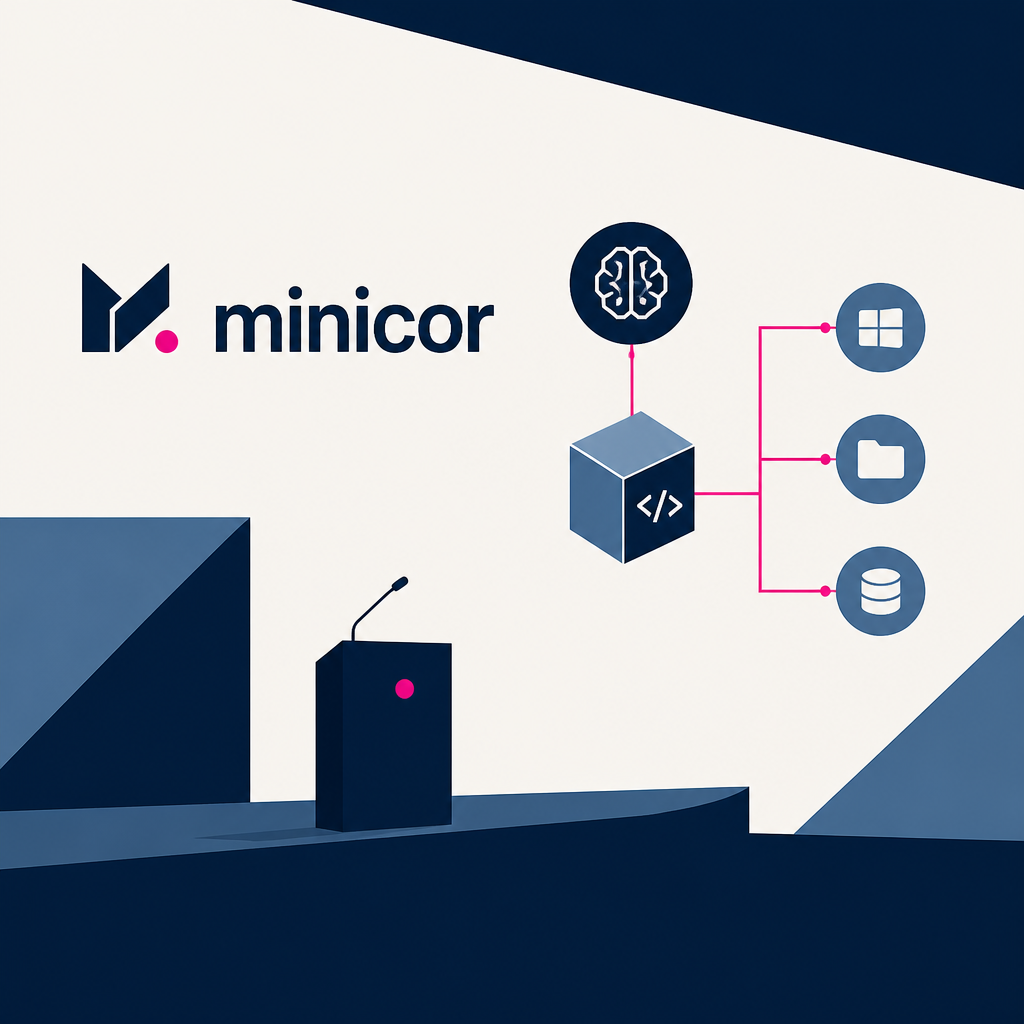
Minicor, a YC P26 startup, launched a tool that uses Claude as an MCP to automate Windows desktop tasks at scale by generating Python-based RPA workflows that can be triggered via API. The founders built this after a customer needed medical records integration in 2 days and found that conventional desktop automation typically fails 30% of the time due to scripting complexity, orchestration challenges, and debugging difficulties. The platform reduces failures by using AI-generated code, version control, video replay logging, and integrated human-in-the-loop options, addressing a market pain point where failed automations at scale generate thousands of support tickets monthly.
A tech newsletter discusses whether SaaS is declining as users increasingly build custom solutions with AI agents and modular tools instead of monolithic platforms. Perplexity open-sourced Bumblebee, a safety scanner for developer machines, and WorkOS released auth.md, an open protocol for agents to register for web services. The shift toward API-first and composable software tools is reshaping how users expect to customize and control their software features.
Dario Amodei, Anthropic's cofounder, argues that rapid AI progress requires societies to actively shape the technology's future rather than passively react to it. He cites AI achieving gold in the International Math Olympiad in July 2025 and co-authoring mathematical proofs the same year as evidence of accelerating capabilities, with self-improving systems potentially arriving within two years. The stakes demand immediate decisions about how to distribute AI's benefits and manage existential risks, since continued development under geopolitical competition makes coordinated global slowdowns unlikely.
Google unveiled Gemini 3.5 and the Gemini Spark agent at I/O 2026, alongside multimodal video generation capabilities and research tools, while Elon Musk lost his OpenAI lawsuit on statute-of-limitations grounds and Anthropic secured a $30 billion funding round at a $900 billion valuation. Cerebras' IPO surged 90%, coding-agent competition accelerated with Cursor Composer 2.5 and xAI's Grok Build, and OpenAI resolved an 80-year-old Erdős geometry problem. AI research advanced in interpretability, cyber capabilities, and autonomous hacking, while policy efforts addressed deepfakes and image provenance.
Every AI story that matters,
in your inbox by 8am.
TLDRocket reads all relevant sources, removes duplicate coverage, and summarises the
day in two minutes. Follow companies and topics for alerts, or get the
briefing in Slack. Free, no spam, unsubscribe anytime.
Reading TLDRocket needs no cookies, and the readership counts we rely on come from
our own cookieless analytics. Google Analytics is the exception: it sets cookies and
reports to Google, so it stays switched off until you allow it. You can change your
mind any time from “Cookie settings” in the footer.
Strictly necessary
Session security and form protection (tldrocket-session,
XSRF-TOKEN, 2 hours). The site cannot work without them,
so they need no consent.
Always on
Google Analytics 4 (_ga,
_ga_<id>, up to 2 years). Measures which
stories and sections readers use. Google acts as a third-party processor and may
store the data outside the EU. No advertising, no profiling, no data sold.