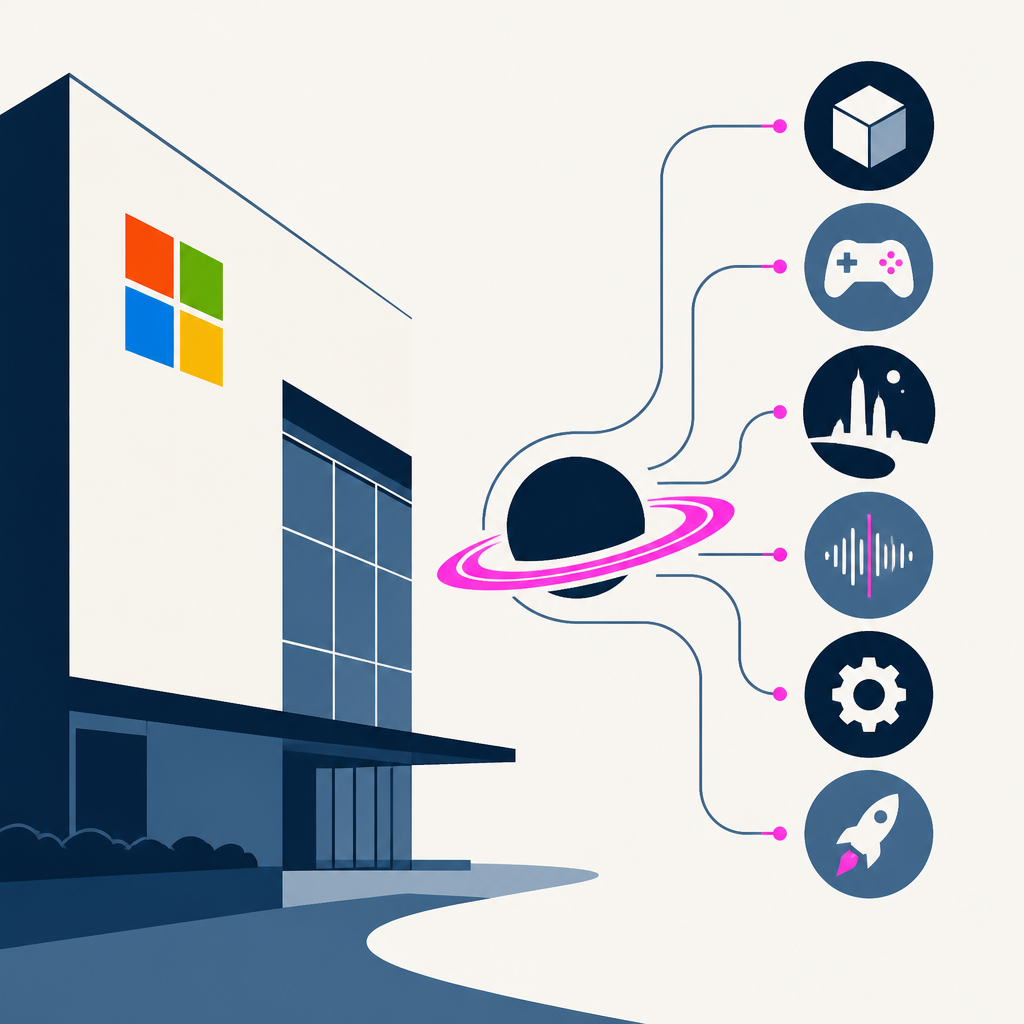
Corey and Grant stress-tested GPT-6 Astra with six one-shot build tasks and minimal follow-up steering. One of the tasks was a black hole simulator. The results are that the model can still produce working builds across varied prototypes—from Blender and a physics game to a sci-fi world, sound diagnosis, and Cat Doom.
SpaceXAI released Grok 4.7, a coding agent model trained to handle long, hours-long runs by focusing reinforcement learning on harder tasks and improving self-verification and long-context management. Grok 4.7 scored 38.0% on Terminal-Bench 4.0, up from 20.3% for Grok 4.6. The model’s long-horizon performance improved substantially, but it still fails most of the time in long-running codebase evaluations, so reliability remains a limiting factor.
Amazon Bio Discovery’s research team published three papers introducing AI methods to better predict binding and developability properties and to design antibodies or nanobodies for experimentally validated candidates. MochiBind scored 200,000 antibody pairs in roughly 13 seconds on a CPU, reporting more than a 100-fold inference speedup over competing methods. The work shifts antibody evaluation toward cross-antigen relative binding and batch-effect-aware context prediction, and it combines an epitope hotspot agent with de novo generative design to produce lab-validated hits against a novel cancer target.
Researchers reformulated transformer block pruning as a constrained binary optimization mapped to an Ising glass, enabling fast scoring of block-removal combinations without running full benchmarks. At 50% depth pruning of Llama-3.3-70B-Instruct (removing 40 of 80 blocks), it reported an almost 23-point MMLU advantage over the best block-removal baseline. The method shifts block selection from independent/heuristic ranking to searching low-energy coupled configurations, including “excited” low-energy states that can outperform the single best solution.
Grok 4.7 was launched as a more capable model for coding and knowledge work. It is served at the same price and speed as Grok 4.6. The update focuses on longer performance on difficult tasks, more careful self-checking, and improved safeguards.
Every AI story that matters,
in your inbox by 8am.
TLDRocket reads all relevant sources, removes duplicate coverage, and summarises the
day in two minutes. Follow companies and topics for alerts, or get the
briefing in Slack. Free, no spam, unsubscribe anytime.
Reading TLDRocket needs no cookies, and the readership counts we rely on come from
our own cookieless analytics. Google Analytics is the exception: it sets cookies and
reports to Google, so it stays switched off until you allow it. You can change your
mind any time from “Cookie settings” in the footer.
Strictly necessary
Session security and form protection (tldrocket-session,
XSRF-TOKEN, 2 hours). The site cannot work without them,
so they need no consent.
Always on
Google Analytics 4 (_ga,
_ga_<id>, up to 2 years). Measures which
stories and sections readers use. Google acts as a third-party processor and may
store the data outside the EU. No advertising, no profiling, no data sold.