Google’s September Android feature Drop added “remembered items” support in Find Hub and expanded Motion Assist dots and messaging changes across more Android devices. The item-location logging via Gemini is available on Android 16 or higher. As a result, users can have Gemini record the location of untacket-tagged items (optionally with a photo) so they can be retrieved in Find Hub later.
Ernst & Young plans to spend $100 million on bonuses and awards to push U.S. employees to develop non-automatable human skills while experimenting with AI-related technology in client service work. Spot awards can pay up to $500 for individuals and up to $25,000 for individuals or teams whose work has a material impact. The firm is tying rewards more directly to human judgment and learning agility so employees stay valuable as entry-level tasks shift.
Basis, Clay, and Exa Labs use AI agents to improve onboarding, account management, and developer integrations. The piece profiles three companies: Basis, Clay, and Exa Labs. It changes what enterprise leaders focus on by turning workflow improvements into operating capability patterns to copy.
Sequoia-incubated Empirik launched as an independent company to predict infrastructure outages by tracking system changes and inferring likely ripple effects. It raised $21 million in seed funding from Sequoia, Canapi, and Alumni Ventures. The spinout introduces an observability tool that acts as an autonomous traffic cop by allowing low-risk changes, setting guardrails, and escalating dangerous updates for human review.
Atos ran an AWS AI League event to upskill 400 engineers in agentic AI by moving from theory to building multi-agent systems. The program ran over 3 days and covered tasks scored on performance and efficiency. The engineers left with hands-on capability using Amazon Bedrock, Bedrock AgentCore, AWS Lambda, Kiro, and Amazon SageMaker, and internal champions emerged for client delivery.
Amazon Quick guidance explains why POC pilot security plans often fail in production and lays out a production-ready architecture for dashboards, Spaces, knowledge bases, Agents, and Flows. It uses an AnyCompany example with 5,000 employee rows to create three shaped datasets, apply row-level security for managers, and generate audience-specific Dashboards plus purpose-built Agents. By removing sensitive columns and sensitive documents before users can reach them and adding human approval gates in Flows, access control becomes auditable and more robust as users and departments scale.
ZS Associates built a security-hardened Amazon SageMaker environment to let developers do ad-hoc analytics while staying compliant in regulated industries. It serves 1,000+ daily active users across 200+ SageMaker domains and uses an internet-free default setup with VPC endpoints. As a result, ZS can run SageMaker as the organization’s primary ad-hoc analytics tool with enforced governance, cost controls, and automated resilience features that reduce manual compliance work.
Callstack announced its acquisition of Vienna engineering firm Margelo, valuing Margelo at more than 20 million euros.
The deal leaves the reported valuation as the only disclosed figure, with no public purchase price breakdown or closing date.
Margelo’s projects remain open source, Marc Rousavy stays on, and the combined firms plan to expand their React Native portfolio for enterprise customers with a focus on performance and architecture as AI changes software development.
CBTS Technology Solutions launched Forge Agents, a platform that converts plain-language job descriptions into working AI agents with enterprise security controls. The platform is built from a library of 187 prebuilt artifacts and 34 cross-industry blueprints to get agents into production in days. It targets midmarket buyers by offering usage-based pricing and options to run agents on clients’ existing cloud or on-prem systems with governance and audit trails included.
Orchestra Technologies launched an agentic management platform to help enterprise teams control how they build, automate, and operate data and AI workflows.
The release is backed by $4.6 million in total funding, including a $3.3 million seed round.
Teams can manage and orchestrate large numbers of AI agents and tasks on Orchestra’s managed infrastructure using dashboards and low-code tooling with 100+ integrations, while customers report up to 80% runtime cost cuts and faster migrations.
Orchestra, an agentic data orchestration startup, raised a $3.3 million seed round led by Differential Ventures after reporting more than 10x platform usage growth in about one year. The financing brings Orchestra’s total funding to $4.6 million. The company will use the money to expand its engineering and go-to-market teams in London and grow across the US and Europe.
Sonos introduced the Sonos Beam Ultra soundbar, the Sonos Ace Ultra headphones, and a new audio operating system update called Sonos 27 in New York City. The update arrives after Sonos faced backlash during a 2024 app rollout. Sonos says Sonos 27 adds AI-focused features, including a built-in Sonos 27voice assistant for music and system control.
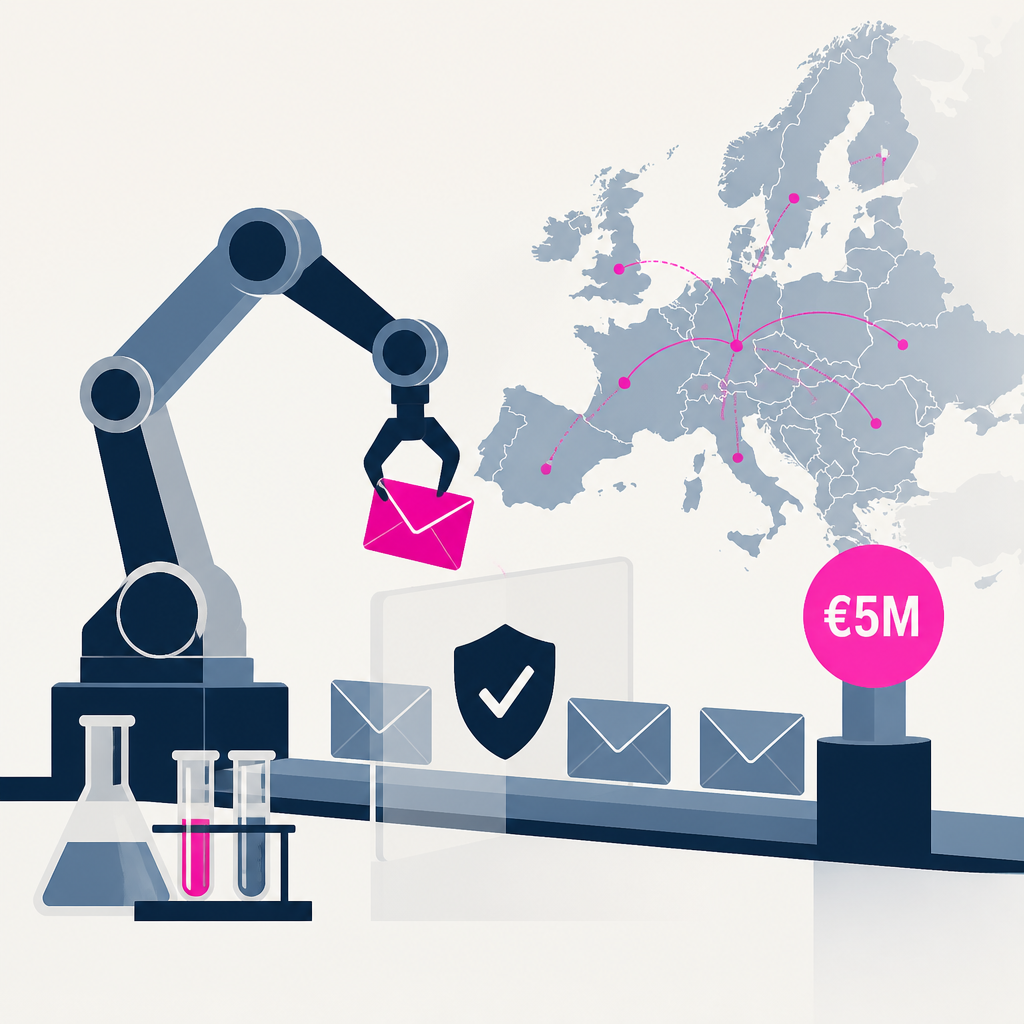
xorlab raised a €5M Series A+ round to expand its email security platform across Europe and further develop the product. The funding is led by existing investor Spicehaus Partners with continued participation from Grapha Holding, EquityPitcher Ventures and ZKB Start-up Finance. The company will use the money to grow in the DACH region, Benelux and the Nordics while its behavioural AI platform continues to be positioned for compliance with DORA, NIS2 and GDPR.
Gilbert + Tobin describes its internal approach to rolling out OpenAI tools across the firm. The article does not provide any number or specific date. As a result, it frames the rollout as scaled use of ChatGPT Enterprise and Codex under CEO-led commitment and formal governance rather than ad hoc adoption.
Every AI story that matters,
in your inbox by 8am.
TLDRocket reads all relevant sources, removes duplicate coverage, and summarises the
day in two minutes. Follow companies and topics for alerts, or get the
briefing in Slack. Free, no spam, unsubscribe anytime.
Reading TLDRocket needs no cookies, and the readership counts we rely on come from
our own cookieless analytics. Google Analytics is the exception: it sets cookies and
reports to Google, so it stays switched off until you allow it. You can change your
mind any time from “Cookie settings” in the footer.
Strictly necessary
Session security and form protection (tldrocket-session,
XSRF-TOKEN, 2 hours). The site cannot work without them,
so they need no consent.
Always on
Google Analytics 4 (_ga,
_ga_<id>, up to 2 years). Measures which
stories and sections readers use. Google acts as a third-party processor and may
store the data outside the EU. No advertising, no profiling, no data sold.