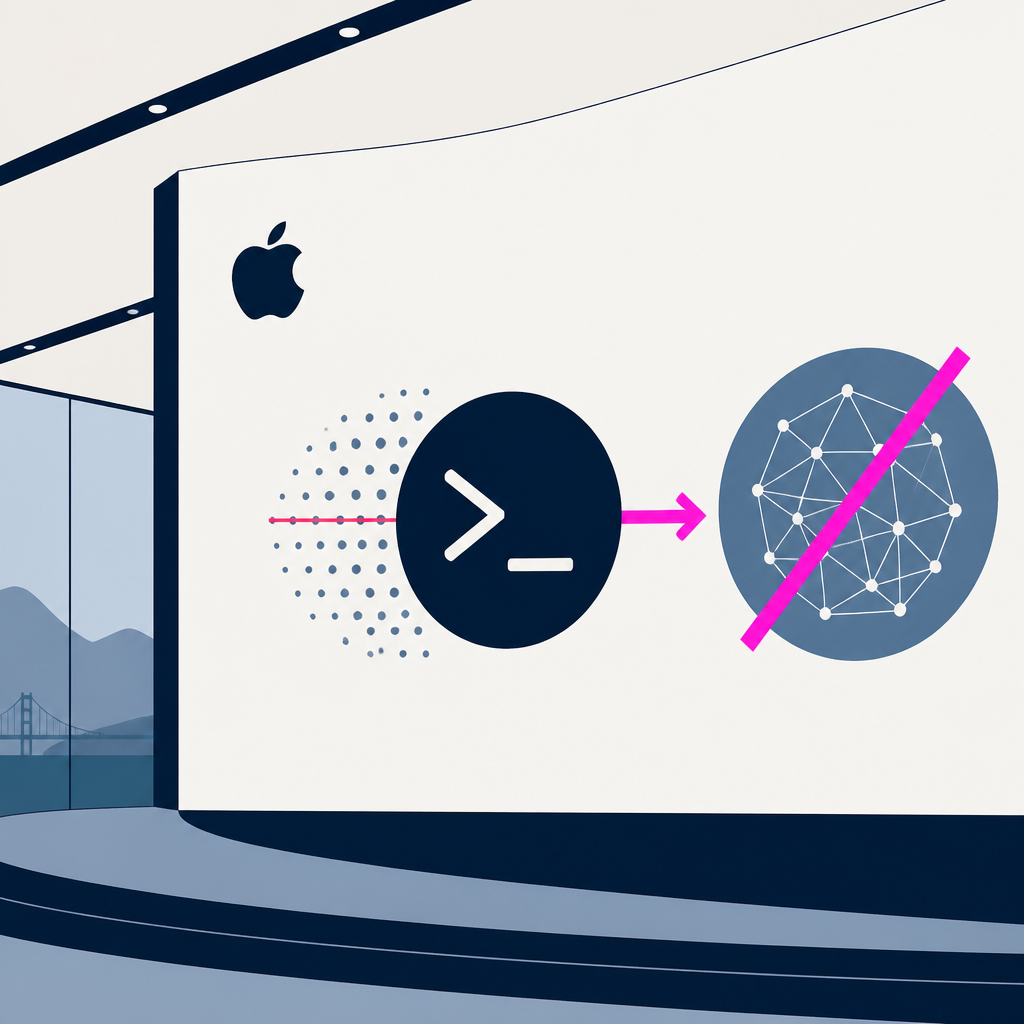
RemoveMacAI was released as a command-line tool to let macOS 27 users disable Apple Intelligence in a fully reversible way. The models use about 12GB of storage, and can exceed 30GB depending on what’s installed. With no built-in toggle in macOS 27 Golden Gate, users now have a simpler method to remove the AI model files and reclaim disk space.
RemoveMacAI removes Apple Intelligence models from Macs on macOS 27, so users who do not use Apple’s AI don’t have to keep the downloaded models. It can free up about 12GB of storage by deleting those models. Disabling individual features no longer prevents the models from occupying disk space, but after running the tool those features and related services stop working and the storage is reclaimed until macOS downloads the models again.
Cakie launched as a screen-recording app that turns your screen actions and spoken narration into instructions for AI coding tools. The launch is dated “today.” As a result, it claims you no longer need to manually describe your screen to use Claude Code, Codex, or Cursor.
Sona8, a startup founded by former BCG and McKinsey consultants, was accepted into Y Combinator’s current batch using AI voice agents to interview employees about how work is done. It has supported more than 10,000 employee interviews so far. The company plans to expand from interviews into a “context layer” that other AI automation tools can query and keep updated as systems and work change.
Amazon introduced the aws-ai-ml skill for the Agent Toolkit for AWS, which lets coding agents optimize and benchmark Amazon SageMaker AI generative inference and generate SageMaker Python SDK v3 code. The setup can take you from zero to a working conversation in 10 minutes. After installing the skill (or using a preconfigured SageMaker Studio space), agents can run endpoint load tests and produce ranked, code-ready deployment and performance recommendations instead of leaving engineers to pick instances and settings manually.
OpenSwarm launched as an AI-first operating system that lets software agents control apps and browsers to carry out tasks. It has 138 followers listed on the page at launch. Users shift from doing tasks one at a time to orchestrating many agents running in parallel.
LangChain support for Amazon Bedrock Managed Knowledge Bases showed that single-shot retrieval can return topically relevant chunks that still omit evidence needed for multi-part comparative questions. With numberOfResults set to 5 for a question containing 6 sub-intents, it covered 4 of 6, while setting it to 10 covered all 6 but with duplicated and unused coverage. Using Bedrock’s agentic retrieval adds a planning loop that breaks the query into sub-queries, checks whether it has enough evidence, and runs additional searches when it does not.
IrisGo launched an AI operating system for Windows and Mac that automates everyday workflows across applications using Watch & Learn. The beta is free at launch. This changes how solopreneurs set up repeat tasks by demonstrating them once and re-running the resulting reusable workflows with new inputs.
A Git code review desktop app launched today for reviewing Git branches and GitHub pull requests with line comments held private until publishing. It adds AI reviewers you can connect to using OpenAI, Anthropic, Gemini, OpenRouter, or local via Ollama. Reviews can be split across multiple models so you can see which rules each one checked and retry only the missed items.
Menlo Ventures announced an investment in Factory, a platform meant to autonomously automate the end-to-end software lifecycle for enterprise teams using coding agents. The coding market it targets has grown from $550 million to more than $30 billion in two years. As a result, Factory expands its enterprise “software factory” approach—governance, a shared knowledge base, and model-agnostic deployment—to speed up shipping from days instead of quarters.
Appto launched as an iOS app factory for Macs that uses an AI subscription to pick profitable app niches, generate the app, create the App Store listing, and submit it to Apple when you choose. It says one non-developer shipped 10 apps with the service. After launch, it shows live sales, answers reviews, and tracks keywords with suggested fixes.
Equs Inc. launched Equs X, pairing a personal AI assistant with user-managed private storage to keep information access under the customer’s control. The company said the model reads nothing unless the user allows it file by file using an access toggle. Access can be revoked immediately, and the AI keeps what it learns in the user’s private storage instead of on the provider’s servers.
Namespace raised $42M in a Series B financing round, seven months after its Series A, to speed up developers’ build and test workflows without managing infrastructure. The round totals $42M and was led by Scale Venture Partners with participation from 20VC, NEA, Essence, Burst Capital, and angel investors. The company will use the money to accelerate product development and expand its compute and server operations, positioning the platform as an infrastructure layer for AI coding agents.
Vincentt launched on Product Hunt as a tool to build and launch web camera experiences using a coding agent with an open SDK. The listing says it supports Claude Code or Codex. As a result, users can preview live on their phone and publish a shareable link without app stores or headsets.
StayCharted was launched as an AI product that learns from your uploaded rows or photos and then fills in categories like support tickets, expense lines, survey answers, and product photos without prompts or code. The listing shows it launched today with 7 followers. It changes the workflow by automating the missing parts of your categorized data and routing uncertain answers back for your review.
The article argues that developers do not consistently follow the “use the platform” guidance because history, familiarity with packages, documentation patterns, and personal enjoyment of building custom solutions all make rolling your own feel more practical or rewarding. It cites that Safari’s browser update cadence is about 7 times per year. It predicts AI coding could both reduce userland code by steering toward platform APIs and increase duplicated, over-engineered code if agents skip existing helpers and rely on first drafts.
Together Link was launched as a tool that connects coding agents to open models on Together AI. It launched as version 5.0. It lets developers keep existing tools and workflows while aiming to reduce model costs.
ruOS launched a private cloud desktop that includes an AI team to handle tasks like research, writing, and code from your browser. It offers ruOS Lite free to try in seconds with no sign-up. As a result, users can start work immediately across devices with persistent files and AI memory, and power users get a Linux environment plus an MCP server for LLMs to control it.
RemoveMacAI, a new open-source command-line tool for macOS, removes locally stored Apple Intelligence assets and turns off Apple Intelligence features.
It deletes about 12GB of Apple Intelligence data.
Since macOS 27 removed the single Settings toggle, the tool replaces it by handling roughly a dozen related settings (including ones under Screen Time) to reclaim storage.
DevAlly launched its DevAlly AI Agent, which captures user journeys in natural language and navigates an app to record them. This is the 3rd launch from DevAlly. The platform then audits each journey stage against WCAG criteria and suggests fixes, shifting accessibility monitoring from manual engineering work to automated checks.
Postquel is a fast, native PostgreSQL client for macOS that includes an AI assistant connected to your existing Claude Code, Codex, or Cursor account. It is free and open source, and it can only read your real schema while suggested changes wait for your dry-run approval. The result is that database changes are proposed with AI but applied only after you confirm them.
iphone-use launched a system where an AI agent controls a real iPhone by reading the screen as text and performing taps, typing, scrolling, and other actions via WebDriverAgent. It includes a 21-tool MCP server for Claude Code. As a result, automation can replay completed tasks as flows without repeatedly involving a model, while unsupported actions return an “unknown” status and some blocked apps show wireframes instead of screenshots.
Plugins Radar tracks the ChatGPT plugin directory to rank and compare plugins across 192 common searches, and lets users monitor competitors and receive email updates. It supports looking up 5,000+ plugins. As a result, plugin makers can identify where their listings rank, which rivals they overlap with, and which searches they miss.
Brnch launched a code hosting service aimed at coding agents working in the same repo as their sponsor. It launched today, with a page showing 6 followers. Developers can give an agent a dedicated identity, get line-level visibility into what it did, and verify signed receipts for each tested merge.
Remocn Studio launched today as a free, open-source macOS AI video editor built from users’ Claude Code, Codex, Copilot, or Grok outputs into a Remotion-style project. It lets exports go up to 4K. The app changes video editing by replacing a timeline with live, clickable element editing, chat-based notes, and MP4 export from those generated projects.
OrgComputers launched as a shared workspace for AI agents that brings projects, context, and tools together for use with Claude Code, Cursor, and Codex. The listing shows 9 followers. It changes how teams organize and reuse their existing knowledge when running AI coding tools.
Every AI story that matters,
in your inbox by 8am.
TLDRocket reads all relevant sources, removes duplicate coverage, and summarises the
day in two minutes. Follow companies and topics for alerts, or get the
briefing in Slack. Free, no spam, unsubscribe anytime.
Reading TLDRocket needs no cookies, and the readership counts we rely on come from
our own cookieless analytics. Google Analytics is the exception: it sets cookies and
reports to Google, so it stays switched off until you allow it. You can change your
mind any time from “Cookie settings” in the footer.
Strictly necessary
Session security and form protection (tldrocket-session,
XSRF-TOKEN, 2 hours). The site cannot work without them,
so they need no consent.
Always on
Google Analytics 4 (_ga,
_ga_<id>, up to 2 years). Measures which
stories and sections readers use. Google acts as a third-party processor and may
store the data outside the EU. No advertising, no profiling, no data sold.