
Sona8: Former Consultants Get Into Y Combinator With A.I. Interviews
Trending Topics Jakob Steinschaden
Sona8 got into Y Combinator with AI that interviews a company’s whole staff. It turns those chats into process maps and automation ideas, not just survey fluff.
Based on reporting by Trending Topics, Jakob Steinschaden — read the original for the full story.
Summary, retelling and take written by AI under human oversight; images are AI-generated illustrations. How we work · Report an error
Sona8 has landed in Y Combinator’s current batch with a pitch that is both simple and slightly unnerving: instead of asking a few dozen people what happens inside a company, it sends an AI voice agent to ask everyone. The startup was founded by former consultants from BCG and McKinsey, and it wants to turn those conversations into a living knowledge base for automation.
The idea grew out of BCG projects that CEO Anton Hantel and CPO Thilo Tamme worked on together. Hantel’s summary of the problem was blunt: why interview only a few dozen employees when an AI could speak to all of them? In practice, Sona8 asks companies to pick a process they want to improve or automate, then lets each selected employee spend about 20 minutes talking to the voice agent in their own language. The agent follows up on specifics, like why a step is still manual or who else is involved.
That produces process maps, a list of pain points broken down by site and team, and recommendations for optimization and automation. After the work starts, the agent comes back and checks what actually changed. Sona8 describes the end result as something like a project management office that has talked to everyone, which is a neat way of saying the startup wants to replace a lot of expensive coordination work with software.
For now, the company is selling mostly to consulting firms, which use it for stakeholder interviews at the start of engagements, and to transformation teams running change programs. Sona8 says it has already supported more than 10,000 employee interviews, and one of the three largest management consulting firms is among its customers. The sales strategy makes sense: the founders know that world, and consulting firms can push the tool across multiple client projects. The first customers came through the founders’ network, and the team is now building its U.S. market from San Francisco.
There is, of course, a privacy problem hiding in plain sight. Employees are talking about internal processes, trade secrets and all sorts of sensitive operational detail, so Sona8 says it handles the data carefully, keeps participation voluntary, and anonymizes results by team or site. Before each deployment, it agrees with the client what gets collected, who can access it and how it will be used. The company says data protection, security and co-determination shaped the product from the start. That is the sort of sentence everyone says right before a procurement team asks for six more forms.
Long term, Sona8 wants to be more than a survey tool. The founders see a future where companies use many AI agents and automation tools, but those tools still need context about how work is actually done. Sona8 wants to sit in the middle as a “context layer,” pulling in what employees say and combining it with data from Slack, email and business systems so the picture stays current even when the software changes.
My take — AI-written commentary, not fact-checked reporting
This is a sensible wedge into enterprise AI: start with the boring part no one documents properly, then sell the memory. The hype crowd wants agents that act; the grown-ups know the real moat is context, permissions and a sales motion that actually reaches a budget holder. Consulting firms are still the old kingdom here, and apparently they’ve found a new courier service for their slide decks.
Read more about this at: Trending Topics
Related stories
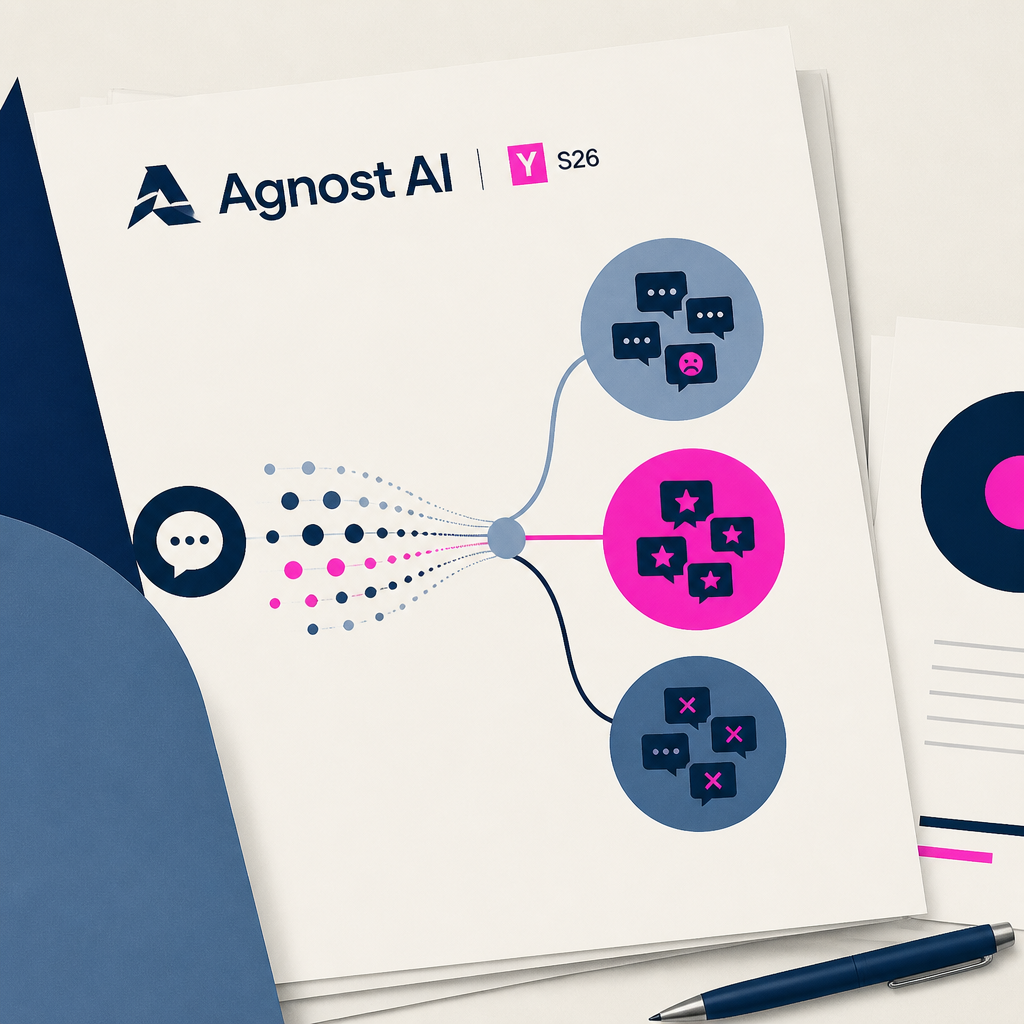 Launch HN: Agnost AI (YC S26) – Extract user feedback from agent conversations
agnost.ai · 2 months ago ·
8
Launch HN: Agnost AI (YC S26) – Extract user feedback from agent conversations
agnost.ai · 2 months ago ·
8