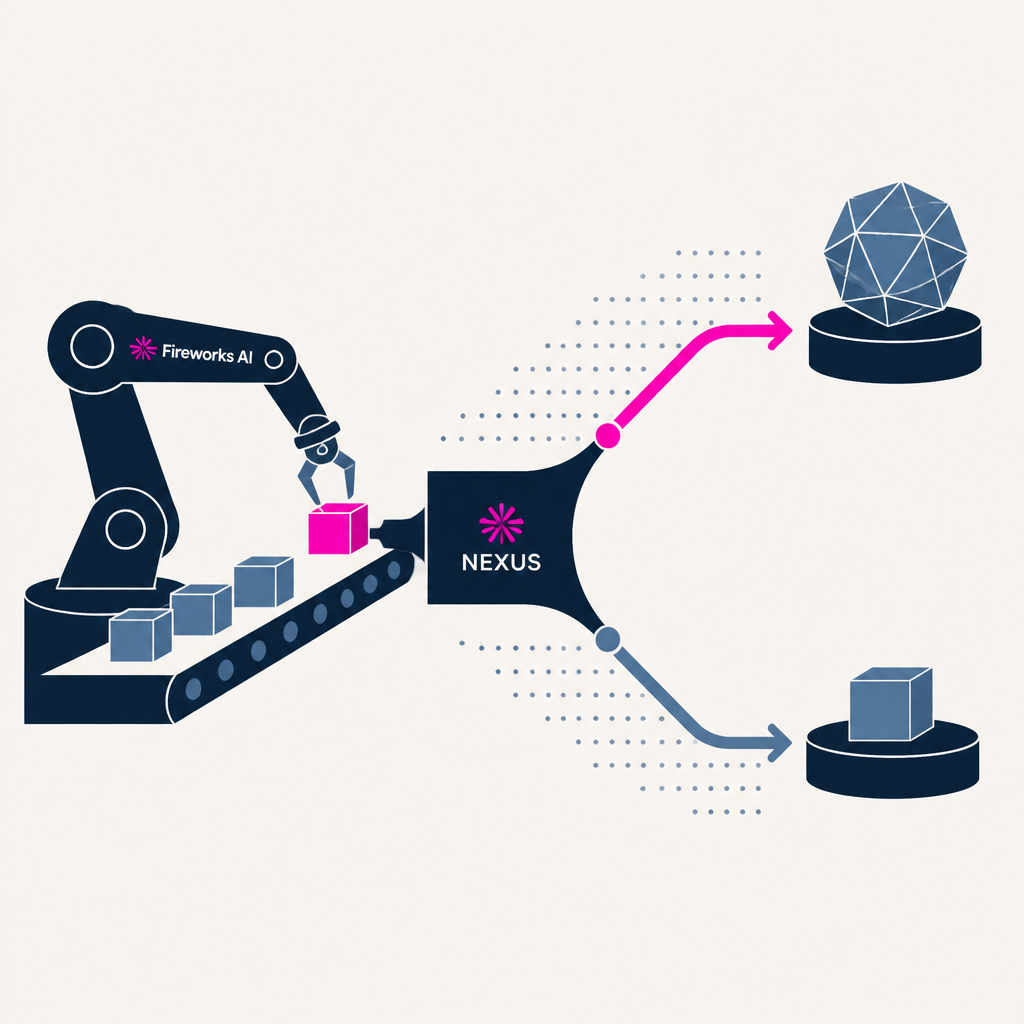
Fireworks AI released Nexus, a routing platform that directs routine coding tasks to cheaper open-weight models while escalating difficult requests to frontier models like Claude Opus. Independent evaluations from Faros AI and Arize showed routing strategies achieved similar quality outcomes at 50–75% of the cost of using frontier models exclusively. Organizations can now reduce AI coding costs while maintaining developer workflow continuity through a one-line plugin install.
Zvi (Don't Worry About the Vase)·2 months ago·
17
● 5 sources
Anthropic released Claude Opus 5, positioning it as a cheaper alternative to their flagship Fable 5 model at half the API token cost while delivering comparable performance on most real-world tasks. Opus 5 achieves state-of-the-art scores on benchmarks like Frontier-Bench and GDPval-AA, and is notably the most resistant to prompt injection attacks of any Claude model to date. However, the model struggles with high-level autonomous reasoning compared to Fable, has polarizing personality traits that many users find off-putting, and ultimately does not expand what's possible—it mainly offers a cost-effective option for specific use cases like subagent work and bounded tasks.
Google increased its 2025 capital expenditure estimate to as much as $205 billion, up from the previous forecast of $190 billion, signaling unpredictable costs that now exceed revenue. The company's lower-bound estimate of $195 billion already exceeds what it previously projected as its maximum spending, a $15 billion swing that reflects inability to forecast AI infrastructure costs. Investors are growing concerned about the sustainability of such spending levels, particularly when capital outlays are outpacing revenue growth.
Cursor built an agent swarm system that separates cheaper worker models from expensive frontier models used for planning, achieving 1,000 commits per second by dividing cognitive context between roles. In a Rust SQLite implementation benchmark, the hybrid approach (Opus planner with Composer 2.5 workers) scored 73–100 percent while costing $1,339 total, compared to $10,565 for GPT-5.5 running solo at similar quality. By using cheaper models for execution after frontier models establish plans, Cursor reduced codebase sizes by up to 85 percent and cut worker costs from $9,373 to $411 at comparable performance.
Every AI story that matters,
in your inbox by 8am.
TLDRocket reads all relevant sources, removes duplicate coverage, and summarises the
day in two minutes. Follow companies and topics for alerts, or get the
briefing in Slack. Free, no spam, unsubscribe anytime.
Reading TLDRocket needs no cookies, and the readership counts we rely on come from
our own cookieless analytics. Google Analytics is the exception: it sets cookies and
reports to Google, so it stays switched off until you allow it. You can change your
mind any time from “Cookie settings” in the footer.
Strictly necessary
Session security and form protection (tldrocket-session,
XSRF-TOKEN, 2 hours). The site cannot work without them,
so they need no consent.
Always on
Google Analytics 4 (_ga,
_ga_<id>, up to 2 years). Measures which
stories and sections readers use. Google acts as a third-party processor and may
store the data outside the EU. No advertising, no profiling, no data sold.