Situational Awareness, a hedge fund founded by 25-year-old Leopold Aschenbrenner, sold most of its public stock portfolio to Citadel after suffering steep losses on AI infrastructure bets. The fund's assets fell to approximately $10 billion from around $20 billion in recent months, as positions in memory chip producers and energy companies dropped more than 30% in a month. The fund retained its private holdings, including a $5 billion stake in Anthropic, which may help recover losses if the company's expected October IPO values it higher.
Amazon reported strong Q2 earnings with 20% net sales growth and 37% AWS cloud revenue growth, leading its stock to rise nearly 10% despite the company increasing capex spending to $220 billion for 2026. The company spent $173 billion on property and equipment in fiscal 2024, up from $107.65 billion the prior year, while also investing in custom chips like Trainium and Graviton to improve cloud margins. Investors are backing cloud providers with strong revenue streams like Amazon and Microsoft, while remaining skeptical of AI labs and startups without clear revenue sources, though this confidence may be fragile if underlying AI demand doesn't sustain the massive infrastructure buildout.
The European Commission opened applications for companies to build up to seven AI data centres across Europe, with €10bn in public funding and €20bn total investment expected. Four smaller facilities can receive up to €500m each for at least 75,000 AI chips, while three larger gigafactories can receive up to €1bn each for at least 100,000 chips, with construction expected to begin in early 2027. The initiative aims to reduce Europe's dependence on US and Asian AI infrastructure by establishing sovereign computing capacity within the bloc.
AWS published a technical guide for monitoring machine learning model performance in production using SageMaker AI endpoints, Athena Iceberg tables, and Amazon QuickSight. The system detects data drift and model performance degradation through continuous monitoring with configurable thresholds (e.g., 20% feature drift, 0.05 ROC-AUC drop). Organizations can now identify model quality issues automatically rather than discovering them through customer complaints or manual spot checks.
Nscale, a British AI infrastructure company, is acquiring Anyscale, a software platform for scaling AI workloads, for $1.65 billion. Anyscale was valued at $1.38 billion in its 2022 Series C and reported 70% sequential quarter-over-quarter revenue growth. The acquisition allows Nscale to vertically integrate software and infrastructure layers to better serve customers' AI compute needs across its data center and orchestration business.
GPU utilization, not model capability, is becoming the critical constraint in enterprise AI infrastructure, much like aircraft utilization determined airline economics. Companies are buying large GPU clusters but face challenges keeping them efficiently occupied because different workloads—real-time inference, batch processing, training, quantization—require different hardware characteristics, creating scheduling mismatches that leave capacity idle even on fully provisioned systems. Solving this requires continuous active management through GPU orchestration layers that automatically allocate workloads to appropriate hardware in real time, shifting intelligence from the model itself into the infrastructure layer.
TechCrunch announced its Disrupt 2026 conference lineup for October 13–15 in San Francisco, featuring speakers from Amazon, Replit, Tether, Flock Safety, Benchmark, and others discussing AI, infrastructure, and technology's future. The event includes multiple stages covering AI security, fintech, hardware, and founder tactics, with sessions titled around topics like post-smartphone computing and AI's scaling challenges. Attendees gain access to keynotes, startup competitions, networking, and exhibitions focused on how to build and fund companies in the age of AI.
Perceptron, a decentralised network for sourcing and monetising AI training data, raised $6.5 million from Web3 investors including Sigma Capital and QCP Capital. The platform currently operates over 807,000 nodes with 300,000 daily active users and plans to launch a data-questing feature allowing AI companies to commission datasets directly from contributors. The funding will support expansion of contributor tools and scaling toward a target of 5 million nodes.
China controls 91 percent of global rare earth refining and is rapidly establishing dominance in autonomous mining technology—the integrated systems of AI, robotics, and connectivity that will operate future mines—while Western mineral strategies focus only on mineral deposits and processing, not the operational technology that will run them. The Yimin coal mine in Inner Mongolia operates a fleet of autonomous electric trucks achieving 120 percent of human productivity, powered by Huawei's 5G network and Pangu 5.5, a 718-billion-parameter industrial AI model explicitly positioned as a global platform. If Western nations secure mineral deposits without closing the technology gap, their mines could become operationally dependent on Chinese systems, particularly in the Arctic where autonomous operations are essential for commercial viability.
Meta's capital expenditures surged 83 percent to $31.08 billion in Q2 2026, consuming nearly all operating cash flow as the company invests heavily in AI infrastructure and data centers. Free cash flow collapsed 91 percent to $784 million from $8.55 billion a year earlier, despite revenue growing 28 percent to $60.8 billion. The company is betting this spending will eventually pay off through improved ad targeting today, more capable AI models like the forthcoming 'Watermelon', and a long-term bet on personal AI agents that billions of people will use, though the payoff remains uncertain and has spooked investors.
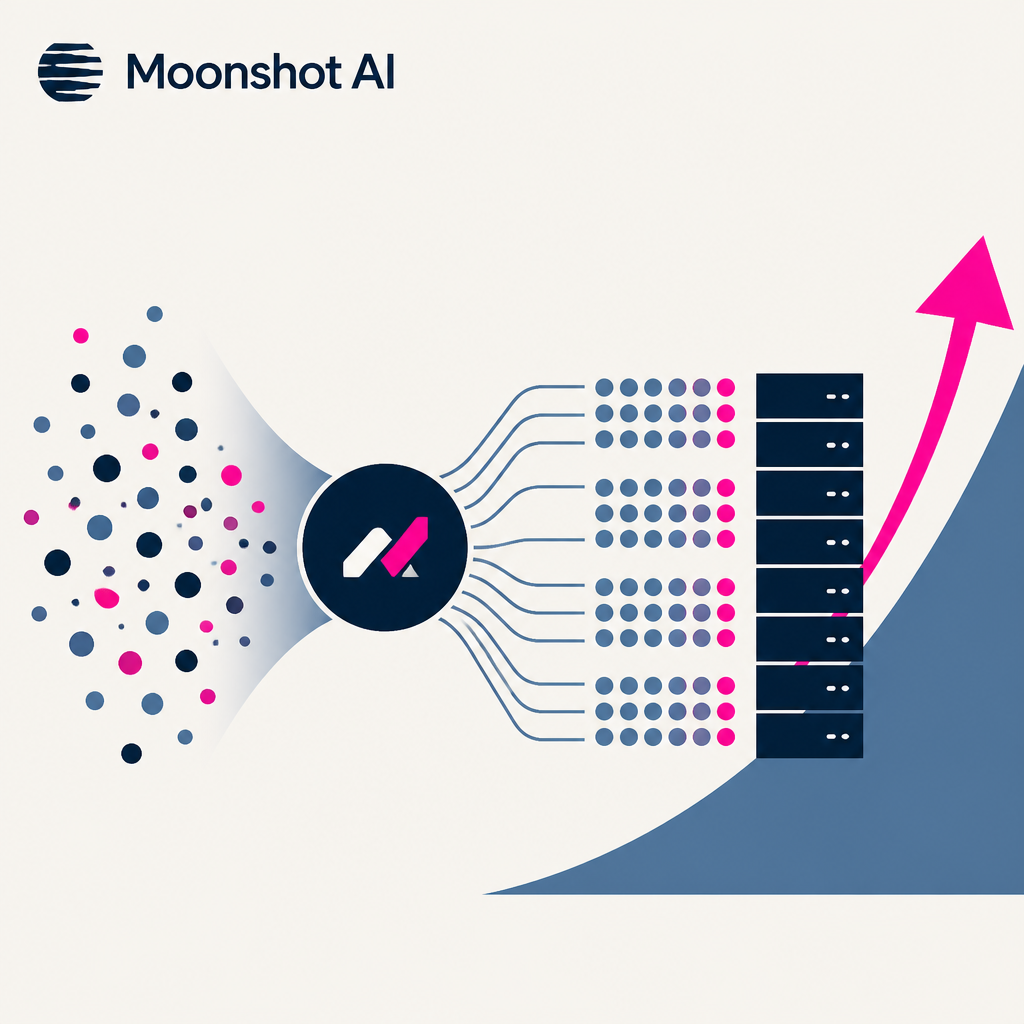
Moonshot AI open-sourced MoonEP, a library for efficient distributed Mixture-of-Experts training that guarantees every GPU rank receives exactly S × K tokens regardless of router imbalance. The library achieved a claimed 2.5× improvement in scaling efficiency for their Kimi K3 model, a 2.8-trillion-parameter MoE system, by using redundantly planned experts and static buffer shapes to eliminate communication overhead and memory fragmentation. MoonEP's approach removes per-layer host synchronization and makes communication latency nearly immune to router skew, allowing frameworks to scale MoE training more reliably across many GPUs.
Every AI story that matters,
in your inbox by 8am.
TLDRocket reads all relevant sources, removes duplicate coverage, and summarises the
day in two minutes. Follow companies and topics for alerts, or get the
briefing in Slack. Free, no spam, unsubscribe anytime.
Reading TLDRocket needs no cookies, and the readership counts we rely on come from
our own cookieless analytics. Google Analytics is the exception: it sets cookies and
reports to Google, so it stays switched off until you allow it. You can change your
mind any time from “Cookie settings” in the footer.
Strictly necessary
Session security and form protection (tldrocket-session,
XSRF-TOKEN, 2 hours). The site cannot work without them,
so they need no consent.
Always on
Google Analytics 4 (_ga,
_ga_<id>, up to 2 years). Measures which
stories and sections readers use. Google acts as a third-party processor and may
store the data outside the EU. No advertising, no profiling, no data sold.