
Moonshot AI Open-Sources MoonEP: A Perfectly Balanced Expert Parallelism Library for MoE Training
MarkTechPost Michal Sutter ● Covered by 33 sources
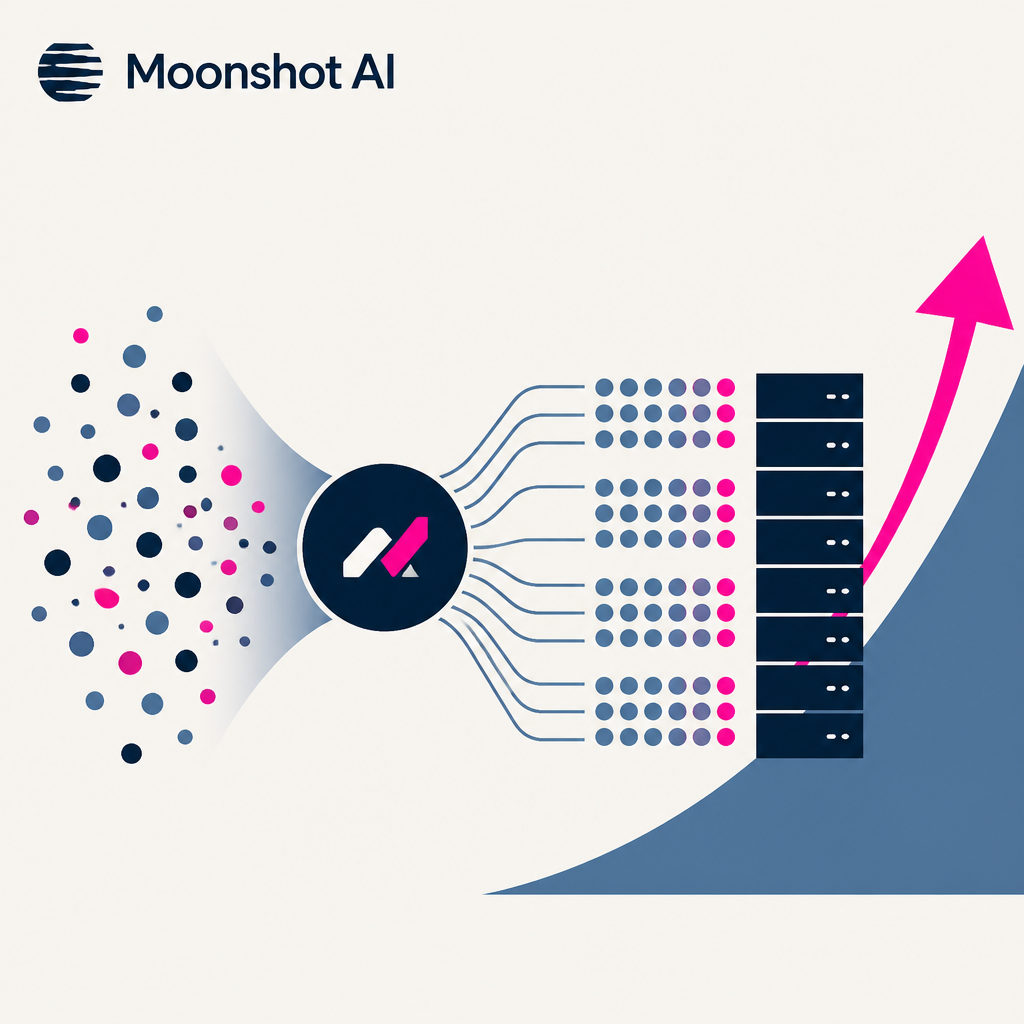
Moonshot AI open-sourced MoonEP, a tool that fixes a nagging bottleneck in giant AI models. It forces perfectly even GPU workloads even when routing gets messy, speeding up training a lot.
Based on reporting by MarkTechPost, Michal Sutter — read the original for the full story.
Summary, retelling and take written by AI under human oversight; images are AI-generated illustrations. How we work · Report an error
Mixture-of-Experts models have a dirty secret: the router that decides which "expert" handles each token almost never spreads the work evenly. Some experts get flooded, others sit idle, and because a distributed system only moves as fast as its slowest participant, that imbalance becomes the tax everyone pays on every single training step. Moonshot AI just released a fix, and they're giving it away for free.
The library is called MoonEP, and it landed under an MIT license as part of Kimi K3 Open Day, alongside a codebase called AgentEnv and the previously released FlashKDA. Moonshot credits MoonEP as one of the reasons Kimi K3 — a 2.8-trillion-parameter MoE model with a 1-million-token context window — hit a claimed 2.5x improvement in scaling efficiency. That's not a small number for infrastructure work that most people outside the training-cluster crowd will never think about.
The trick is oddly simple to describe, even if it's hard to build. MoonEP guarantees that every GPU rank receives exactly S times K tokens — no more, no less — no matter how skewed the router's decisions are. It pulls this off by duplicating a handful of overloaded experts on the fly, planned directly from live router output using a GPU kernel written in CUTLASS's CuTe DSL, then prefetching those duplicates before computation even starts. Because every rank ends up with an identical, predictable workload, Moonshot can also lock in static buffer shapes, which kills the per-layer synchronization stalls and memory fragmentation that have plagued MoE training at scale.
Moonshot backed this up with benchmarks against DeepEP v2 on H20 GPUs, cranking up router imbalance from a maxvio of 0.2 all the way to 20. DeepEP v2's communication time degrades steadily as imbalance rises, which tracks with the theory that the hottest rank sets the pace for everyone. MoonEP, by contrast, stays nearly flat, and it's already faster at the baseline thanks to a zero-copy design that skips an extra buffer copy DeepEP still performs.
There's a real engineering tradeoff buried in the details, though. Training requires setting aside prefetch slots equal to E divided by R — the number of experts per rank — to guarantee every duplicated expert stays local. Inference gets away with far less, just 3 to 4 slots, falling back to slower remote reads only when it runs out. It's a pragmatic compromise, and it's the kind of decision that separates a research toy from something people will actually run in production.
My take — AI-written commentary, not fact-checked reporting
I've watched half a dozen labs quietly rebuild the same expert-parallelism plumbing behind closed doors, so seeing Moonshot MIT-license this is genuinely useful rather than just good PR. The DeepEP comparison is the interesting bit — this isn't a lab beating a strawman, it's beating the open-source standard everyone already uses, and doing it with a design that's actually simpler to reason about. My one gripe: publish more independent benchmarks beyond H20, because infra claims age badly when nobody outside the vendor can reproduce them.
Read more about this at: MarkTechPost
Related stories
 Kimi K3 vs DeepSeek V4 Pro vs GLM-5.2: Open Trillion-Scale MoE Models Compared on Benchmarks, License, and Serving Cost
MarkTechPost · 1 month ago ·
45
Moonshot is Chinese But Its AI Models Are From Another Planet
The Algorithmic Bridge · 1 month ago ·
12
Kimi K3 vs DeepSeek V4 Pro vs GLM-5.2: Open Trillion-Scale MoE Models Compared on Benchmarks, License, and Serving Cost
MarkTechPost · 1 month ago ·
45
Moonshot is Chinese But Its AI Models Are From Another Planet
The Algorithmic Bridge · 1 month ago ·
12