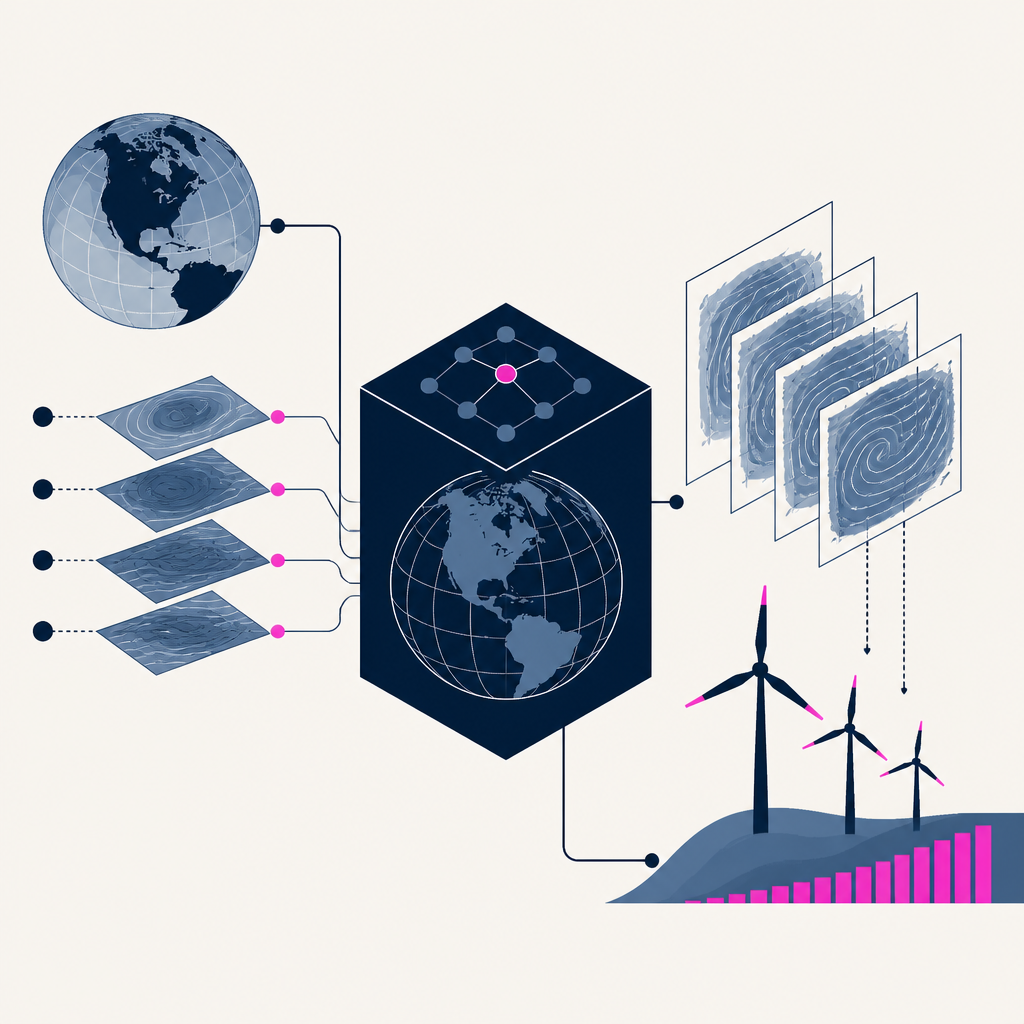
Earth2Studio is used to build a custom batched ensemble weather forecasting workflow that loads an FCN prognostic model, pulls GFS initial conditions, applies variable-scaled perturbations, and runs a wind-power diagnostic converting 10-meter winds into turbine capacity factors. The ensemble is configured with NENSEMBLE=8 members, batched with BATCH_SIZE=2 over NSTEPS=8 forecast steps and verified against GFS using latitude-weighted RMSE and fair CRPS. Results are written to a coordinate-aware Zarr store and evaluated across lead times, producing spatial and uncertainty visualizations based on forecast error, ensemble spread, and spread-skill ratios.
Bluecore Energy is working with the Port of Long Beach to build floating-barrel small modular nuclear reactors, despite California’s 1976 ban on new nuclear reactors.Each 10-megawatt reactor on a barge is described as powering about 10,000 homes. The effort depends on new state and federal regulatory approvals and could shift port and AI data-center power planning toward near-coastal nuclear electricity once frameworks and supply chains are in place.
GitHub’s platform scaled less than demand, culminating in an August 17 outage after a Central US component failed to scale with traffic while commit volume surged.
oMLX launched, turning a Mac into an LLM inference server with APIs for text and vision tasks. It targets about 5s response times instead of 90s. It provides continuous batching and a RAM+SSD KV cache that persists across restarts, and it swaps in OpenAI/Anthropic-compatible endpoints.
The 3 roles AI agents play in a developer platform were mapped from hundreds of customer calls into three distinct operating modes. One role-specific detail is that early 2026, 47% of organizations asked for an agent and skill registry to support agenticOps-style agent lifecycle management. As a result, teams can design platforms with a governed context layer for agent use, an orchestration/registry flow for agents inside workflows, and self-service provisioning to request, register, and publish reusable agents.
Nvidia is reframing its AI advantage as shifting from just GPU sales to efficiency gains in the surrounding rack-level systems that orchestrate data movement for megascale compute. It reported “upwards of 3x improvement” in these operations via its Vera CPU for traffic direction that prevents bottlenecks on flash and helps lower tokens-per-watt. As a result, competition is moving toward whole-system performance rather than GPU chips alone, with Nvidia aiming to benefit from the buildout of Vera Rubin-based infrastructures.
Every AI story that matters,
in your inbox by 8am.
TLDRocket reads all relevant sources, removes duplicate coverage, and summarises the
day in two minutes. Follow companies and topics for alerts, or get the
briefing in Slack. Free, no spam, unsubscribe anytime.
Reading TLDRocket needs no cookies, and the readership counts we rely on come from
our own cookieless analytics. Google Analytics is the exception: it sets cookies and
reports to Google, so it stays switched off until you allow it. You can change your
mind any time from “Cookie settings” in the footer.
Strictly necessary
Session security and form protection (tldrocket-session,
XSRF-TOKEN, 2 hours). The site cannot work without them,
so they need no consent.
Always on
Google Analytics 4 (_ga,
_ga_<id>, up to 2 years). Measures which
stories and sections readers use. Google acts as a third-party processor and may
store the data outside the EU. No advertising, no profiling, no data sold.