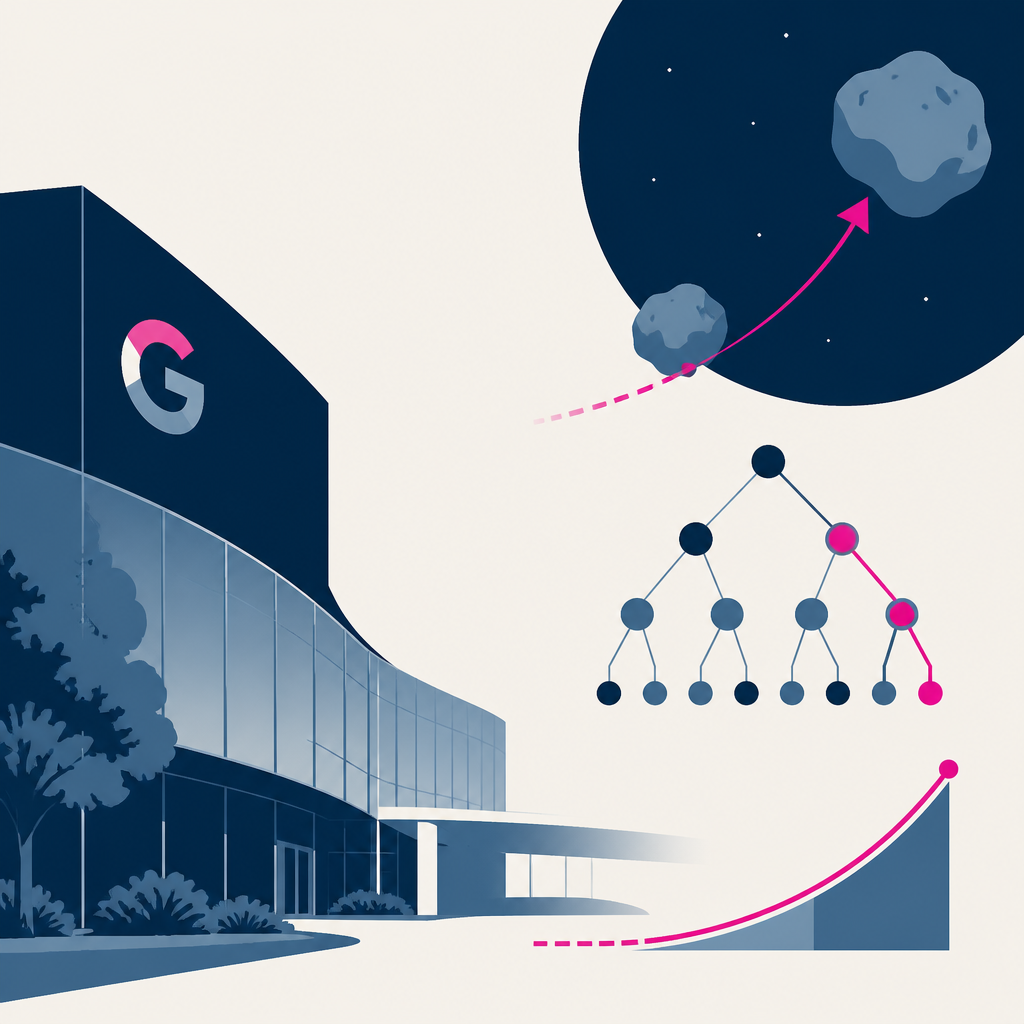
John Platt discusses Google’s Empirical Research Assistance (ERA) and how AI can automate science by optimizing “scoreable” problems like contrail climate counterfactual modeling. ERA uses a tree of prior experiments and a step change from Gemini 2.0 to 2.5, which the article says went from not working to working well. The approach shifts scientific work toward faster, automated search with predictive models that scientists must validate to avoid metric and dataset overfitting when the optimization objective can be “hacked.”
Amazon SageMaker AI Inference Recommendations adds concurrency sweeps to benchmark generative AI endpoints by sending controlled simultaneous requests and measuring throughput and latency to find the saturation point. In the walkthrough, the endpoint’s throughput-to-latency “knee” appears at 256 concurrent requests. Teams can use the results to right-size instance type and serving configuration (and optionally run an SLA-based search) to automate capacity planning and avoid over- or under-provisioning.
Open-source parsing and bitmap libraries were rebuilt and re-benchmarked, showing large performance gains across six widely used codebases in 2026 after long flat periods. simdjson’s serialization speed rose 2.1x on citm_catalog.json from February 2026 onward. The result is faster URL/number/JSON/unicode parsing and bitmap operations for many downstream users, likely enabled by more accessible optimization work in that period.
EvalEval and the UK AI Security Institute (AISI) have expanded their collaboration by using EvalEval’s Evaluation Cards infrastructure to publicly share reproducible benchmark evaluation methods and results. The release includes verified results for five benchmarks from AISI’s main experiment and covers six frontier models, including GPT-5.4. This makes the evaluation setup and configurations available alongside results for those benchmarks, enabling closer comparison and reproducibility across studies.
Every AI story that matters,
in your inbox by 8am.
TLDRocket reads all relevant sources, removes duplicate coverage, and summarises the
day in two minutes. Follow companies and topics for alerts, or get the
briefing in Slack. Free, no spam, unsubscribe anytime.
Reading TLDRocket needs no cookies, and the readership counts we rely on come from
our own cookieless analytics. Google Analytics is the exception: it sets cookies and
reports to Google, so it stays switched off until you allow it. You can change your
mind any time from “Cookie settings” in the footer.
Strictly necessary
Session security and form protection (tldrocket-session,
XSRF-TOKEN, 2 hours). The site cannot work without them,
so they need no consent.
Always on
Google Analytics 4 (_ga,
_ga_<id>, up to 2 years). Measures which
stories and sections readers use. Google acts as a third-party processor and may
store the data outside the EU. No advertising, no profiling, no data sold.