
🔬 An Oscar, Two Asteroids, and the Algorithm in Your sklearn: John Platt on AI for Science
Latent Space Brandon Anderson
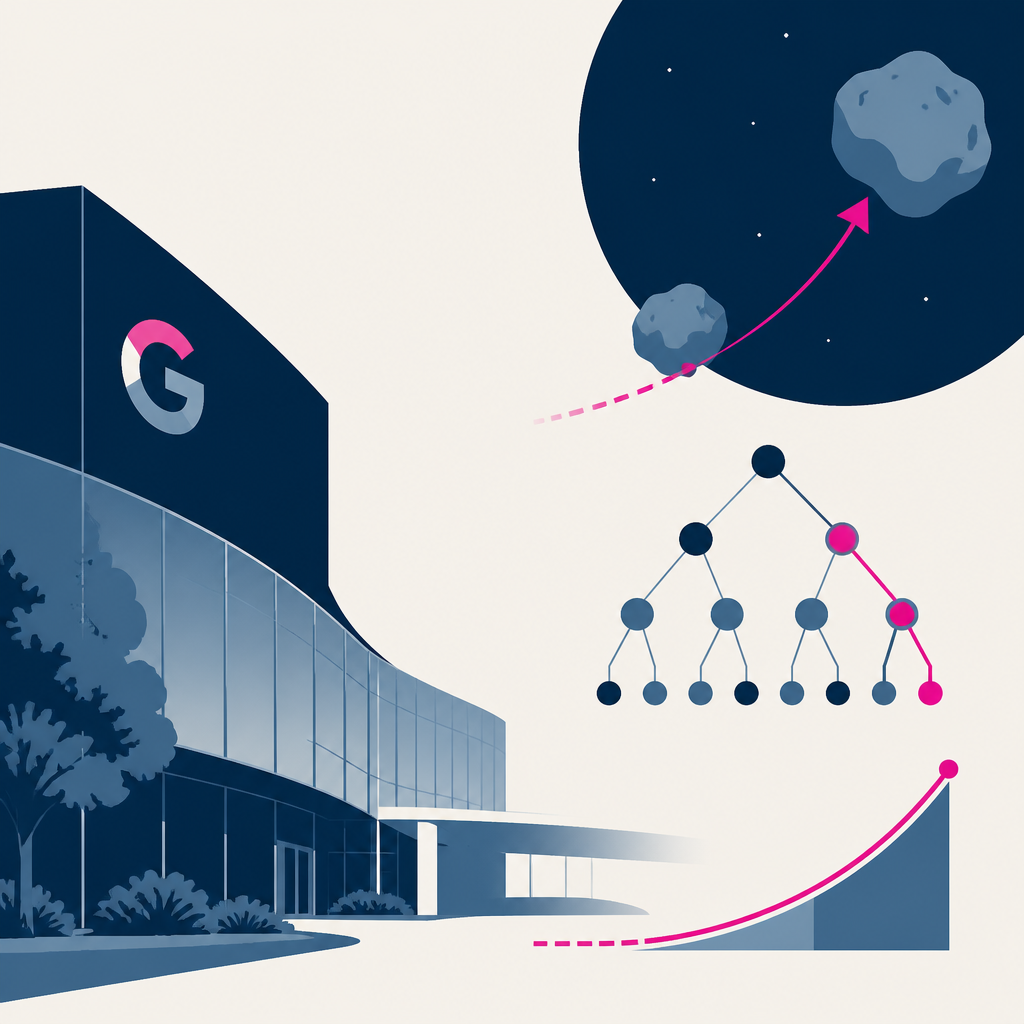
John Platt says AI can now help crack science problems by chasing a score. Google’s ERA has already helped produce at least ten papers, including climate work.
Based on reporting by Latent Space, Brandon Anderson — read the original for the full story.
Summary, retelling and take written by AI under human oversight; images are AI-generated illustrations. How we work · Report an error
John Platt has an Oscar, two textbook algorithms, two named asteroids and an Erdos-Bacon number of 6, which is already an absurd résumé before the science starts. The more interesting part is what he’s doing now at Google: trying to use AI to attack scientific problems that can be written as a score and then optimized against that score.
The project is called Empirical Research Assistance, or ERA. The basic idea is clean enough to fit on a napkin. Gemini keeps a tree of past notebook experiments, picks promising branches with an Upper Confidence Bound rule, and then proposes roughly ten mutations at a time. The history is shared across branches, so one path can learn from another. Platt compared it to a hyper-eager grad student who never sleeps.
That simplicity hides the real trick: Gemini has to know where to look. Platt said there was a real jump from Gemini 2.0 to 2.5, where the system went from not working to working well. And it’s working well enough that his team has used ERA to solve many open problems and produce at least ten papers.
The caution flag comes right alongside the hype. Platt is blunt that a tool like this can fool you if you let it. A model may predict something, but it’s still on the scientist to decide whether it’s actually describing reality. He compared it to a power tool that can slice your fingers off. His antidote is boring and old-school: fit linear regression first, or maybe an SVM, and watch for reward hacking and overfit.
The climate work is the most concrete proof point. One example is contrails, those aircraft trails that can account for 1% of all human-induced global warming. Platt’s team spent more than two years working out the counterfactuals, including how to model the reflected sunlight piece, and ERA eventually found a simple model with confounders they had missed. He also pointed to FireSat, which aims to spot fires from satellites before they become the kind that race across hundreds of thousands of acres.
Platt’s larger message is old-fashioned in the best way: deep domain expertise still matters, and doing things the hard way is part of how you develop taste. The mountain can be driven up, but sometimes it’s worth hiking. And in an era obsessed with squeezing out every ounce of optimization, that sounds less quaint than sane.
My take — AI-written commentary, not fact-checked reporting
This is the part the AI crowd keeps skipping: the model is not the scientist, and the metric is not the truth. Platt’s whole pitch is basically anti-hype with better tooling, which is exactly where serious science should be. If a system can help with contrails and climate, great; if it mainly helps people reward-hack Kaggle, that’s just automation with better branding.
Read more about this at: Latent Space
Related stories
 Beyond the Model: Engineering AI Infra with Scientific Judgement
airbnb.tech · 3 weeks ago ·
5
Beyond the Model: Engineering AI Infra with Scientific Judgement
airbnb.tech · 3 weeks ago ·
5