Developers are shifting focus from autonomous agents themselves to the systems that manage them, with "loop engineering" becoming central to how AI agents are controlled and evaluated in production. A survey by Barr Yaron identified coding agents as a key trend, with tools like Claude Code, Cursor, and Gemini CLI replacing traditional IDE-based development by handling broader objectives across multiple files. Enterprises are now deploying AI engineering specialists called forward-deployed engineers to implement AI capabilities, with companies building "software factories" that automate parts of the development lifecycle while keeping humans in control of critical decisions.
Tailscale is hosting a webinar on July 28, 2026 addressing how enterprises can manage network access for both human users and AI agents using a unified architecture rather than separate tools. The event will cover how traditional VPN and privileged access management tools designed for humans fall short when dozens or hundreds of AI agents need secure access to corporate networks. Organizations need consistent access policies that can handle requests from any source—developers, contractors, pipelines, and AI agents—while maintaining security audits and the ability to revoke access when tasks complete.
Armin Ronacher argues that software projects maintain shared understanding through friction—code reviews, conversations, and coordination—which forces developers to align on concepts, boundaries, and system design. This synchronization process slows development but serves a purpose beyond waste reduction: it ensures mutual comprehension of how the system actually works. AI agents that bypass this friction risk eroding the distributed knowledge that keeps large systems coherent.
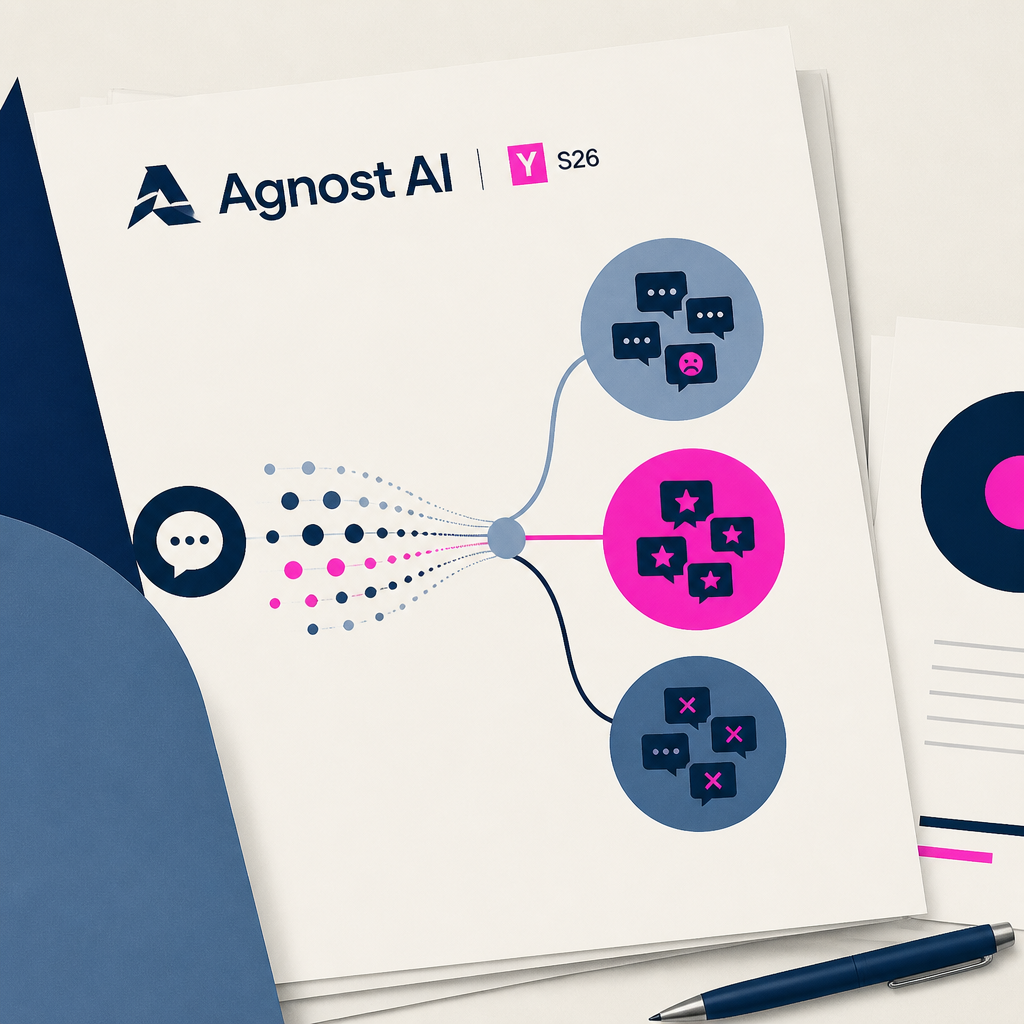
Agnost AI, a YC S26 startup, launched product analytics software that extracts user behavioral signals from chat and voice agent conversations by clustering messages to identify frustration patterns, feature requests, and failures. The company ingests approximately 1 million messages daily from production agents, uses a hybrid clustering approach combining cosine drift segmentation with BIRCH and HDBSCAN to avoid expensive LLM processing at scale, and charges $499 per month for pro-tier access. Teams can now discover hidden product feedback like the video editor company that found 70 users requesting auto-subtitles expressed through varied phrasings across 12 repeated interactions.
Enterprises need to evaluate AI investments by measuring the amount of useful work generated per dollar spent rather than relying on traditional metrics. The article emphasizes efficiency improvements and identifying workflows that deliver the highest return on investment as key benchmarks for assessment. Organizations can allocate resources more effectively by focusing spending on AI systems that complete high-value tasks at scale.
AgentKey launched a unified API platform that consolidates access to search, social media, finance, and cryptocurrency data sources through a single authentication key for AI agents. The service operates on a subscription model with shared credit balances across all integrated services, priced at rates like $3.55 per 120 web searches and $1.40 per 450 Twitter data requests. Users can now connect multiple data sources in one installation step without managing separate API keys, vendor dashboards, or per-service billing.
The page titled “Omniwork” promotes something called the “Creative Agent OS” for creating with desktop AI agents. The only concrete detail provided is the name “Creative Agent OS” itself. No specific features, benchmarks, pricing, or dates are given, so the concrete impact or changes can’t be determined from the text provided.
Every AI story that matters,
in your inbox by 8am.
TLDRocket reads all relevant sources, removes duplicate coverage, and summarises the
day in two minutes. Follow companies and topics for alerts, or get the
briefing in Slack. Free, no spam, unsubscribe anytime.
Reading TLDRocket needs no cookies, and the readership counts we rely on come from
our own cookieless analytics. Google Analytics is the exception: it sets cookies and
reports to Google, so it stays switched off until you allow it. You can change your
mind any time from “Cookie settings” in the footer.
Strictly necessary
Session security and form protection (tldrocket-session,
XSRF-TOKEN, 2 hours). The site cannot work without them,
so they need no consent.
Always on
Google Analytics 4 (_ga,
_ga_<id>, up to 2 years). Measures which
stories and sections readers use. Google acts as a third-party processor and may
store the data outside the EU. No advertising, no profiling, no data sold.