
Previewing the Model Hardware Standard
Anthropic ● Covered by 3 sources
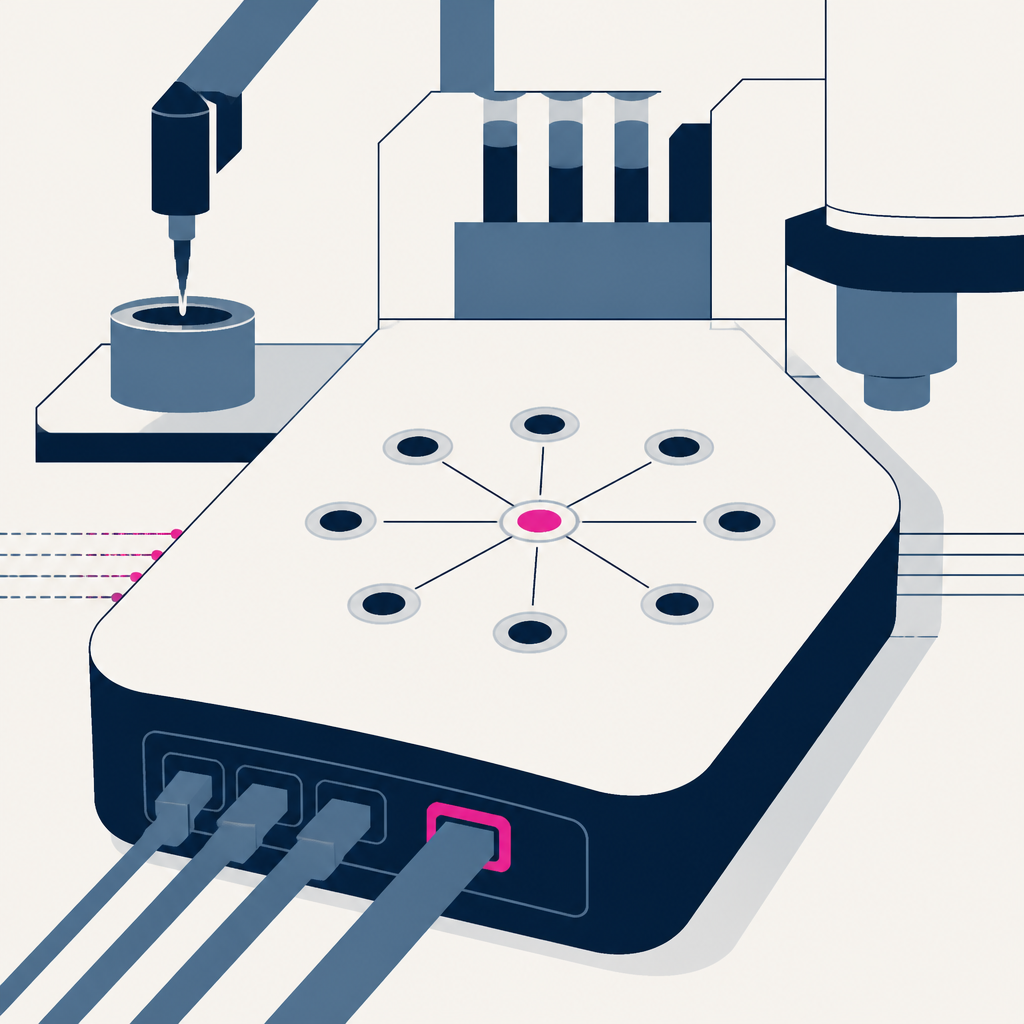
Anthropic is previewing a standard for AI agents to run lab gear and factory tools. It could cut device setup from weeks to hours, but safety is the whole point.
Based on reporting by Anthropic — read the original for the full story.
Summary, retelling and take written by AI under human oversight; images are AI-generated illustrations. How we work · Report an error
Anthropic has opened a research preview of the Model Hardware Standard, or MHS, a shared spec for AI agents that need to run physical devices. The first testers are scientific labs and advanced manufacturers, and the pitch is simple: stop forcing every microscope, liquid handler, and robotic arm to speak a private dialect before work can even begin.
That friction is real. In many labs and factories, getting hardware integrated still takes weeks or months, because devices don’t naturally talk to one another and specialists end up writing one-off connections. Anthropic says MHS can reduce that integration work to hours or even minutes. Once it’s in place, an agent can coordinate multiple instruments in parallel, keep experiments going around the clock, update parameters as conditions change, and sometimes recover from hardware errors without a human stepping in.
The core idea is a standardized driver. Instead of bespoke translator software for every device, MHS uses a common set of primitives like read and write, plus tags that let users describe hardware in natural language. Those tags feed a reference file with the machine’s characteristics, what it can measure, what can be adjusted, and what safety limits apply. MHS is model-agnostic, works with any device that has a programmable interface, and can be accessed through standard protocols such as the Model Context Protocol.
Anthropic says Claude has already used the system in a fairly scientist-like way: adjusting a laser, checking the result through a camera, then repeating the process until it understood what was happening. It later turned that into a deterministic script so the alignment could run as a single command. That is the real story here. Not the marketing gloss, but the shift from chatty experimentation to repeatable machine control.
The early partners are all over the map. Genentech used MHS on a proof-of-concept for the BCA protein assay. University of Washington researchers built a remote monitoring dashboard, an AI-supervised qPCR workflow, and a collision-free plate handoff between a robotic arm and a liquid handler. Carnegie Mellon says it ran serial dilution dose-response experiments about three times faster than before. QuEra used MHS on parts of a laser system in quantum machines and says the agent recovered the laser’s lock 99.3% of the time without human help. Anthropic also says AWS, Automata, Danaher, Doosan Robotics, MBF Bioscience, QIAGEN, Tecan, Universal Robots, Hugging Face, and Raspberry Pi are all moving on support in some form.
Still, Anthropic is unusually blunt about the limits. Claude’s physical reasoning is not magic, and researchers had to correct it when foaming in protein samples was a real hardware problem, not a software bug. MHS also doesn’t work with hardware that lacks a programming interface yet. The company says it will use the preview to build safety evaluations and a physical safety roadmap before opening MHS source code.
My take — AI-written commentary, not fact-checked reporting
This is the right bet: if AI is going to touch the physical world, it needs boring standards, not heroic one-off hacks. The industry loves calling everything “autonomous” right up until a robot arm clips something expensive. MHS sounds like Anthropic doing the unglamorous work that should have happened years ago.
Read more about this at: Anthropic
Related stories
 Anthropic Opens a Research Preview of the Model Hardware Standard (MHS): A Shared Specification for AI Agents to Safely Operate Physical Devices
MarkTechPost · 1 month ago ·
50
Anthropic previews MHS standard for AI agents that operate machines
SiliconANGLE · 1 month ago ·
24
Anthropic's new hardware standard lets AI agents control the physical world
Ars Technica · 1 month ago ·
31
Anthropic Opens a Research Preview of the Model Hardware Standard (MHS): A Shared Specification for AI Agents to Safely Operate Physical Devices
MarkTechPost · 1 month ago ·
50
Anthropic previews MHS standard for AI agents that operate machines
SiliconANGLE · 1 month ago ·
24
Anthropic's new hardware standard lets AI agents control the physical world
Ars Technica · 1 month ago ·
31