Google DeepMind released the Gemini Robotics 2 model series designed to control humanoid robots and enable them to collaborate on multi-step tasks. The core model, Gemini Robotics ER 2, accepts natural language instructions and can coordinate tasks across multiple robots while tracking progress via camera feeds and recovering from failures without restarting from scratch. The new capabilities allow robots to handle complex chores comprising hundreds of steps and adapt their execution in real time.
Google released Gemini Robotics 2.0, an AI system that enables robots to perform more complex tasks, adapt to changing environments, and coordinate with other robots through improved reasoning models. One of three new sub-models is publicly available to developers starting today via the Gemini Live API. The upgrade allows robots to control complex humanoid bodies with better dexterity, moving closer to the goal of creating generalist machines that can perform diverse physical tasks.
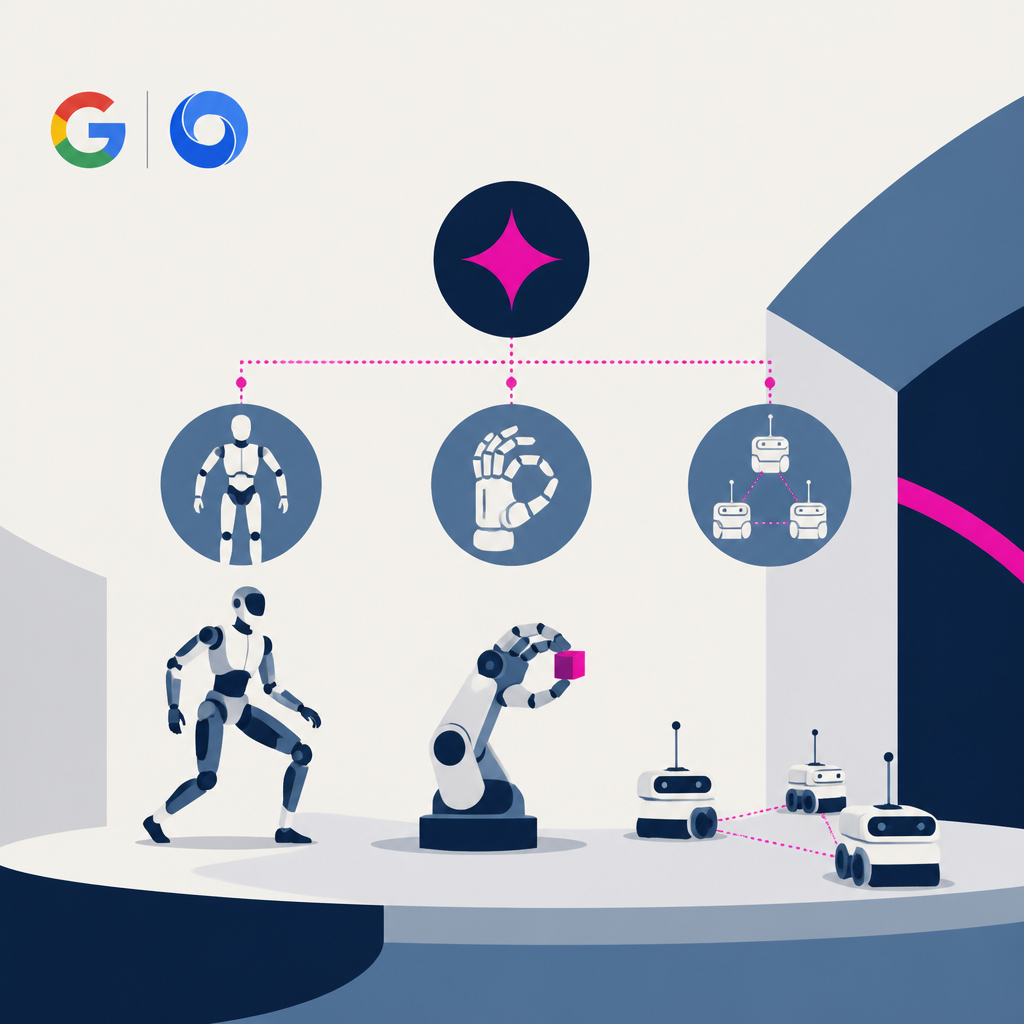
Google DeepMind released Gemini Robotics 2, a suite of three AI models for controlling robots across whole-body movement, multi-finger dexterity, and multi-robot collaboration. The system achieves success rates ranging from 32% to 92% depending on task complexity, with one model checkpoint controlling multiple robot embodiments including the Apptronik Apollo 2 and Franka Duo. Robots can now adapt to unpredictable environments, transfer skills between different bodies, and coordinate with other robots on shared tasks rather than relying on pre-programming or teleoperation.
Google launched Gemini Robotics ER 2, an AI model that enables robots to understand video feeds, plan multi-step tasks, and collaborate with other robots in physical environments. The model achieves 57.4% accuracy on progress classification and 91.3% accuracy on moment-finding tasks while operating at sub-second latency required for safe real-world robotics. Developers can now access the model via the Gemini API and Google AI Studio, enabling robots to independently track progress, adapt to failures, and coordinate with other machines to complete complex workflows.
Google DeepMind released Gemini Robotics 2, an AI model that controls humanoid robots' entire bodies including legs and arms, extending beyond its predecessor which only handled upper-body movements. The model enables robots like Apptronik's Apollo 2 to perform full-body tasks such as walking, crouching, bending to pick up objects, and retrieving specific items from shelves. Humanoid robots can now execute a broader repertoire of physical actions previously impossible with upper-body-only control.
Amazon-owned Zoox received NHTSA approval to charge for robotaxi rides in its steering-wheel-free vehicles. The exemption permits deployment of up to 2,500 vehicles annually over two years and waives requirements for traditional controls like steering wheels, pedals, and mirrors. Zoox can now operate paid passenger services with its purpose-built autonomous vehicles that lack driver controls.
Researchers developed MoMo, a framework that teaches robots to perform manipulation tasks with different execution styles by learning motion modes as reusable behavioral factors. The system uses spatiotemporal action tokenization and behavior cloning to enable robots to vary joint speed, acceleration, and approach pitch across six real-world tasks. This approach allows robots to generalize learned motion modes to new task combinations, enabling flexible skill execution beyond what was directly demonstrated.
Every AI story that matters,
in your inbox by 8am.
TLDRocket reads all relevant sources, removes duplicate coverage, and summarises the
day in two minutes. Follow companies and topics for alerts, or get the
briefing in Slack. Free, no spam, unsubscribe anytime.
Reading TLDRocket needs no cookies, and the readership counts we rely on come from
our own cookieless analytics. Google Analytics is the exception: it sets cookies and
reports to Google, so it stays switched off until you allow it. You can change your
mind any time from “Cookie settings” in the footer.
Strictly necessary
Session security and form protection (tldrocket-session,
XSRF-TOKEN, 2 hours). The site cannot work without them,
so they need no consent.
Always on
Google Analytics 4 (_ga,
_ga_<id>, up to 2 years). Measures which
stories and sections readers use. Google acts as a third-party processor and may
store the data outside the EU. No advertising, no profiling, no data sold.