
Google DeepMind Ships Three Physical AI Models For Whole Body Control, Dexterity And Multi Robot Collaboration
MarkTechPost Asif Razzaq ● Covered by 7 sources
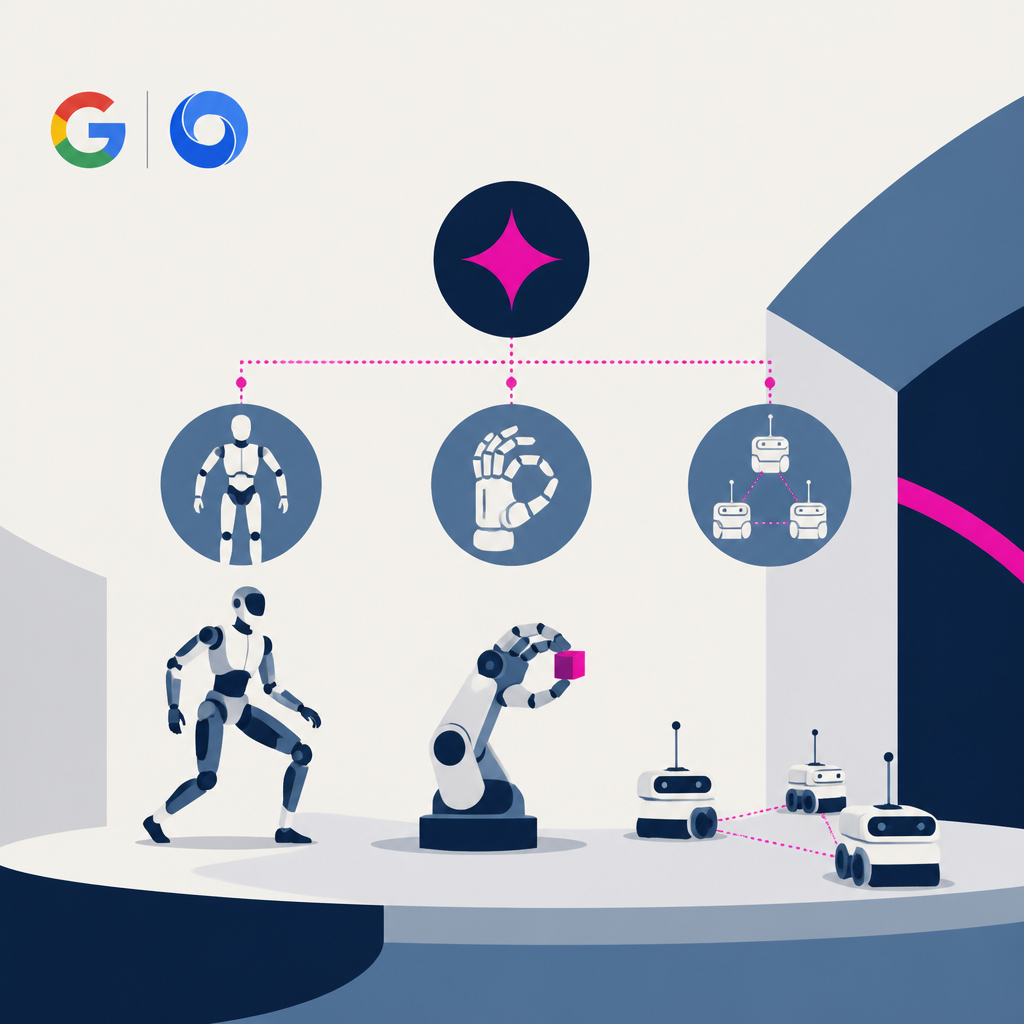
Google DeepMind just launched Gemini Robotics 2, three AI models that let robots use their whole body, not just table-top arms. One model can already tie knots and seal ziplock bags with a five-fingered hand — but it still fumbles a dustpan 68% of the time.
Based on reporting by MarkTechPost, Asif Razzaq — read the original for the full story.
Summary, retelling and take written by AI under human oversight; images are AI-generated illustrations. How we work · Report an error
Google DeepMind's latest robotics push isn't one model, it's three, each doing a distinct job in a stack that finally lets a humanoid walk across a room instead of just fiddling with objects bolted to a table. Gemini Robotics 2 handles the actual motor control, Gemini Robotics ER 2 does the high-level reasoning and planning, and an on-device variant runs locally when there's no time to wait on a network round-trip. The split matters: ER 2 acts like a manager, tracking a multi-step task and calling the motion model as a tool, rather than one giant model trying to do everything at once.
The headline demo involves Apptronik's Apollo 2 humanoid, told simply to put a watering can in a green bin on a bottom shelf. The robot walks to the table, grabs the can, crosses the room, and places it — full-body coordination that earlier Gemini Robotics releases couldn't touch, since those were limited to upper-body, table-top manipulation. DeepMind is candid that Apollo still moves slower than you'd want in production.
Dexterity is where the numbers get uneven. A single checkpoint drives three different embodiments — Apollo 2 with SharpaWave five-finger hands, Apollo 2 with Inspire hands, and a Franka Duo parallel gripper — and the same model unscrews a lightbulb 92% of the time but only manages a dustpan task 32% of the time. Tying a trash bag or sealing a ziplock lands in the 40% range. Parallel-gripper tasks on the Franka Duo, like precise insertion, fare much better at nearly 90%. That gap between simple grippers and complex hands is basically the current frontier of robot manipulation, and DeepMind isn't hiding it.
ER 2, built on Gemini 3.5 Flash, is arguably the more interesting release for developers, because it tackles something rarely benchmarked: knowing when a task is actually finished. It classifies task progress in video with 57.4% accuracy and pinpoints critical moments — like exactly when to stop pouring coffee — with 91.3% accuracy and under a second of error, reportedly matching much larger models at four times the speed. It also streams through the Gemini Live API to avoid the awkward pauses that break up multi-step execution, and it's the only one of the three models in public preview, available now through the Gemini API and AI Studio.
The on-device model, meanwhile, is aimed at robots that can't lean on cloud latency. DeepMind says it adapts to new bi-arm robot bodies in a few hours using fewer than 200 examples, and the data backs that up on the SO101 platform: the previous generation barely improved with training data while On-Device 2 jumped from 6.7% to 53.3% success. That's a real generational leap, even if On-Device 2 still struggles with high-degree-of-freedom robots and tasks outside its training distribution. DeepMind also quietly dropped a new safety benchmark, ASIMOV-Agentic, on Hugging Face, which suggests they know shipping robots that walk around unsupervised needs its own guardrails.
My take — AI-written commentary, not fact-checked reporting
The dustpan stat says more than any keynote slide: we're still years from robots that reliably do boring chores, even as they nail flashy party tricks like tying knots. Gating the actual motion model behind early-access partners while throwing the reasoning layer into public preview is a smart hedge — let developers play with the brain, keep the risky physical actions on a leash. That's the right instinct, and more robotics labs should copy it instead of racing to demo humanoids that can't yet be trusted with a dustpan.
Read more about this at: MarkTechPost