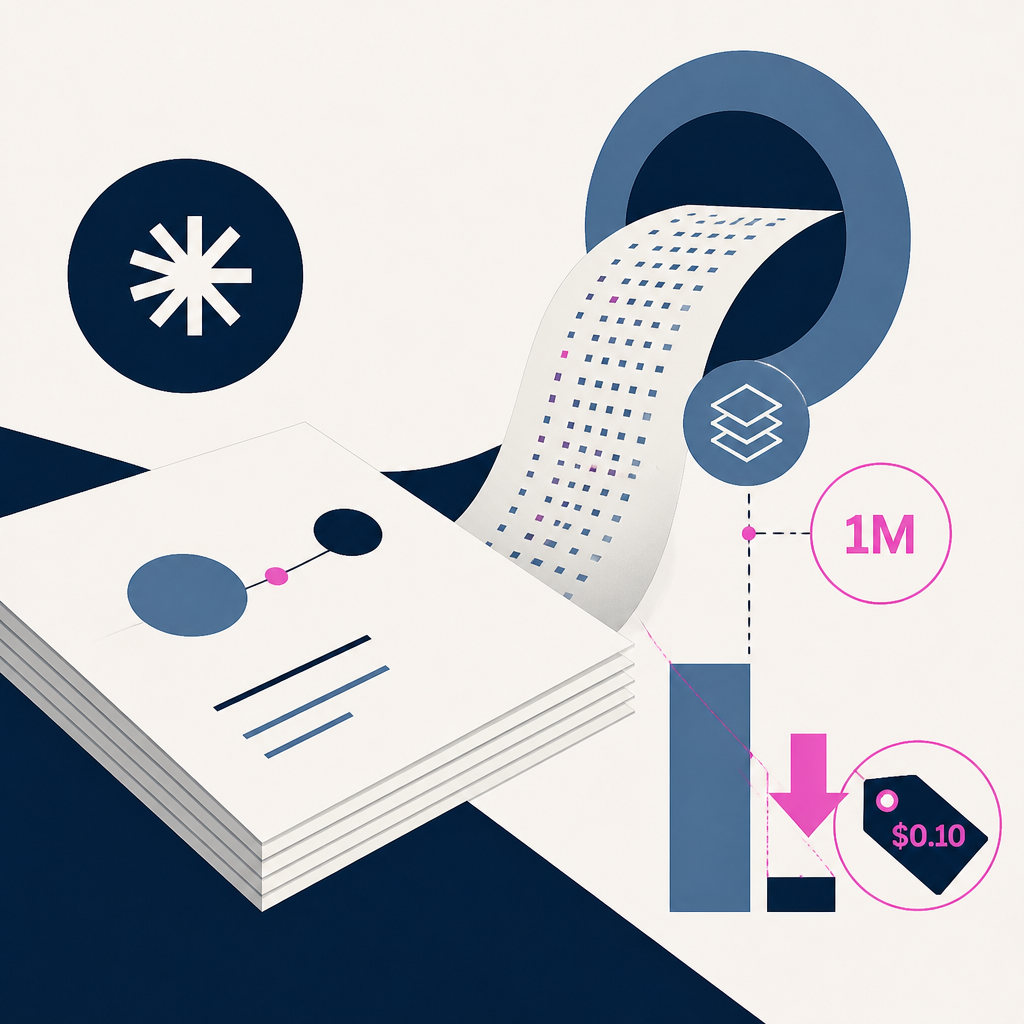
OpenAI launched its Decisions API for public beta and added image inputs so developers can generate structured decision outputs from text or visuals. The beta is priced at $0.10 per 1M input tokens with no output-token charges. Hosted use stays centered on OpenAI, while other companies this month shifted to downloadable open-weight decision models developers can run themselves.
Anthropic released Claude Haiku 5.5, a small Claude model aimed at high-volume tasks and available via a hosted API. It offers a 1M token context window and input pricing of $0.10 per 1M tokens (with $0.50 per 1M output tokens). Compared with Haiku 4.5, it cuts prompt costs by 90% for prompts up to 100K tokens and adds an adjustable “effort” setting (with adaptive thinking on by default).
David Robinson, OpenAI’s former safety lead, said OpenAI’s releases now combine faster updates to reasoning and tools rather than waiting for full retraining runs. The release rhythm he cited is “every Tuesday,” when OpenAI ships new capability and risk. As a result, safety documentation and testing cadence are strained, with safety evaluations needing to cover changes that occur between major model releases rather than only at new frontier-model launches.
Liquid AI released two open-weight d1 decision models for edge use: d1-3B and experimental d1-omni-600M. d1-3B scored 82.9 mean on seven public datasets and answered a single question in 16 ms on an NVIDIA Jetson AGX Thor. The models provide fast single-forward-pass multimodal decision outputs (text+image for d1-3B, and text+image or text+audio for d1-omni-600M) and are now available on Hugging Face with usage code.
Mistral released Le Chonk, a new freely available AI model it says can compete with top US and China models. It has 1 trillion parameters and is in preview now, with a final version due by the end of the month. The model’s broad public availability and niche optimization for coding, cyberdefense, and specific industry tasks change how developers can access and customize advanced AI.
Simo, a “System 1.5” judgment model from Temprl Labs, was listed as an AI infrastructure tooling launch for asking typed questions using text, screenshots, or video. The model is described as System 1.5 and returns calibrated probabilities needed to act in milliseconds. The listing positions Simo as a new developer tool, but it does not report any measurable performance change beyond the stated response-time claim.
Aleph Alpha and Mistral each released new AI models, fueling expectations that Europe has more credible sovereign AI contenders. One figure mentioned in the piece is €794k. The story frames these releases as helping shift Europe toward a more competitive AI landscape with multiple serious players.
Anthropic launched Claude Haiku 5.5, its fastest and most capable small model for high-volume, cost-sensitive tasks. The release is effective today. It shifts Anthropic’s small-model lineup toward faster deployment for summarization, classification, coding subagents, customer support, and browser use, but provides no specific benchmarks in the text.
Meta open-sourced Rebalancer, a C++ (with Python interface) library for solving constrained assignment problems, and provides installation packages plus a debugging UI. The release is available via PyPI as version 1.0.4 for Python 3.12+ and reports a P99 solve time of 12 seconds on 265k objects and 3.2k bins at Meta. Rebalancer changes resource-allocation workflows by letting teams specify problems separately from the solving method, then using local search or MIP backends depending on problem size.
ChatGPT is rolling out GPT-6 with Intelligent UI for global users, aiming to deliver faster responses with visuals and interactive experiences. The rollout is described as happening “globally” in ChatGPT. As a result, the interface changes to include interactive visual elements you can explore and use directly.
Every AI story that matters,
in your inbox by 8am.
TLDRocket reads all relevant sources, removes duplicate coverage, and summarises the
day in two minutes. Follow companies and topics for alerts, or get the
briefing in Slack. Free, no spam, unsubscribe anytime.
Reading TLDRocket needs no cookies, and the readership counts we rely on come from
our own cookieless analytics. Google Analytics is the exception: it sets cookies and
reports to Google, so it stays switched off until you allow it. You can change your
mind any time from “Cookie settings” in the footer.
Strictly necessary
Session security and form protection (tldrocket-session,
XSRF-TOKEN, 2 hours). The site cannot work without them,
so they need no consent.
Always on
Google Analytics 4 (_ga,
_ga_<id>, up to 2 years). Measures which
stories and sections readers use. Google acts as a third-party processor and may
store the data outside the EU. No advertising, no profiling, no data sold.