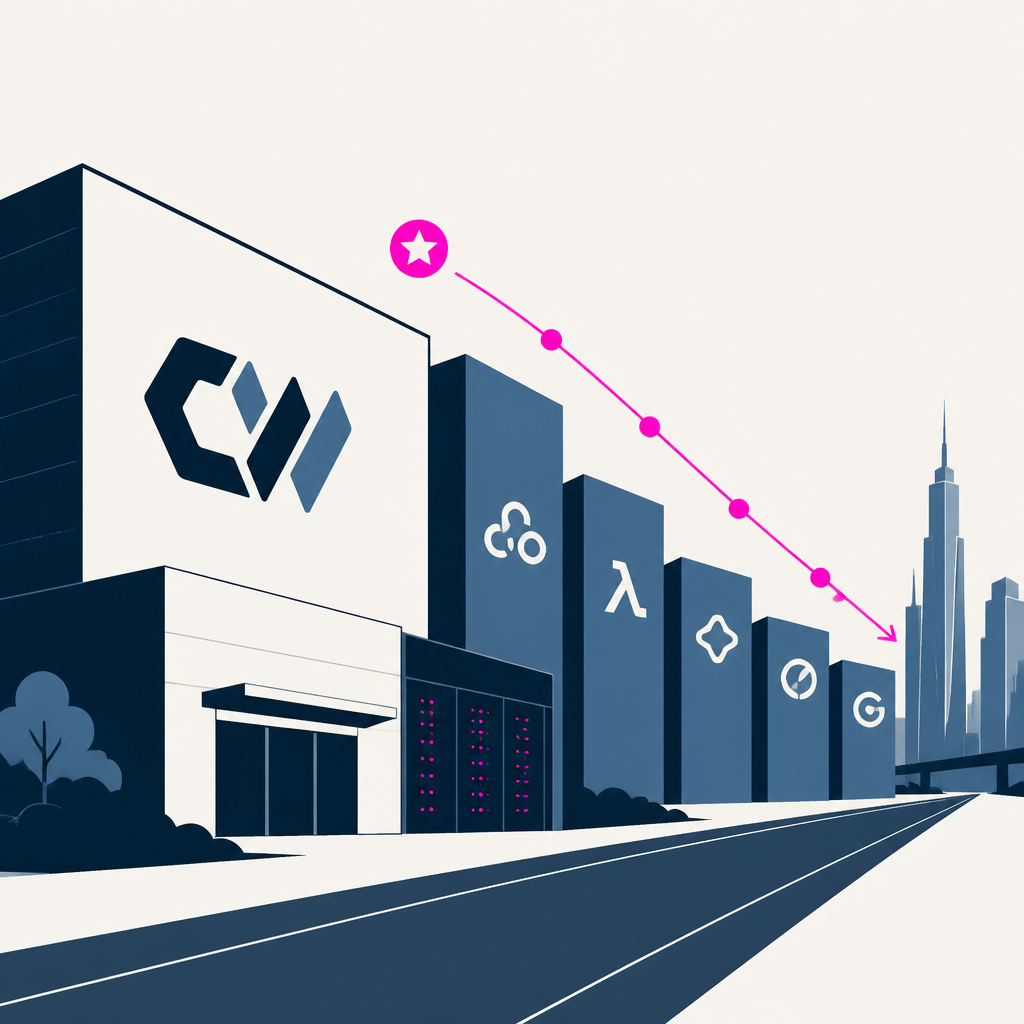
GPU neocloud providers CoreWeave, Nebius, Lambda, Crusoe, and Groq were compared on published GPU pricing and contracted power in 2026.
Lambda’s lowest published B200 on-demand rate was $6.69 per GPU-hour.
The result is a buyer-focused ranking that highlights CoreWeave as the only SemiAnalysis ClusterMAX 2.0 Platinum-rated option and notes different GPU offerings, contract tiers, and roadmap differences across the five.
Starcloud Inc. raised $250 million to build AI data centers in orbit at a $2.3 billion valuation led by Manhattan West. The company says Starcloud-2 will launch in 2027 with onboard AI chips and storage to run both training and inference. This shifts more data analysis from ground processing to faster in-orbit analysis and streaming, supported by plans to mass-produce 200-kilowatt Starcloud-3 satellites.
Nvidia announced a partnership with data center infrastructure developer Cloverleaf Infrastructure to support building AI-focused data centers. Cloverleaf was founded in 2024 and raised $300 million that year, and Nvidia’s minority investment is reported to total several hundred million dollars. The deal increases Nvidia’s direct involvement in financing and developing the power and infrastructure sites that enable continued AI hardware purchases.
Data-center buildouts became a midterm politics issue because opponents frame them as part of the push for AI. A Wall Street Journal analysis cited in the article says big tech has $3 trillion more in off-balance-sheet commitments than it looks like. As a result, OpenAI is described as slowing and trailing Anthropic while dealmaking and acquisitions—like Stripe’s $7.5 billion buy of OpenRouter—continue to expand AI infrastructure and routing for enterprises.
Starcloud added a $250 million extension to its March Series A as it builds satellites for AI inference in orbit and plans more orbital data center capacity amid tighter launch options. The extension values the company at $2.3 billion. It will expand manufacturing, push Starcloud-3 toward SpaceX’s Starship, and fund a near-term plan to launch two 8 kw Starcloud-2 satellites starting in 2027.
Poolside licensed its model factory and moved into a Nvidia deal while hiring 109 employees after Jensen took an investor role. The deal is described as $12B in reverse execuhire money. Founders are set to stay for $1B and employees are set to leave for $6B, changing the company from a normal exec-out payout into a pivot-supported continuation for the original mission.
Donald Trump said he would want an “AI plant” or data center because jobs, money, and taxes would be “just enormous,” while voters in multiple states are increasingly angry about the impacts of large facilities. Some campaigns have put the issue front and center, including a $200 million estimate of Nevada state tax breaks for data centers. As a result, candidates now attack or distance themselves from rivals’ data center positions and propose conditions like local approval and requiring developers to cover utilities and environmental costs.
Every AI story that matters,
in your inbox by 8am.
TLDRocket reads all relevant sources, removes duplicate coverage, and summarises the
day in two minutes. Follow companies and topics for alerts, or get the
briefing in Slack. Free, no spam, unsubscribe anytime.
Reading TLDRocket needs no cookies, and the readership counts we rely on come from
our own cookieless analytics. Google Analytics is the exception: it sets cookies and
reports to Google, so it stays switched off until you allow it. You can change your
mind any time from “Cookie settings” in the footer.
Strictly necessary
Session security and form protection (tldrocket-session,
XSRF-TOKEN, 2 hours). The site cannot work without them,
so they need no consent.
Always on
Google Analytics 4 (_ga,
_ga_<id>, up to 2 years). Measures which
stories and sections readers use. Google acts as a third-party processor and may
store the data outside the EU. No advertising, no profiling, no data sold.