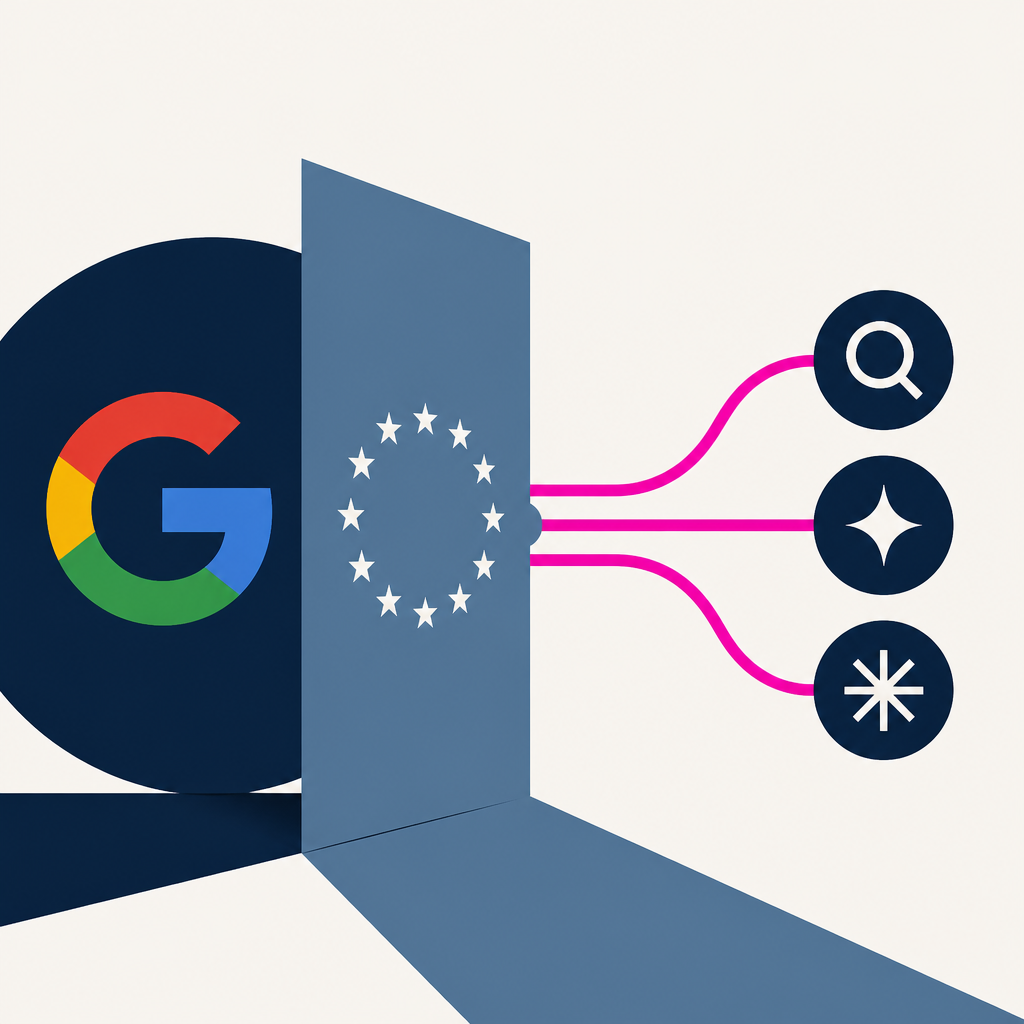
The European Commission has issued legally binding orders requiring Google to share search data and allow competing AI platforms equal access on Android devices, ending Gemini's current preferential treatment and system integration advantages. Google must implement these interoperability measures across Android phones and search in the EU, with Gemini no longer having exclusive access to the "Hey Google" voice activation and system automation features. The changes aim to increase competition and consumer choice in the EU market, though Google argues they will harm privacy and security.
Google expanded its AI Mode search feature to allow users to link and interact with select third-party apps including Instacart, Canva, and YouTube, enabling tasks like adding grocery items to shopping carts and saving playlists. The rollout started in the U.S. with plans to support additional apps in the future. This update positions AI Mode as a task completion tool to compete with ChatGPT and Claude, which already offer app integration capabilities.
The European Union ordered Google to provide AI rivals greater access to Android, the open-source operating system used by billions of devices worldwide. The decision was announced by the European Commission on Thursday as part of its competition enforcement actions. Google's compliance with this directive will require it to share Android access with competing AI assistants, altering how the company can control its platform's ecosystem.
Google is renaming its note-taking app NotebookLM to Gemini Notebook while keeping it as a standalone product with deeper integration into Gemini and Google Search. The app, initially called Project Tailwind when announced in May 2023, has accumulated features including AI podcast summaries, narrated slideshows, and TikTok-style clips. The rebrand reflects Google's consolidation of its AI offerings under the Gemini umbrella.
Google must give rival search engines and AI assistants greater access to Android and Google Search following EU antitrust orders. The company has until January 2027 to begin sharing search data and July 2027 to implement Android changes. This could diminish Google's control over these platforms and create opportunities for competitors to expand their services.
Every AI story that matters,
in your inbox by 8am.
TLDRocket reads all relevant sources, removes duplicate coverage, and summarises the
day in two minutes. Follow companies and topics for alerts, or get the
briefing in Slack. Free, no spam, unsubscribe anytime.
Reading TLDRocket needs no cookies, and the readership counts we rely on come from
our own cookieless analytics. Google Analytics is the exception: it sets cookies and
reports to Google, so it stays switched off until you allow it. You can change your
mind any time from “Cookie settings” in the footer.
Strictly necessary
Session security and form protection (tldrocket-session,
XSRF-TOKEN, 2 hours). The site cannot work without them,
so they need no consent.
Always on
Google Analytics 4 (_ga,
_ga_<id>, up to 2 years). Measures which
stories and sections readers use. Google acts as a third-party processor and may
store the data outside the EU. No advertising, no profiling, no data sold.