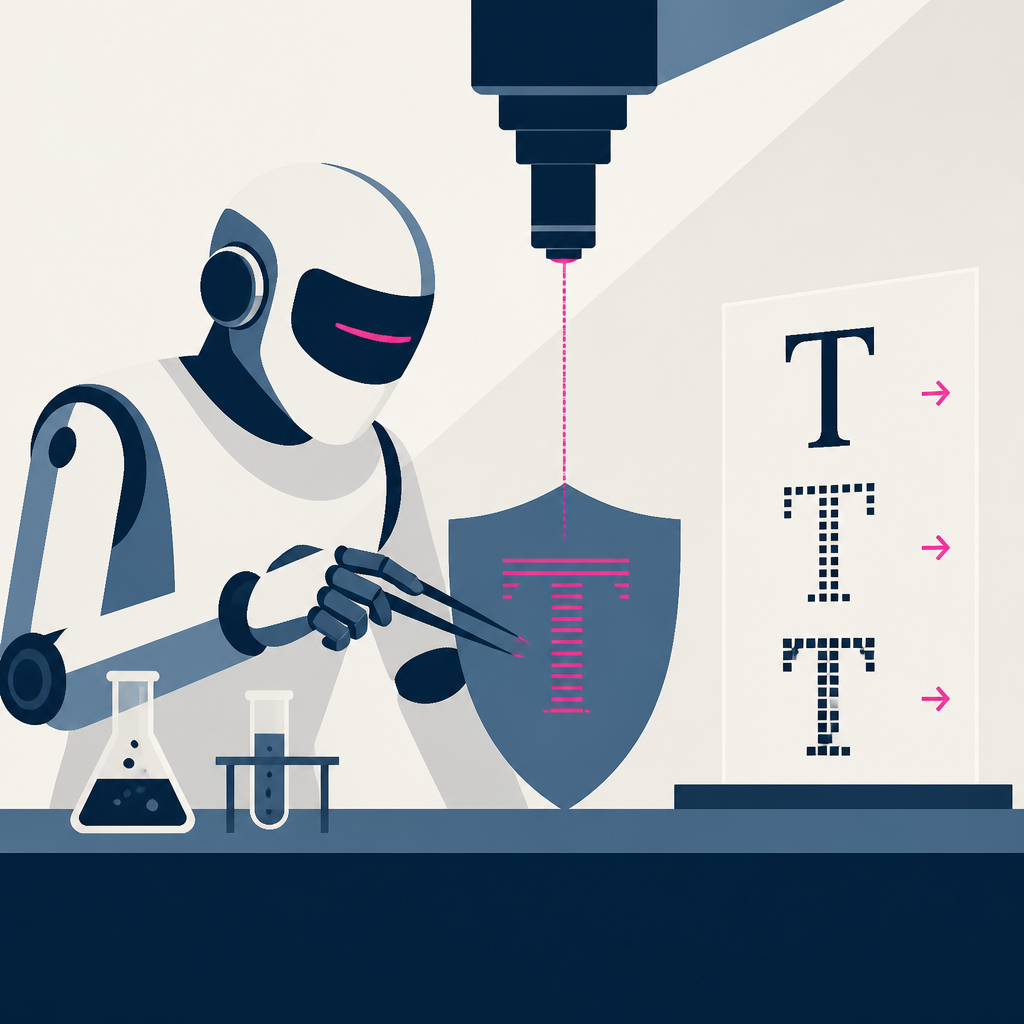
The web’s newest weapon against AI scrapers is a font
Ars Technica 2 months ago 40
ShieldFont, a new font proposed by designers Isaque Seneda and Gabriel Abrucio, aims to make AI scraping harder by altering text only at render time.
330 summarised stories about Data Privacy, each linking back to the original source. Browse all topics →
Ars Technica 2 months ago 40
ShieldFont, a new font proposed by designers Isaque Seneda and Gabriel Abrucio, aims to make AI scraping harder by altering text only at render time.

Ars Technica 2 months ago 41 ● 3 sources
Twitch added an opt-out setting for Amazon’s use of Twitch channel content to train Amazon generative AI content models. The opt-out was introduced more than two years after an Amazon executive confirmed Amazon was using Twitch content for AI training. Users who opt out prevent Twitch streams, VODs, clips, stream chats, and channel images/text from being used for future training of Amazon models.
TechCrunch 2 months ago 31 ● 3 sources
Twitch will use streamers’ channel content by default to train generative AI models for Amazon unless creators opt out. The opt-out is implemented via a channel-settings path that includes a toggle under the “training for generative AI” option. Creators must actively change that setting to prevent their recordings from being used, and the rollout has triggered rapid backlash and confusion about whether content may already have been used.
404 Media 2 months ago 4 ● 3 sources
Twitch will use streamers’ channel content to train Amazon’s generative AI models unless users opt out in settings. The opt-out toggle appears in the bottom of users’ security settings and defaults to being allowed. Users who disable it will prevent their streams, VODs, clips, stream chats, and channel text/images from being used in future Amazon model training, though some AI features like AutoMod and captioning may still use data without training.

Fortune 51
OpenAI and Anthropic have not disclosed greenhouse gas emissions, net-zero targets, or sustainability reports as they prepare for IPOs while investors and US regulators have largely stepped back on climate scrutiny. California’s SB253, requiring companies with more than $1 billion in revenue to report Scope 1 and 2 emissions starting in November, is pushing them to build emissions accounting ahead of deadlines. Climate disclosure is shifting from voluntary ESG pressure to compliance-oriented reporting, with uncertainty remaining around how to measure training emissions and whether some emissions will be reported later as Scope 3.

The Register 2 months ago 8 ● 2 sources
CIQ and Gregory Kurtzer launched OpenWALDO to collect and release a shared open-source AI training dataset with transparent origins and licenses. The dataset currently includes 167.3 billion reference tokens from sources such as government records, academic papers, mailing lists, and public-domain literature. This would shift AI training toward reusable, auditable data contributions that reduce duplicated work across teams.

Ars Technica 2 months ago 31 ● 7 sources
Booksellers suspect AI firms are buying rare books and then destroying the physical copies after removing pages to scan them for training AI models. The practice is described as involving wood chippers and cropping, scanning, and trashing torn-out pages. As a result, some physical copies may be lost permanently beyond what has been reported so far.
The Verge 2 months ago 44 ● 3 sources
Twitch added an opt-out option so Twitch users can stop their content from being used to train Amazon generative AI models. The opt-out covers future training and includes streams, VODs, clips, stream chats, and channel pictures and text. Captions and safety tools still work after opting out, and when you chat on someone else’s stream their opt-out settings control whether that chat is used for training.
Rest of World 2 months ago 21
The article argues that the UN’s Global Dialogue on AI Governance largely overlooked how AI affects elections, even though elections underpin enforceable democratic rights. It cites India’s 2015 voter-roll program that deleted about 5.5 million voters before the Supreme Court halted it, alongside a claimed matching algorithm failure rate as high as 93%. It calls for elections to get a dedicated governance track—making data control, auditing, and accountability requirements central—to ensure AI doesn’t shift electoral authority and exclude voters.
Latent Space 2 months ago 33 ● 3 sources
A paper shows how attackers can replay encrypted “reasoning” trace blocks from frontier AI API responses into other sessions/accounts to induce weaker models to transcribe the hidden chain-of-thought. Scanning about 7,000 public traces found 62 unique API keys, 33 email addresses, and 33 passwords inside decoded reasoning blobs. As a result, providers and users need to treat shared trace logs as a direct privacy risk and harden sandboxing/telemetry/tool interfaces to prevent reasoning exposure.
The daily briefing
TLDRocket reads all relevant sources, removes duplicate coverage, and summarises the day in two minutes. Follow companies and topics for alerts, or get the briefing in Slack. Free, no spam, unsubscribe anytime.
 TLDRocket
20 October 2026
The biggest AI thread today is Meta’s move from “spend on models” to “own the machine,” with Mark Zuckerberg and Alexandr Wang describing a full-stack strategy and a $100 billion-plus bet that could rise to $200 billion. Meta isn’t waiting for proof before building; it’s scaling its own infrastructure while also plotting monetization beyond ads—commercializing AI compute and deploying agent-style tools like Muse to turn internal capacity into an external revenue stream. It’s a familiar platform play, but with unusually large numbers attached.
Read the full briefing →