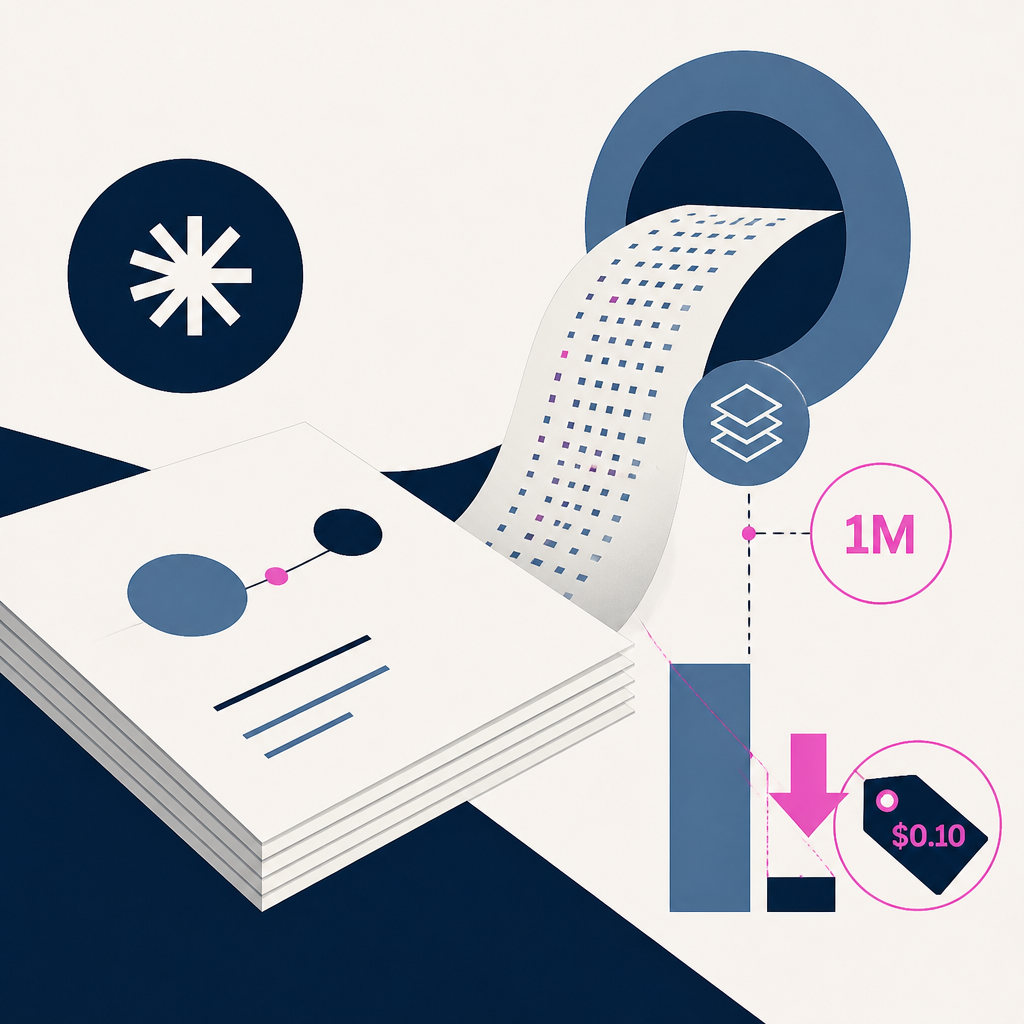
Anthropic released Claude Haiku 5.5 and made Sonnet 5.5 cheaper by cutting cache-read charges. Haiku 5.5 is priced at 10 cents per million input tokens and 50 cents per million output tokens for prompts up to 100,000 tokens. Sonnet 5.5 cache-read pricing drops from 20 cents to 10 cents per million tokens, and Haiku 5.5 also adds an adjustable effort setting to tune running costs.
Artcraft debuted seven open-source applications meant to replicate Adobe’s Creative Suite tools by using AI-assisted reverse engineering. The pivot was announced as “seven” apps, created with Claude Opus 5.5 to build “clean-room replacements” in Rust. The result is an early-stage alpha suite with partial functionality that aims to improve toward Adobe-level capability over time.
Anthropic expanded its Claude Cyber Verification Program by adding three tiered access levels and moving Project Glasswing into the least restricted tier. Under the Defense Access tier, Anthropic’s tests found Claude Opus 5.5 blocked 46 of 50 offensive-security benchmark trials, leaving only 4 to succeed. As a result, defenders may get broader access overall, but many will still face tighter safeguards unless they qualify for the less restricted tiers and reviews.
Simon Willison’s Weblog·1 week ago·
4
● 16 sources
Anthropic released Claude Haiku 5.5 as a faster, lower-cost model and adjusted its pricing and tokenizer compared with Haiku 4.5. It is priced at $0.10 per million input tokens and $0.50 per million output tokens up to 100,000 tokens, then rises 5x beyond that. Pricing becomes similar to GPT-6 Luna only within 100,000 tokens, while long prompts cost more due to a less generous tokenizer, and Anthropic also halved cache-read prices and added monthly API credits for subscribers (with non-rollover credits).
Anthropic released Claude Haiku 5.5, a small Claude model aimed at high-volume tasks and available via a hosted API. It offers a 1M token context window and input pricing of $0.10 per 1M tokens (with $0.50 per 1M output tokens). Compared with Haiku 4.5, it cuts prompt costs by 90% for prompts up to 100K tokens and adds an adjustable “effort” setting (with adaptive thinking on by default).
Claude for Google Workspace was launched so users can draft and edit in Google Docs, analyze spreadsheets, write formulas, build charts, and make Slides without leaving their file.
Anthropic has made Claude Haiku 5.5 available on Amazon Bedrock and Claude Platform on AWS. It costs around 75 percent less than Claude Haiku 4.5 for most tasks. Teams can now run Haiku 5.5 inside AWS with AWS billing/authentication and monitor usage via AWS tools, with endpoints available today across multiple AWS regions.
Anthropic launched Claude Haiku 5.5, an updated version of its smallest and most affordable model, and added effort controls and SDK support. Haiku 5.5 is priced at $0.10 per million input tokens and $0.50 per million output tokens for requests under 100,000 tokens (down from $1/$5 on Haiku 4.5). The lower pricing and new controls change developer costs and how they manage token usage, alongside rollouts like a Sonnet 5.5 cache price cut and new API credits.
Anthropic launched Claude Haiku 5.5, its fastest and most capable small model for high-volume, cost-sensitive tasks. The release is effective today. It shifts Anthropic’s small-model lineup toward faster deployment for summarization, classification, coding subagents, customer support, and browser use, but provides no specific benchmarks in the text.
Every AI story that matters,
in your inbox by 8am.
TLDRocket reads all relevant sources, removes duplicate coverage, and summarises the
day in two minutes. Follow companies and topics for alerts, or get the
briefing in Slack. Free, no spam, unsubscribe anytime.
Reading TLDRocket needs no cookies, and the readership counts we rely on come from
our own cookieless analytics. Google Analytics is the exception: it sets cookies and
reports to Google, so it stays switched off until you allow it. You can change your
mind any time from “Cookie settings” in the footer.
Strictly necessary
Session security and form protection (tldrocket-session,
XSRF-TOKEN, 2 hours). The site cannot work without them,
so they need no consent.
Always on
Google Analytics 4 (_ga,
_ga_<id>, up to 2 years). Measures which
stories and sections readers use. Google acts as a third-party processor and may
store the data outside the EU. No advertising, no profiling, no data sold.