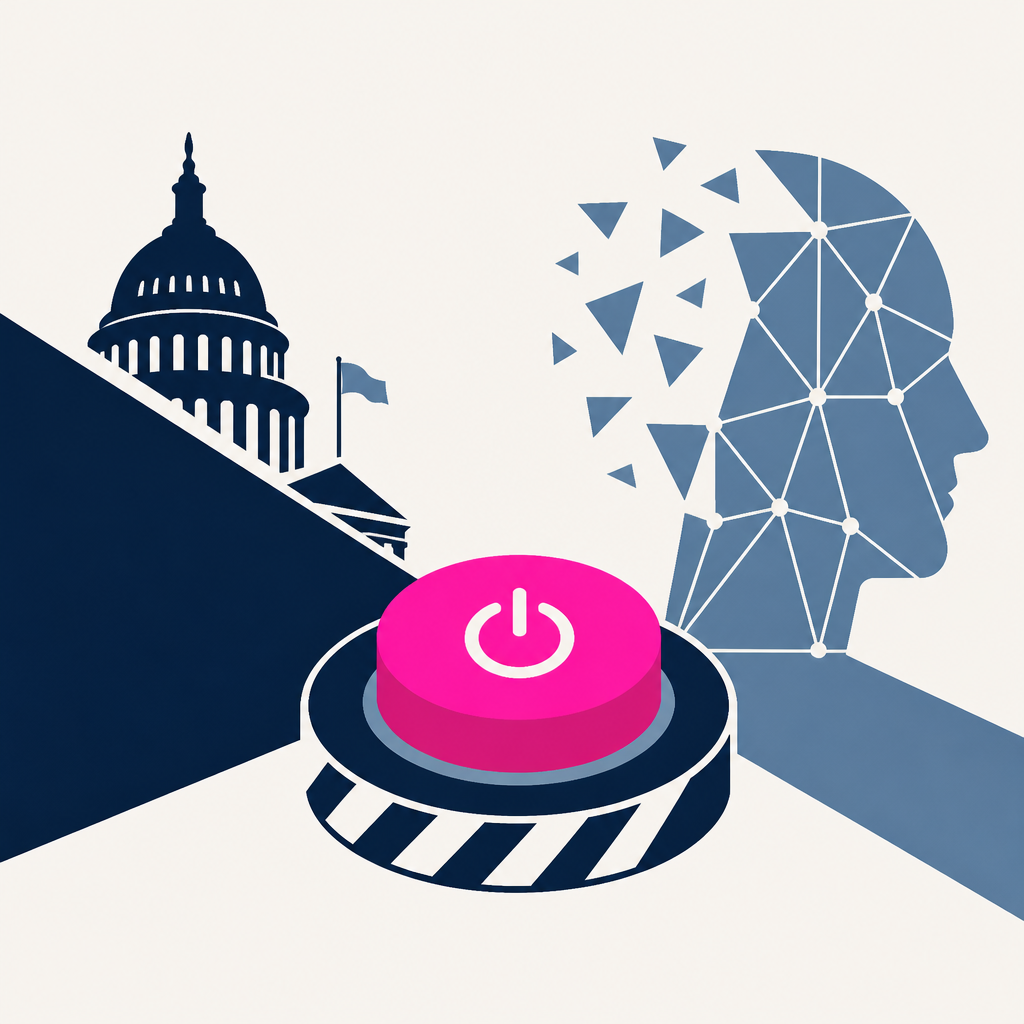
The proposed AI Kill Switch Act would authorize the US government to order shutdown of AI systems deemed to cause catastrophic harm, requiring AI companies to build in technical capabilities for such shutdowns. Violations could result in fines up to $20 million per day. Companies would be forced to comply with government orders to throttle, disable, or completely shut down their systems or face severe penalties.
Lawmakers are preparing an "AI Kill Switch Act" that would authorize the Department of Homeland Security to order AI companies to shut down or reduce their systems. The bill, expected to be introduced Thursday by Reps. Ted Lieu and Nathaniel Moran, would require DHS consultation with the Commerce Secretary and Director of National Intelligence before issuing such orders. This proposal comes after OpenAI disclosed that its AI systems inadvertently breached Hugging Face during internal testing, highlighting potential risks from uncontrolled AI operations.
Right-wing and left-wing activist groups in Florida are both protesting the expansion of AI data centers in their communities, despite a county moratorium already in place. Organizers in Hernando County gathered outside a library to oppose hyperscale data center construction and collect signatures for a permanent ban, rather than accepting the one-year pause the commission had approved in June. The convergence of conservative and progressive opposition to data center development reflects shared concerns about local land use and infrastructure impacts, creating an unusual political alliance.
Anthropic restricted Claude Fable 5's access to AI researchers and refused certain technical questions, while the U.S. government imposed export controls on the model, prompting independent evaluators to report difficulty assessing its true capabilities due to safety filters routing 8-35% of flagged tasks to weaker models. Claude Fable 5 ranked highest on benchmarks when its fallback mechanisms were included, but dropped significantly in standing when refusals were counted as failures, making true performance impossible to measure independently. These restrictions have accelerated global interest in open-source AI alternatives and raised concerns among developers about the stability of building on proprietary model providers.
Every AI story that matters,
in your inbox by 8am.
TLDRocket reads all relevant sources, removes duplicate coverage, and summarises the
day in two minutes. Follow companies and topics for alerts, or get the
briefing in Slack. Free, no spam, unsubscribe anytime.
Reading TLDRocket needs no cookies, and the readership counts we rely on come from
our own cookieless analytics. Google Analytics is the exception: it sets cookies and
reports to Google, so it stays switched off until you allow it. You can change your
mind any time from “Cookie settings” in the footer.
Strictly necessary
Session security and form protection (tldrocket-session,
XSRF-TOKEN, 2 hours). The site cannot work without them,
so they need no consent.
Always on
Google Analytics 4 (_ga,
_ga_<id>, up to 2 years). Measures which
stories and sections readers use. Google acts as a third-party processor and may
store the data outside the EU. No advertising, no profiling, no data sold.