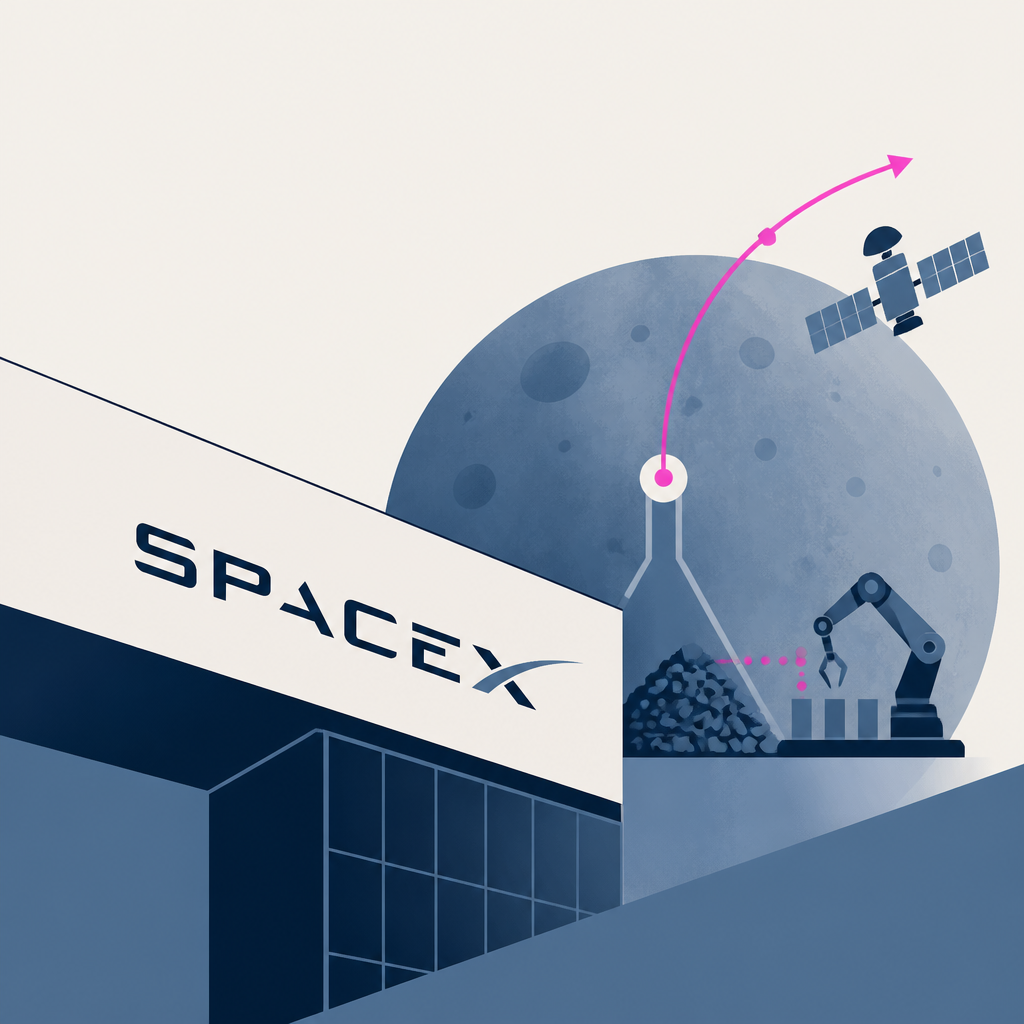
SpaceX plans to build AI compute satellite factories on the moon using robotic workers and local resources, with Musk stating the company aims to extract minerals like aluminum and silicon from lunar regolith via a mass driver launcher. The company currently delivers 2,500 tons per year to orbit and is working toward 1 million tons annually with Starship rockets. If executed, this lunar manufacturing capability would serve as a stepping stone to establishing a human colony on Mars, leveraging operational experience gained from moon operations.
AWS published guidance on monitoring Codex usage across teams using OpenTelemetry metrics routed to CloudWatch, enabling organizations to track adoption, consumption, and costs without adding infrastructure to the model-request path. The solution uses a local collector on each developer workstation that enriches metrics with IAM Identity Center attributes and forwards them to CloudWatch with AWS Signature Version 4 authentication. Organizations can now group usage by user, team, department, or cost center to distinguish broad adoption from isolated experimentation and make informed decisions about scaling or enabling developer access.
Vangrid, a Dutch startup, raised $9 million in seed funding to build a decentralised spatial intelligence network that uses smartphone cameras and sensors to generate mapping data for physical AI systems. The platform processes data on-device with privacy protections and verifies it onchain before delivery to enterprise customers, enabling continuous map updates at the speed of app downloads rather than vehicle fleet cycles. This approach positions Vangrid as infrastructure for robotics and autonomous systems that require up-to-date environmental awareness without relying on centralised capture fleets.
The UK raised €18.7 billion across 423 technology deals in H1 2026, with cloud infrastructure and AI companies dominating funding flows. The top ten companies captured €12.3 billion (66% of total), led by Nscale at €3.57 billion for GPU cloud platforms and Pure Data Centres at $2.7 billion for hyperscale data centres. Concentration of capital in AI infrastructure and cloud services reflects enterprise demand for computing capacity to support large-scale AI deployment.
AI lab Mirendil signed a multi-year partnership with Google Cloud worth over $100 million to access TPUs, GPUs, and managed training clusters for developing self-improving AI systems. The deal represents roughly half of Mirendil's $1 billion seed funding raised in late June and provides access to multiple chip types for optimizing workload allocation. Mirendil gains critical compute infrastructure to scale recursive self-improvement research, while Google secures a strategic partnership in frontier AI technology it can eventually offer to enterprise customers.
Self-hosting AI inference makes financial sense above roughly two million tokens per day or when data sovereignty is required; below that threshold, hosted APIs are cheaper and require less engineering overhead. An MLOps engineer costs around 160,000 dollars annually, typically exceeding GPU hardware costs, making the salary the true expense of self-hosting. Most companies optimize through hybrid setups routing sensitive or high-volume work locally while using frontier models via API, achieving 40 to 70 percent savings versus all-API approaches.
SoftBank donated $50 million to the Trump Presidential Library in January, months before announcing a federal land lease deal for an Ohio data center. The company made the contribution to Trump's library approximately two months before the administration approved the data center lease arrangement. Democratic senators raised concerns about potential quid pro quo and requested information about whether the donation influenced the federal land decision.
Communities across the US are organizing bipartisan protests against AI data center construction, with Hernando County, Florida unanimously approving a yearlong moratorium last month. Local opposition focuses on specific concerns like groundwater contamination, PFAS pollution, and lack of long-term job creation, with facilities typically generating only hundreds of permanent jobs despite construction promises. The backlash cuts across traditional political lines as a populist technocrat divide rather than left-right culture war, giving voters a tangible target to oppose generative AI's societal effects through local government action.
Modal Labs, a New York-based AI infrastructure startup, is opening a London office in the Marble Arch area with capacity for up to 40 employees by early September. The company raised $355 million in May at a $4.65 billion valuation, up from $1.1 billion eight months prior. The expansion follows similar recent moves by OpenAI, Anthropic, and other North American AI firms establishing or expanding London presence.
Every AI story that matters,
in your inbox by 8am.
TLDRocket reads all relevant sources, removes duplicate coverage, and summarises the
day in two minutes. Follow companies and topics for alerts, or get the
briefing in Slack. Free, no spam, unsubscribe anytime.
Reading TLDRocket needs no cookies, and the readership counts we rely on come from
our own cookieless analytics. Google Analytics is the exception: it sets cookies and
reports to Google, so it stays switched off until you allow it. You can change your
mind any time from “Cookie settings” in the footer.
Strictly necessary
Session security and form protection (tldrocket-session,
XSRF-TOKEN, 2 hours). The site cannot work without them,
so they need no consent.
Always on
Google Analytics 4 (_ga,
_ga_<id>, up to 2 years). Measures which
stories and sections readers use. Google acts as a third-party processor and may
store the data outside the EU. No advertising, no profiling, no data sold.