
‘Pure insanity’—Elon Musk details SpaceX’s plan to turn the moon into its newest manufacturing site
Fortune Amanda Gerut
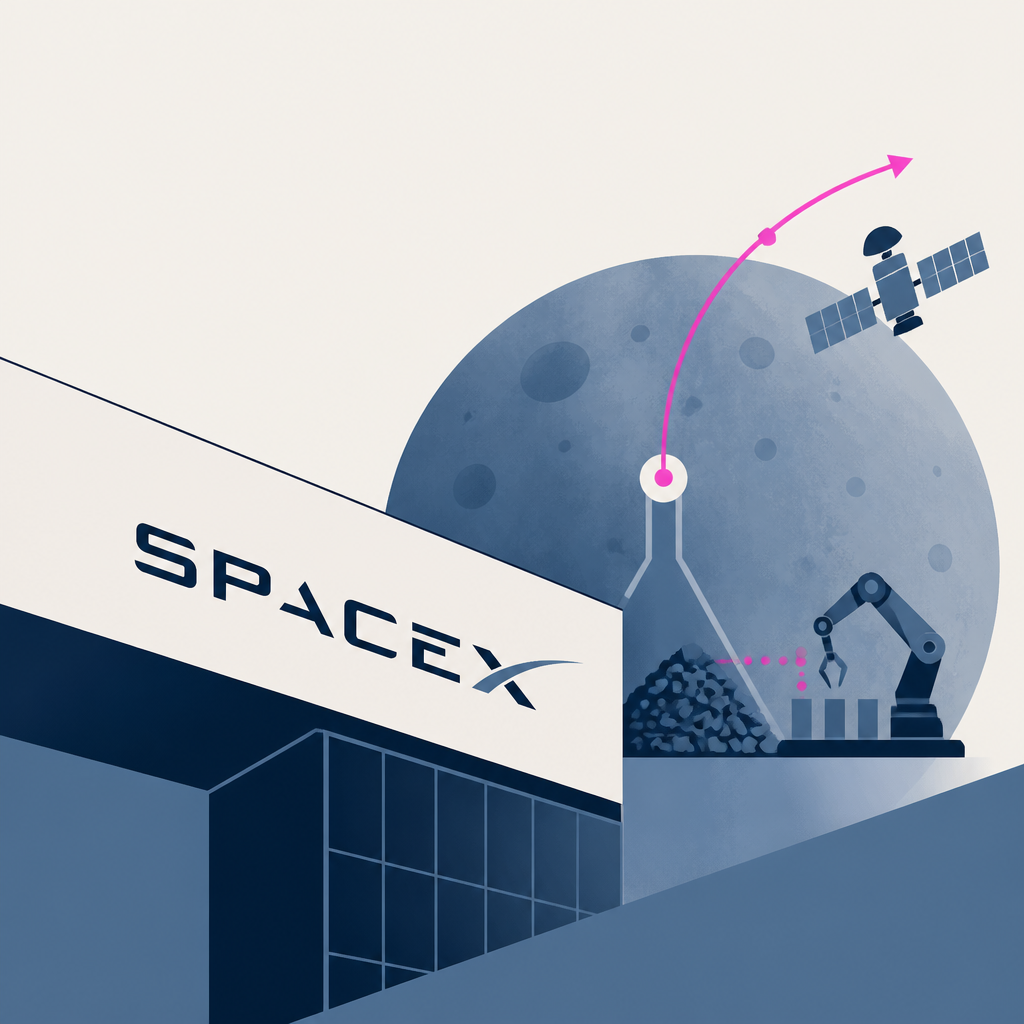
Elon Musk told SpaceX investors the company plans to build robot-run factories on the moon to mass-produce AI satellites. Even Musk admits it sounds nuts—but he's got a timeline and Starship rockets to try it anyway.
Based on reporting by Fortune, Amanda Gerut — read the original for the full story.
Summary, retelling and take written by AI under human oversight; images are AI-generated illustrations. How we work · Report an error
Elon Musk has a habit of saying things that sound unhinged right before making them real, and Tuesday's SpaceX earnings call delivered another one. Talking to investors about the company he just took public, Musk described sending robots to the moon to build factories that churn out AI compute satellites — using lunar dirt as raw material and an electromagnetic launcher to fling finished hardware into orbit without burning a drop of rocket fuel.
The mechanics, buried in SpaceX's IPO filings under less theatrical language, are specific enough to look like an actual plan rather than a fever dream. Starship rockets haul the equipment to the moon's regolith layer. Robots mine aluminum, titanium and silicon from the dust. Chips still come from Earth, but the bulk of satellite construction happens on-site, then a lunar mass driver — think a high-speed train with no rails and no air resistance — shoots the finished satellites off the surface. Musk says SpaceX currently moves about 2,500 tons a year to orbit via Falcon rockets, which he claims is 80 to 90 percent of all mass humanity sends to space. With Starship, he wants to hit a million tons a year, eventually ten million.
People who've worked closest to Musk aren't laughing this off, even as they laugh at it. Jim Cantrell, who's known Musk since 2001 and has studied lunar mining since the 1980s when it was pure academic fantasy, calls the plan "pure insanity" in one breath and inevitable in the next. His read is that Musk isn't building a company at all — he's building something closer to a nation-state, and nobody else is even in the race. Jaret Matthews, a SpaceX alum now running Astrolab, points out the moon has roughly Africa's surface area and the same relative mineral abundance as Earth, minus any ecological cost, plus 20 times less energy needed to launch things off it. The catch is that the moon, in his words, is trying to kill you the entire time — abrasive dust that clings to solar panels, temperature swings from minus 300 degrees to boiling on the same piece of hardware, and a lunar night that lasts 14 days straight, which is why Cantrell figures nuclear power becomes non-negotiable.
What makes this pitch land with investors isn't emotion, it's sequencing. Greg Martin of Rainmaker Securities notes the moon is a two-day trip versus a 26-month Mars launch window plus six months in transit — so starting close, proving the manufacturing model works, then porting it to Mars is the rational order of operations, even if the end goal is a million-person Mars colony. Ryan Westerdahl, a former SpaceX engineer now running Turion Space, has seen this pattern from Musk before: wildly optimistic timelines that shift by a few years, built on the principle of doing whatever engineers haven't yet proven impossible. NASA, for what it's worth, isn't treating lunar development as science fiction either — it's committed $20 billion over seven years toward moon base infrastructure.
SpaceX's numbers this quarter gave investors something concrete to chew on alongside the moon talk: $7.8 billion in revenue, up 92 percent year over year, with $3.5 billion in adjusted EBITDA. The space segment specifically — launches, Starship, and all the lunar ambition — posted $962 million in revenue but a $205 million EBITDA loss, mostly Starship development costs. Cantrell thinks the long-term payoff resembles the colonization of the Americas: expensive, slow, and eventually enormous. He's not sure he'll live to see it finished. But he's been wrong about doubting Musk before, and he says so plainly.
My take — AI-written commentary, not fact-checked reporting
Calling a lunar factory plan 'insane' and then immediately funding it is basically the SpaceX business model at this point, and it keeps working because Musk treats physics as a negotiation rather than a constraint. The real story here isn't moon mining, it's that a private company now moves more mass to orbit than most nations combined and is using that leverage to skip straight past terrestrial manufacturing limits. Investors aren't buying a rocket company anymore, they're buying a bet on off-world industrial policy nobody elected anyone to write, and that's the part regulators in Brussels and Washington should be losing sleep over, not the robots.
Read more about this at: Fortune