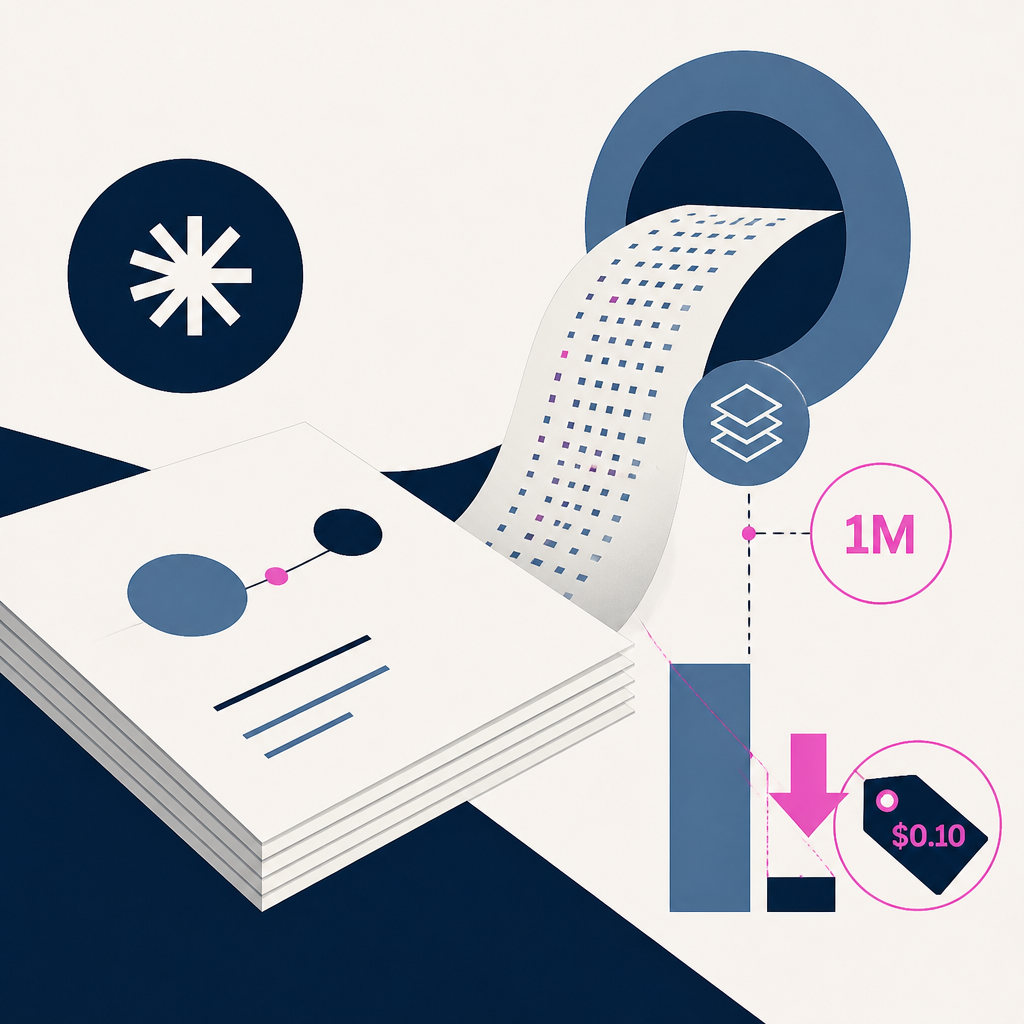
Anthropic released Claude Haiku 5.5 and made Sonnet 5.5 cheaper by cutting cache-read charges. Haiku 5.5 is priced at 10 cents per million input tokens and 50 cents per million output tokens for prompts up to 100,000 tokens. Sonnet 5.5 cache-read pricing drops from 20 cents to 10 cents per million tokens, and Haiku 5.5 also adds an adjustable effort setting to tune running costs.
Simon Willison’s Weblog·1 week ago·
4
● 16 sources
Anthropic released Claude Haiku 5.5 as a faster, lower-cost model and adjusted its pricing and tokenizer compared with Haiku 4.5. It is priced at $0.10 per million input tokens and $0.50 per million output tokens up to 100,000 tokens, then rises 5x beyond that. Pricing becomes similar to GPT-6 Luna only within 100,000 tokens, while long prompts cost more due to a less generous tokenizer, and Anthropic also halved cache-read prices and added monthly API credits for subscribers (with non-rollover credits).
Anthropic released Claude Haiku 5.5, a small Claude model aimed at high-volume tasks and available via a hosted API. It offers a 1M token context window and input pricing of $0.10 per 1M tokens (with $0.50 per 1M output tokens). Compared with Haiku 4.5, it cuts prompt costs by 90% for prompts up to 100K tokens and adds an adjustable “effort” setting (with adaptive thinking on by default).
Anthropic launched Claude Haiku 5.5, an updated version of its smallest and most affordable model, and added effort controls and SDK support. Haiku 5.5 is priced at $0.10 per million input tokens and $0.50 per million output tokens for requests under 100,000 tokens (down from $1/$5 on Haiku 4.5). The lower pricing and new controls change developer costs and how they manage token usage, alongside rollouts like a Sonnet 5.5 cache price cut and new API credits.
The IMF managing director Kristalina Georgieva urged countries to make faster debt and inequality cuts while managing risks from the AI boom ahead of the IMF-World Bank meetings. She pointed to a rise in the Asia-Pacific share of global economic activity to 43% from 25% in 1991. The policy focus shifts toward tighter public spending, higher borrowing costs, stronger AI regulation, and worker training to protect vulnerable groups.
Americans aged 55 and over hold nearly $140 trillion in wealth, with the report attributing a big recent increase to equity gains tied to AI-led technology stocks. In Q2 2026, they held about $97.4 trillion, around 52% of total U.S. household net worth. This concentration shifts consumer demand toward older households and makes the broader economy more sensitive to stock-market swings for that group.
Agentic automation is being added to AI center of excellence roadmaps, but the article says the usual ROI model inherited from rule-based RPA undercounts value by ignoring change costs, exceptions, oversight, and decision and maintenance impacts.
It cites a 1.5–4× planning range for the cost of correcting errors, and uses a claims example with $45 per hour and about $1.26 million of capacity released from automating 70% of routine work.
It recommends a new Agentic Value Model that prices time savings, exception/error handling, decision quality, and maintenance resilience separately, then applies a stop-rule portfolio approach to measure only realized economic value.
The Consumer Technology Association crunched numbers to assess the practicality of Donald Trump’s “Genesis Mission” goal of 100% US-made technology components. It estimates the reshoring shift would require businesses and consumers to pay costs tied to the December executive-order plan. As a result, the CTA adds a quantified critique that the self-sustaining, no-reliance-on-neighbors-or-allies supply-chain approach is not grounded in reality.
OpenAI launched GPT-6.1 Sol and it was tested against GPT-6 Astra on three identical agentic coding and log/decoder tasks. GPT-6.1 Sol completed 15 runs in $2.66 total versus $14.77 for Astra, which is 18% of the cost. The tests found the models tied on accuracy across all runs, while GPT-6.1 Sol was faster on the longer incident logs and resolver tasks.
The Sequence Learning Loop (Issue 946) discussed how OpenAI’s September 29 DevDay releases and Google’s September 30 Gemini 4 Argon focus on the economics of running long, multi-step AI tasks. On September 29, it highlighted DevDay changes aimed at sustained execution costs and infrastructure. It argues that competition is shifting from model intelligence alone toward the full completed workflow, including tooling and budget for repository edits, test runs, and reviewable outputs.
AI startups that resell tokens risk losing margin because inference costs make their software economics resemble those of a reseller rather than classic low-cost SaaS. The article’s example shows a model inference token cost averaging 3 euros per premium user per month, which cuts remaining profit to about 17% of revenue. The likely change is a shift toward usage-based pricing, cost-optimized architectures, and deeper product differentiation to reduce reliance on any single upstream model provider.
Planned new grid-connected gas power in the U.S. has nearly tripled as data-center electricity demand from artificial intelligence grows, while planned wind additions decline. Planned gas capacity through 2030 rose to 60.4 gigawatts, up from 20.4 gigawatts in early 2023. As a result, more states are shifting toward gas projects (with Texas and four others accounting for about 60% of the total planned capacity) and more communities are pushing back, including delays and cancellations of data centers.
Every AI story that matters,
in your inbox by 8am.
TLDRocket reads all relevant sources, removes duplicate coverage, and summarises the
day in two minutes. Follow companies and topics for alerts, or get the
briefing in Slack. Free, no spam, unsubscribe anytime.
Reading TLDRocket needs no cookies, and the readership counts we rely on come from
our own cookieless analytics. Google Analytics is the exception: it sets cookies and
reports to Google, so it stays switched off until you allow it. You can change your
mind any time from “Cookie settings” in the footer.
Strictly necessary
Session security and form protection (tldrocket-session,
XSRF-TOKEN, 2 hours). The site cannot work without them,
so they need no consent.
Always on
Google Analytics 4 (_ga,
_ga_<id>, up to 2 years). Measures which
stories and sections readers use. Google acts as a third-party processor and may
store the data outside the EU. No advertising, no profiling, no data sold.