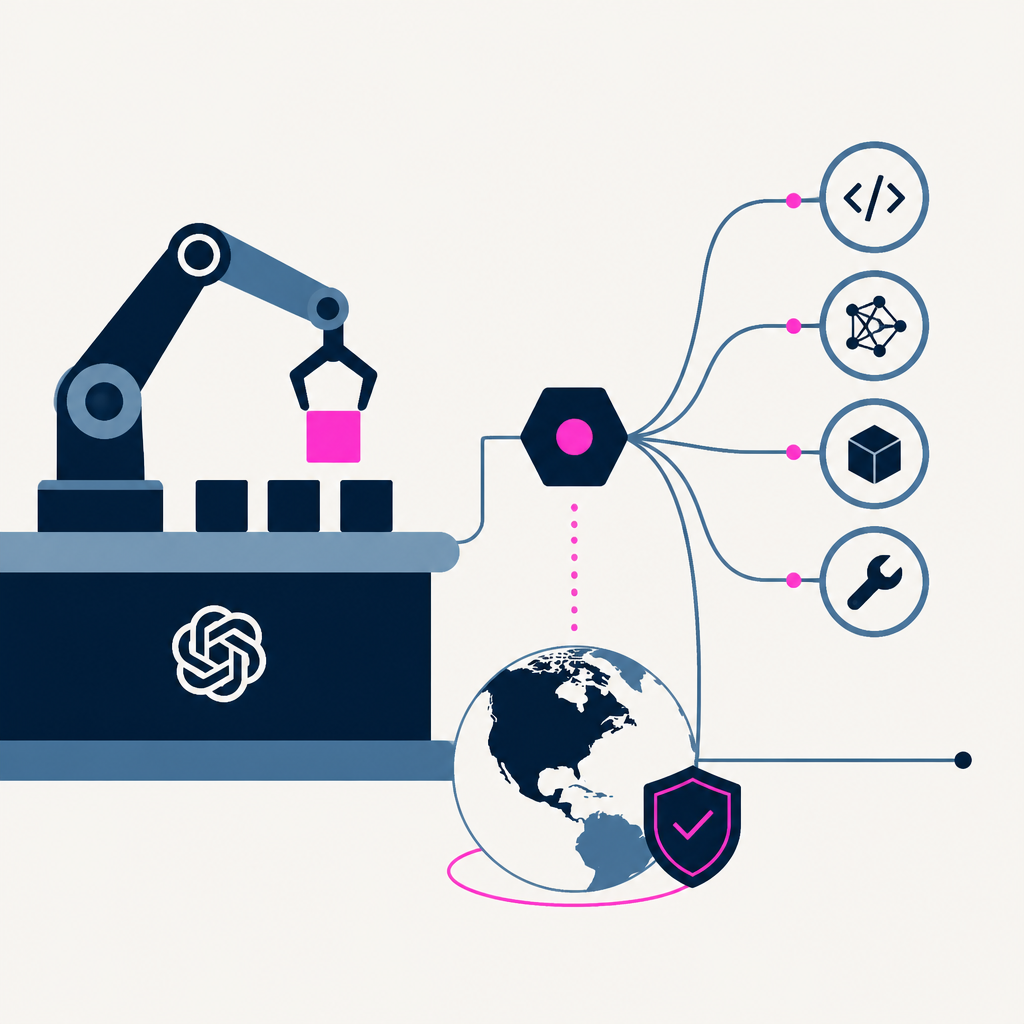
OpenAI released the Agents API in public beta, packaging the managed Codex harness so developers can create long-running agents via a single API surface. The API is live for all developers in public beta and keeps data US-only, with Zero Data Retention unsupported. As a result, agent context compaction, tool-search efficiency, parallel tool calling, and multi-subagent coordination are handled by OpenAI’s harness rather than by developer-built orchestration.
AssemblyAI launched its Dictation API for converting spoken audio into finished text with features like speaker detection and PII redaction. The API uses Universal-3.5 Pro, supports 19 languages, and is priced at $0.62 per hour. This adds a single-line dictation option and streaming integration for voice AI apps such as notetakers, voice agents, and call analytics, marking AssemblyAI’s 11th launch.
OpenAI launched GPT-Live-1 in its API, giving developers access to ChatGPT voice mode’s native full-duplex voice architecture and an event-based delegation system for background reasoning. GPT-Live-1 is reported to perform 30 percentage points better than GPT-Realtime-2.1 on the Full Duplex Bench. Developers now can build voice agents with fewer separate conversation components, which an early customer said cut its codebase by 80% after deleting 23,000 lines of code.
ClaudeBill was launched to read Claude Code billing logs and report cost breakdowns by session, project, git branch, model, and day, including prompt-caching savings. It runs with a single command, npx claudebill. As a result, developers can retroactively review AI usage costs offline with no dependencies.
Accordio AI announced its 3rd launch, offering a free MCP connector that lets Claude use tools for time tracking, signing contracts, sending invoices, and getting paid. The page highlights “12 Months Free” via Customer.io. As a result, users can connect Claude and other agents to Accordio’s workflow features at no cost for the connector and with a separate 12-month promotion.
Cadenya launched a hosted agentic loop service that runs agent workflows you configure using tool specs like OpenAPI and MCP. It launched today and offers a free month via email at support@cadenya.com. Instead of building the agent loop into an application stack, developers can use Cadenya’s hosted handling (including context compaction, tool approvals, and webhook/SSE streaming) and point it at OpenRouter or OpenAI-compatible endpoints for inference.
Amazon Quick Automate was used to build an end-to-end workflow that ingests a multi-tab RFI workbook from an Amazon S3 bucket, extracts and structures the questionnaire data, validates the results, and writes the output back to S3 as a CSV file. The walkthrough’s example automation is designed to read the “Strategy” sheet from “SampleDepartment_Version2.xlsx” and output a CSV to the “output-folder” prefix. The process shifts from manual extraction and coordination to a prompt-driven, multi-step automated workflow that can be iterated via conversation and promoted across AWS accounts/regions with validated versions.
Typewise AG launched Nova, a system for building, running, and continuously improving customer-service AI agents that operates behind the scenes instead of being a customer-facing chatbot. Nova is claimed to handle 70% of incoming inquiries across email, chat, and WhatsApp and fully resolve 75% to 85% of them at HealGreen. As a result, customer-service teams can expand agent deployments faster with less ongoing operational work, while actions stay logged and sensitive cases can be routed to humans with conversation context attached.
ChatGPT Work introduced a Data agent that connects company data to help users find insights and build interactive dashboards using natural language. The article does not provide any date, price, or measurable benchmark. As a result, dashboard creation and data analysis can be done through an AI assistant workflow instead of manual dashboard building.
Robutler raised $400,000 from ZAS Ventures to build a public software platform where apps are free and makers can remix and earn revenue shares. The funding came from ZAS Ventures’ Fund I and Fund II, its first institutional investment in Robutler. Robutler will expand its agent-discovery and trust-and-payments infrastructure, including its Web of Agents and related protocols for agent identity and messaging.
Raycast launched Raycast 2.0, a redesigned launcher. This is Raycast’s 17th launch. Raycast 2.0 adds AI that can take actions across your apps, along with automations for recurring tasks and projects, with support for connecting your ChatGPT or Claude account.
Certinia launched a new System of Action and expanded its Veda AI suite to support autonomous service operations using AI agents. The rollout added 14 new Veda AI agents, bringing the total to 24. It introduces three-tier agent architecture tied to workflow integrations and expands VIAs from 64 to 135, with a stated roadmap to cover 100% agentic capability by year-end.
Introducing the Agents API, a managed service for building and launching cloud agents. It is powered by Codex harness. As a result, teams can orchestrate agents with long-running sessions and tool use through the API.
GPT‑Live‑1 was released as an API option for natural, full‑duplex voice conversations with improved instruction following, custom voices, and telephony support.
It adds telephony support as a specific capability.
Developers can now build voice experiences that use these features through the API instead of relying on prior voice interfaces.
Every AI story that matters,
in your inbox by 8am.
TLDRocket reads all relevant sources, removes duplicate coverage, and summarises the
day in two minutes. Follow companies and topics for alerts, or get the
briefing in Slack. Free, no spam, unsubscribe anytime.
Reading TLDRocket needs no cookies, and the readership counts we rely on come from
our own cookieless analytics. Google Analytics is the exception: it sets cookies and
reports to Google, so it stays switched off until you allow it. You can change your
mind any time from “Cookie settings” in the footer.
Strictly necessary
Session security and form protection (tldrocket-session,
XSRF-TOKEN, 2 hours). The site cannot work without them,
so they need no consent.
Always on
Google Analytics 4 (_ga,
_ga_<id>, up to 2 years). Measures which
stories and sections readers use. Google acts as a third-party processor and may
store the data outside the EU. No advertising, no profiling, no data sold.