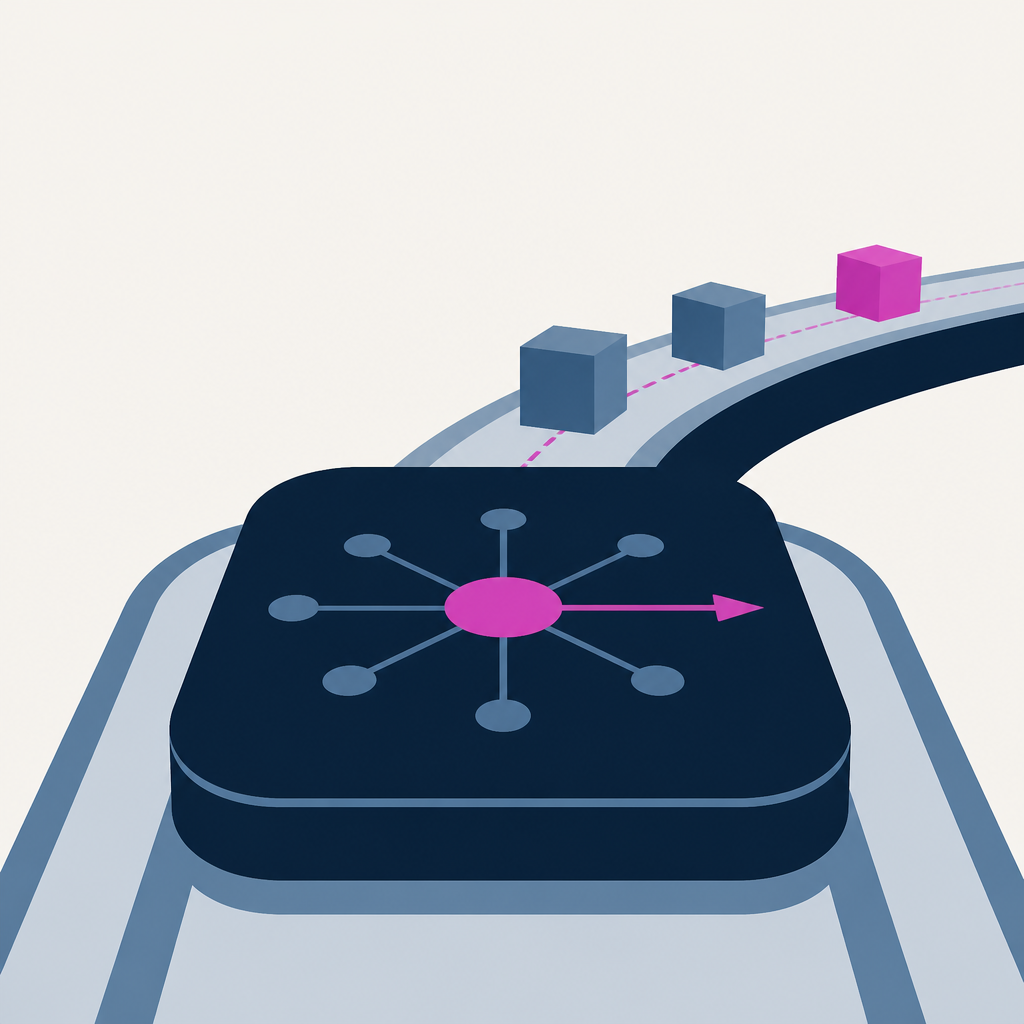
Companies building AI services struggle to price offerings because token consumption is unpredictable—subtle prompt variations and multi-agent systems produce different results and costs. Goldman Sachs forecasts token consumption will grow 24-fold to 120 quadrillion tokens monthly by 2030, while individual token prices keep falling, making long-term contracts impossible. Businesses face margin pressure as they pass volatile AI costs to customers, with no industry consensus yet on whether to charge per-token, per-result, or flat-rate models.
Vizard Agent is presented as a link to a discussion about using one AI agent for different kinds of video tasks. No specific numbers or dates are provided in the available text. The change is simply that readers are pointed to that discussion page, with no additional details included here.
Formula 1 deployed agentic AI on AWS to automate its MarTech data platform operations, replacing manual engineering workflows with autonomous agents that generate production-ready code and configurations. Data source onboarding time dropped from 6–8 weeks to approximately 40 minutes of code generation, with agents handling 95% of the work autonomously and also detecting and remediating upstream schema changes in hours instead of days. The platform now provides end-to-end visibility through unified data lineage, root cause analysis, and governed self-service access for analysts and scientists, eliminating fragmented logs and manual troubleshooting.
Microsoft Research released Orchard, an open-source framework with a reusable Kubernetes environment for training autonomous agents across software engineering, web navigation, and personal-assistant tasks. Orchard-SWE achieves 69.7% on SWE-bench Verified using only 3 billion active parameters, approaching systems with 10 times more parameters, while Orchard-GUI reaches 68.4% average success on web-navigation benchmarks. The release of training data, evaluation methods, and open infrastructure enables researchers to build agentic systems without proprietary sandboxes or closed pipelines.
The article’s discussion prompts readers to move beyond AI coding toward agentic software delivery. No date or number is provided in the text. It shifts the focus from AI coding assistance to building software using more autonomous “agentic” delivery approaches.
A data roundup reports that ChatGPT users are applying the tool to tasks outside their primary job roles, employees using AI for multiple use cases report twice the productivity gains compared to single-use adoption, and agentic AI patents grew 59% globally in the past year to represent 9% of all AI application patents. Companies in the AI supply chain value chain are outperforming the broader market, with Bloomberg's AI Value Chain companies beating earnings expectations by 71% versus 27% for the S&P 500 in Q2. The data suggests AI adoption is broadening across job functions and that infrastructure and supply chain companies are capturing disproportionate value from AI expansion.
Every AI story that matters,
in your inbox by 8am.
TLDRocket reads all relevant sources, removes duplicate coverage, and summarises the
day in two minutes. Follow companies and topics for alerts, or get the
briefing in Slack. Free, no spam, unsubscribe anytime.
Reading TLDRocket needs no cookies, and the readership counts we rely on come from
our own cookieless analytics. Google Analytics is the exception: it sets cookies and
reports to Google, so it stays switched off until you allow it. You can change your
mind any time from “Cookie settings” in the footer.
Strictly necessary
Session security and form protection (tldrocket-session,
XSRF-TOKEN, 2 hours). The site cannot work without them,
so they need no consent.
Always on
Google Analytics 4 (_ga,
_ga_<id>, up to 2 years). Measures which
stories and sections readers use. Google acts as a third-party processor and may
store the data outside the EU. No advertising, no profiling, no data sold.