
Trump’s AI protectionism has come for robotics
MIT Technology Review James O'Donnell ● Covered by 13 sources
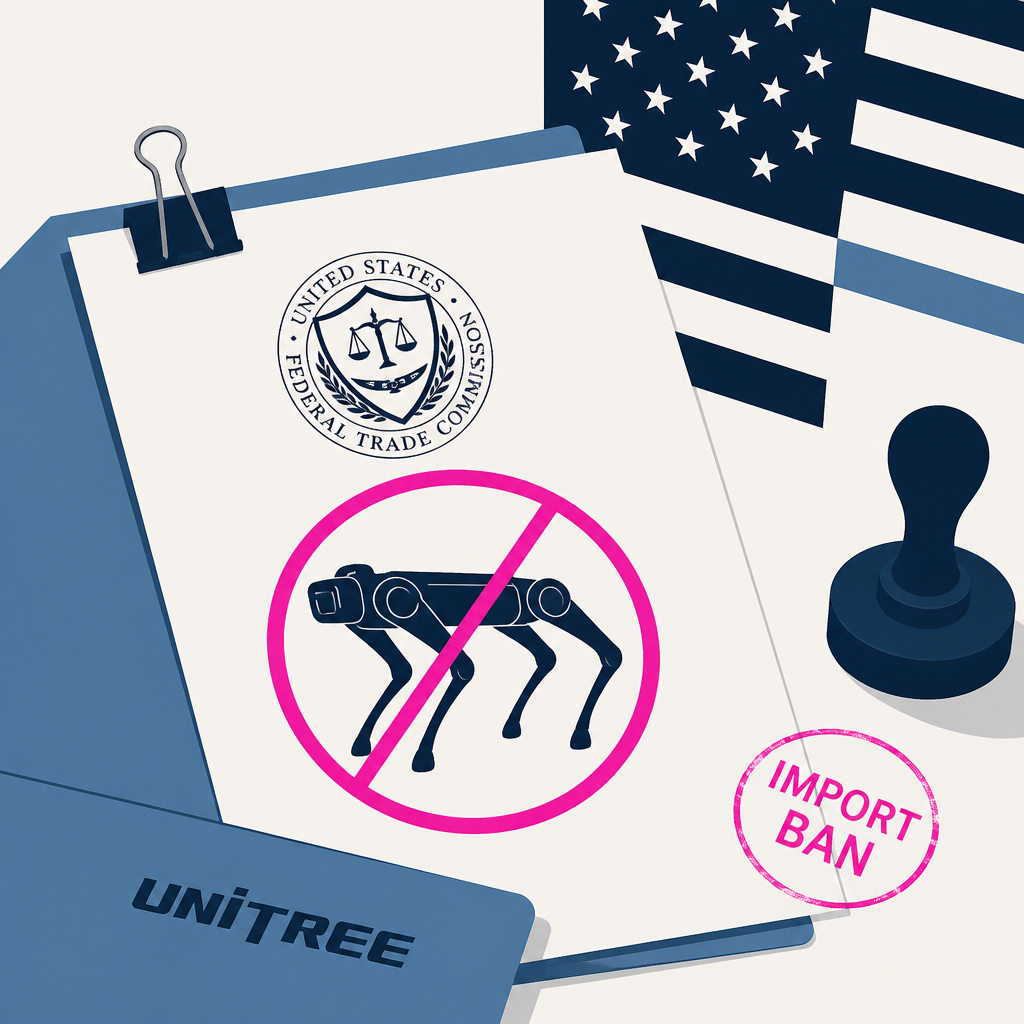
The FTC just banned imports of foreign advanced robots, including Chinese-made humanoids and quadrupeds. US labs run mostly on cheap Chinese robots for research, so this could backfire badly.
Based on reporting by MIT Technology Review, James O'Donnell — read the original for the full story.
Summary, retelling and take written by AI under human oversight; images are AI-generated illustrations. How we work · Report an error
Humanoid robots still trip over curbs and fumble simple tasks more often than they impress anyone, so it was jarring last week when the FTC — increasingly aligned with the Trump administration — issued a sweeping ban on foreign imports of advanced robots. That covers humanoids, quadrupeds, and wheeled robots. The stated reasoning splits two ways: these machines could hoover up sensitive data in homes and secure facilities, and US robotics firms need shielding from Chinese competition to build a sturdier domestic supply chain.
This isn't just a rerun of the tariff playbook the US has used on solar panels, EVs, and drones whenever China undercuts prices. Robotics now sits at the sharp edge of the broader AI industry, and the administration's posture toward AI overall has been getting more combative — it's reportedly weighing a ban on open-source Chinese models that often match offerings from OpenAI and Anthropic at a fraction of the cost, a move that would cost businesses an estimated $25 billion in annual savings. Seen that way, the robot ban isn't really about robots. It's a signal that Washington is willing to extend AI protectionism to a sector that's still finding its legs.
Some domestic players are cheering. Gavin Kenneally, who runs the quadruped-inspection company Ghost Robotics, points to real cybersecurity concerns — the FTC cited an incident where someone remotely hijacked 7,000 robot vacuum cleaners — and argues a more level playing field helps everyone. But the policy has an obvious hole in it. US robotics companies and university labs lean heavily on cheap Chinese hardware to actually do their research, building robot fleets that learn everything from flipping waffles to folding laundry. Aaron Prather of the Association for Advancing Automation says his group's internal review found that 90% of recent US robotics papers used robots made by Unitree, China's dominant humanoid maker, because nothing else matches its price-to-capability ratio. The math is stark: a four-legged Unitree robot runs around $4,600, while a similar Boston Dynamics unit can cost $278,000.
The two industries aren't remotely at the same stage. Unitree is going public this week aiming for a valuation near $6 billion, while Figure's humanoids haven't reached real scale and 1X still isn't shipping to homes. Meanwhile the technology keeps inching forward regardless of trade politics — Google released a new AI model last week meant to help humanoids pick up new tasks faster, and its headline trick was tying a trash bag shut, a small feat that's actually a big deal given how clumsy robot hands remain.
The FTC's order is riddled with carve-outs that make its real-world bite hard to predict. But the message underneath it is clear enough: the administration now treats humanoid robotics as a strategic technology worth defending, not a stage gimmick that occasionally faceplants. For an industry best known until recently for viral blooper reels, that's a genuine shift.
My take — AI-written commentary, not fact-checked reporting
Protecting an industry by cutting off the cheap hardware it actually builds on is a strange kind of protection — it looks more like slowing American robotics research to make a political point about China. If 90% of US papers depend on Unitree gear, banning it doesn't create a domestic champion overnight; it just leaves labs stuck buying $278,000 machines instead of $4,600 ones. Washington keeps treating AI competitiveness as something you can legislate into existence, when the actual gap is showing up in valuations, shipping robots, and who's already at scale.
Read more about this at: MIT Technology Review