
The U.S. wants to contain China’s AI. Silicon Valley keeps using it
Rest of World Paul Triolo ● Covered by 75 sources
Anthropic warns China is copying US AI models via 'distillation.' Meanwhile Mira Murati's new startup just built its own model partly on Chinese tech—and Apple's using Alibaba and Baidu AI in China.
Based on reporting by Rest of World, Paul Triolo — read the original for the full story.
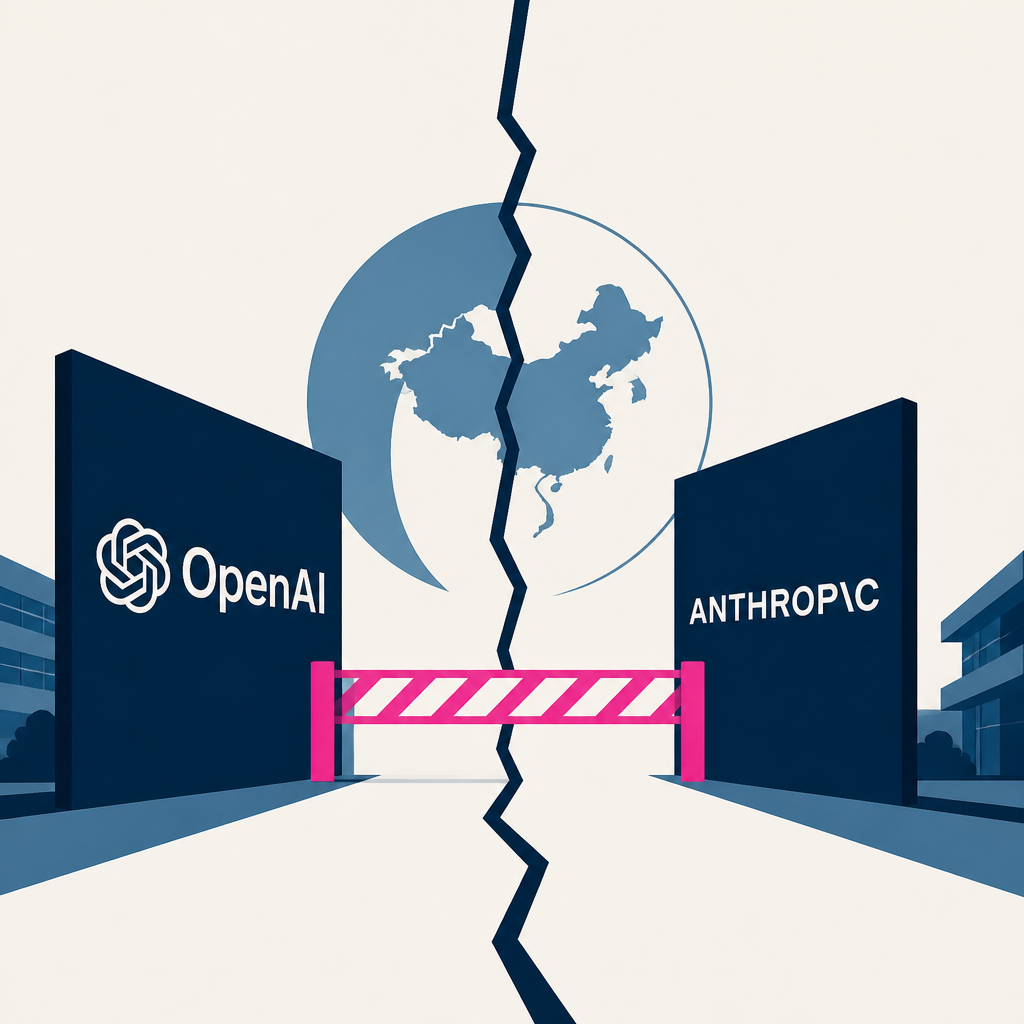
Summary, retelling and take written by AI under human oversight; images are AI-generated illustrations. How we work · Report an error
There's a delicious irony buried in AI's culture-war rhetoric this week. Anthropic's Tarun Chhabra, once an export-control architect under Biden, singled out China's Zhipu for allegedly distilling capabilities from American frontier models — a warning that slots neatly into Washington's preferred story about a one-way flow of innovation from Silicon Valley to Beijing. Hours later, Mira Murati's Thinking Machines, flush with $2 billion in funding and her OpenAI pedigree, revealed that its debut model, Inkling, leans on DeepSeek-V3's architecture and uses synthetic training data from Moonshot AI's Kimi K2.5. So much for the one-way street.
Distillation itself isn't some shadowy new weapon. It's a decade-old machine learning technique — a big teacher model generates outputs, a smaller student model learns to mimic them cheaply. Every major lab does some version of it now, from OpenAI and Google DeepMind to Alibaba and Tencent. What's changed is the politics: distillation has been rebranded, often carelessly, as something close to IP theft whenever a Chinese company is on the receiving end, even as American startups quietly do the exact same thing with Chinese open-weight models like Qwen, Hunyuan, and DeepSeek.
And the entanglement runs deeper than one startup's training pipeline. Apple just got Cyberspace Administration approval to ship Apple Intelligence in China running on Alibaba's Qwen and Baidu's Ernie — two companies the Pentagon has formally tagged as Chinese military-affiliated. That means iPhones carrying Chinese-government-approved models will be crossing borders in the pockets of ordinary travelers, while Washington simultaneously tightens API access and export rules around its own frontier labs.
The practical result is a policy contradiction nobody in DC seems eager to name. Export controls still work well on chips and fabrication equipment — you can physically block a shipment. They work far worse on research papers, open-weight checkpoints, and synthetic datasets that flow freely across the internet. Models like Zhipu's newly released GLM-5.2 are out there, openly licensed, with no meaningful gatekeeping, while American firms build ever-higher walls around Claude and GPT.
What's emerging isn't a single frontier that the US is racing to protect from a trailing rival. It's multiple frontiers, feeding off each other, with Chinese models increasingly functioning as core infrastructure rather than distant competitors to benchmark against. Guarding your own lab's outputs matters less when your own industry keeps reaching across the fence to borrow the neighbor's tools.
My take — AI-written commentary, not fact-checked reporting
I've said it before: export controls on chips make sense, export controls on ideas are theater. The minute a Silicon Valley darling like Thinking Machines builds its flagship model on DeepSeek and Kimi, the containment narrative collapses under its own hypocrisy. Washington should stop pretending it can wall off a research ecosystem that its own companies refuse to wall themselves off from, and start asking why Chinese open models got this good this fast.
Read more about this at: Rest of World
Related stories
 Silicon Valley Splits Over Closing the Borders to Chinese AI
The New York Times · 2 months ago ·
34
Silicon Valley Splits Over Closing the Borders to Chinese AI
The New York Times · 2 months ago ·
34