
How Chevron became the AI darling of Big Oil
Fortune Jordan Blum
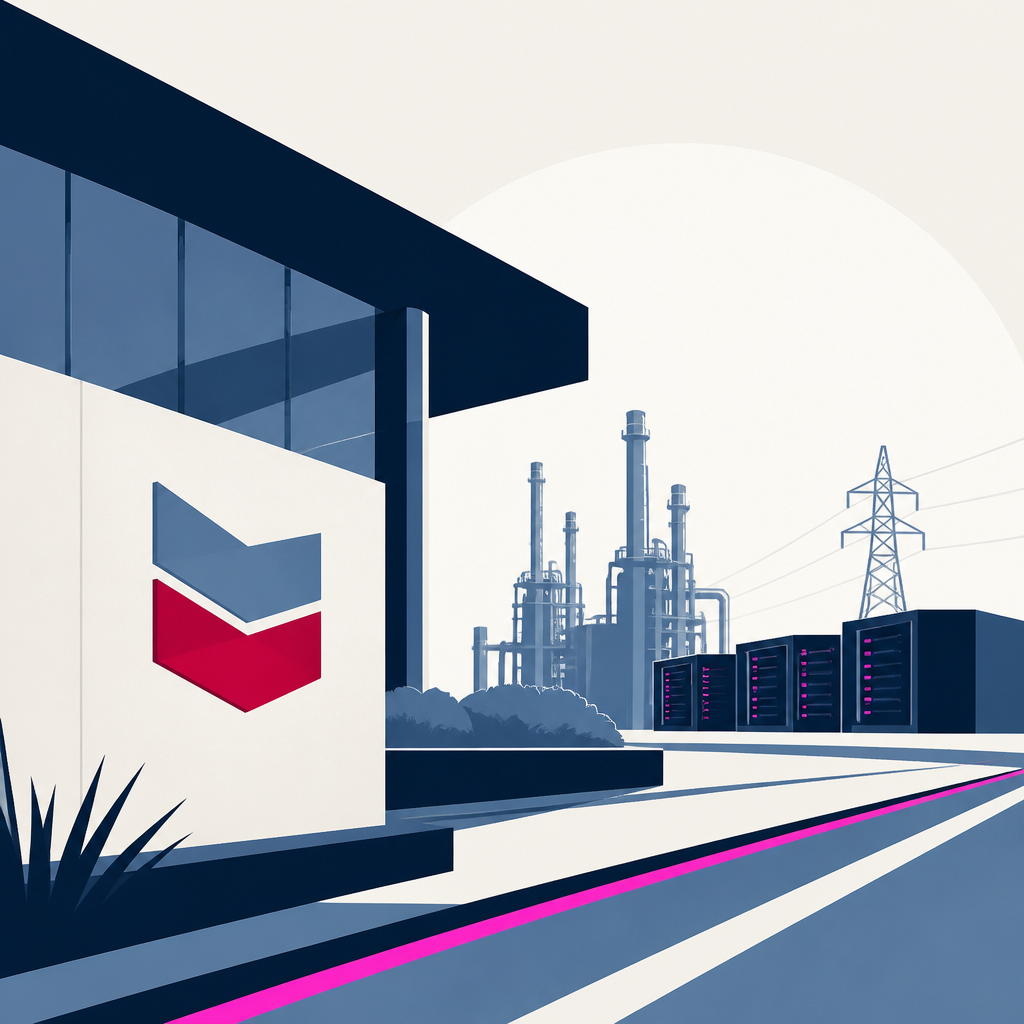
Chevron just locked in a 20-year deal to power Microsoft's AI data centers with natural gas in West Texas. It's the oil giant's first big hyperscaler deal, and rivals don't have customers lined up yet.
Based on reporting by Fortune, Jordan Blum — read the original for the full story.
Summary, retelling and take written by AI under human oversight; images are AI-generated illustrations. How we work · Report an error
Reeves County, Texas has about 4,000 households scattered across 2,600 square miles of dry, empty land. Soon it'll host enough gas-fired electricity to power more than 2 million homes, except none of that power is going to homes. It's all earmarked for Microsoft's data centers under a project Chevron calls Kilby, named after Jack Kilby, the Texas Instruments engineer who invented the microchip.
The numbers are big even by oil-industry standards. The deal runs 20 years and delivers 2.67 gigawatts of natural gas power, with room to add solar and batteries later. Chevron is bringing the land and the gas; Texas Pacific Land is chipping in more land and water services; Engine No. 1 is providing financial backing; and the hardware includes at least seven large GE Vernova turbines plus several smaller Caterpillar Solar Titan 350 units. Kilby is supposed to come online in 2028 and scale up through 2031. Chevron New Energies president Jeff Gustavson says the reaction since the June announcement has been immediate — turbine makers, contractors, and other hyperscalers are suddenly eager to talk, because Chevron just proved it can assemble land, gas, equipment and an actual paying customer in one package.
That wasn't always the plan. Gustavson says Microsoft spent years talking mainly about renewable power, an area Chevron doesn't consider a core strength, so the oil company sat in on early AI-power discussions without landing deals. The shift happened roughly two years ago, once it became clear the U.S. grid couldn't keep up with hyperscaler demand and rising consumer electricity prices became a political headache. Natural gas suddenly became the answer everyone wanted to discuss.
West Texas made obvious sense as the starting point. Chevron is the second-largest producer in the Permian Basin behind ExxonMobil, the region has abundant gas, plenty of open land, a deregulated power market, and — as Gustavson puts it — a state government that's easier to work with. Chevron reserved turbine equipment a year and a half ago, well before the deal was public. Even Texas Governor Greg Abbott's recent freeze on new data-center grid interconnections doesn't touch Kilby, since it's built behind the meter with its own dedicated power rather than pulling from the shared grid.
Chevron's rivals in this space are mostly still assembling pieces. OpenAI's Stargate campus is behind schedule, and other proposed Texas mega-projects from Fermi, Pacifico Energy and Energy Abundance don't have signed customers yet. Exxon, the only company with comparable scale, has leaned toward carbon capture technology for data centers rather than leading its own power projects. Chevron, meanwhile, is eyeing expansion into the Rockies, the Eagle Ford Shale in South Texas, and Midwest states like Ohio, Illinois and Indiana for future hyperscaler deals, with CEO Mike Wirth signaling on a late-July earnings call that Permian production could grow further if it means landing more agreements like Kilby.
My take — AI-written commentary, not fact-checked reporting
Big Oil finally found a growth story that doesn't require pretending to be a renewable-energy company, and hyperscalers finally admitted the grid can't save them. Chevron didn't win this by being greener than Exxon; it won by being faster and more willing to just build gas plants where the gas already is. Expect a scramble among energy companies to copy this playbook, and expect climate promises to keep quietly sliding down the priority list while everyone chases AI power demand.”
Read more about this at: Fortune
Related stories
 Amazon backs power plant that may become top source of US climate pollution
Ars Technica · 1 month ago ·
35
Hyperscalers might regret embracing natural gas if new forecast proves correct
TechCrunch · 1 month ago ·
17
Amazon backs power plant that may become top source of US climate pollution
Ars Technica · 1 month ago ·
35
Hyperscalers might regret embracing natural gas if new forecast proves correct
TechCrunch · 1 month ago ·
17
 Data centers can be good citizens. It’s why we’re partnering with Google and Nvidia to create the AI Energy Management Alliance
Fortune ·
20
Data centers can be good citizens. It’s why we’re partnering with Google and Nvidia to create the AI Energy Management Alliance
Fortune ·
20