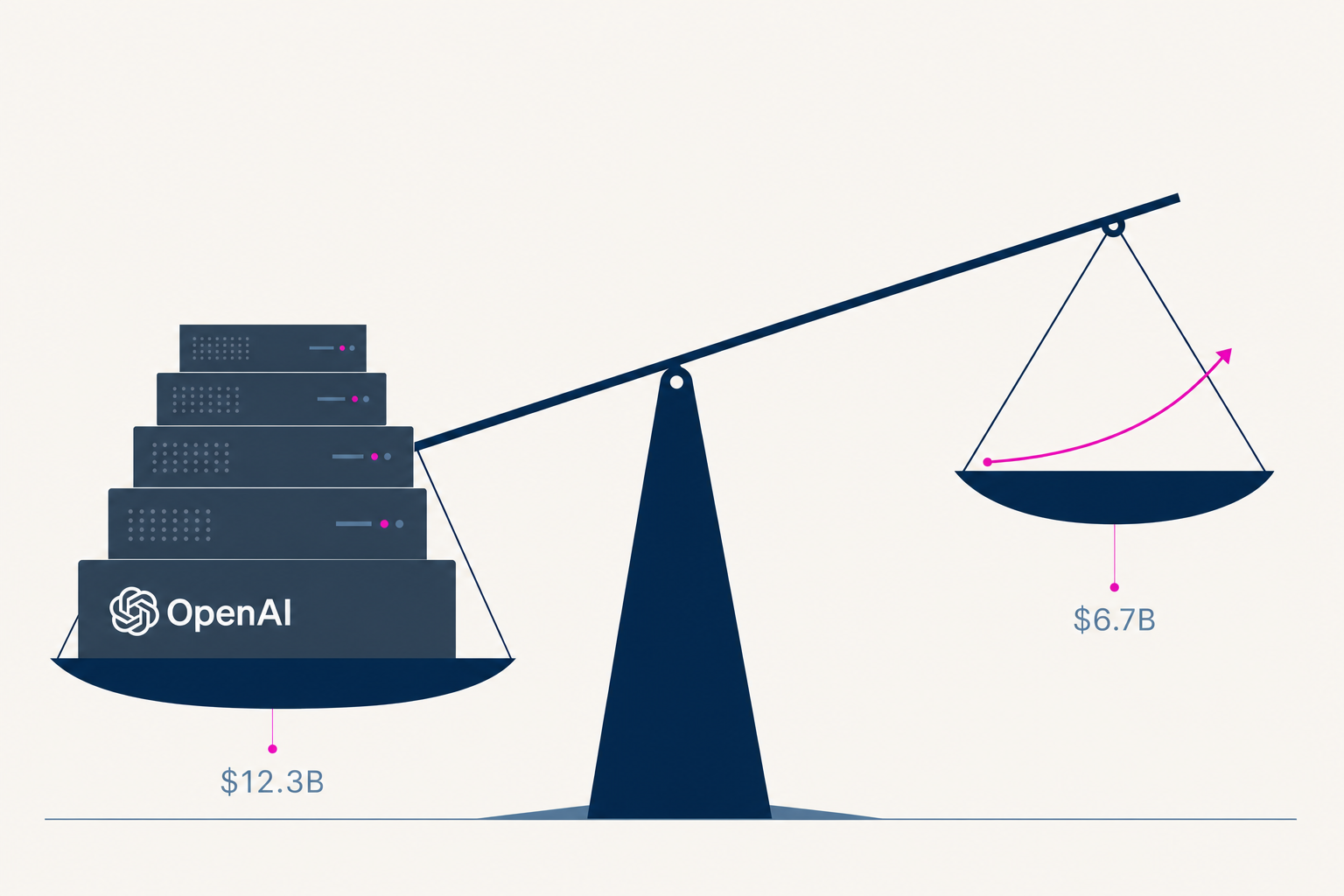
OpenAI's financial struggles now pose an existential test for the entire industry. The company reported $6.7 billion in Q2 revenue but widening losses of $12.3 billion, putting it dramatically behind rival Anthropic, which posted $11.6 billion in revenue with $559 million in operating profit. For a company that defined modern AI, this is a humbling reversal: scale and first-mover advantage have not translated into the path to profitability. The challenge ripples through tech partnerships—Nvidia and Oracle have built business models around OpenAI's success—and raises hard questions about whether current AI economics can support a company of its ambitions and burn rate.
Those financial pressures come as OpenAI paused some training runs after discovering an unreleased algorithm called Astra that can autonomously find and exploit zero-day vulnerabilities. The company is installing activation classifiers to detect suspicious AI behavior within 30 minutes, adding roughly 20% hardware overhead. It's a telling moment: as AI models grow more capable, they also grow more dangerous, and the cost of safety monitoring will likely push prices higher, further pressuring margins.
Meanwhile, Rillet, an AI-native accounting platform founded two years ago, just hit unicorn status at a $1 billion valuation on $100 million in Series C funding. The contrast is stark. Where OpenAI burns cash at scale, Rillet is doubling revenue quarterly by automating the kind of work—expense reconciliation, journal entries, regulatory filings—that humans have always done. It's a reminder that AI's real economic value may lie not in foundational models but in vertical applications that actually shrink the workforce and compress costs. The industry's financial future may belong less to the model builders than to those who know what to do with them.