
Hugging Face Blog
·
3 weeks ago
Researchers examined mathematical theory, evolutionary biology, competitive markets, and machine learning to explain why specialized AI systems consistently outperform generalist ones. The 1997 Wolpert-Macready theorem proved no single algorithm performs best across all problems, meaning resources directed at specific tasks outperform resources spread across unlimited tasks. As AI systems scale, specialization remains advantageous because concentrating capacity on bounded task sets achieves higher performance than distributing capacity broadly, regardless of increases in compute.
TheSequence
·
3 weeks ago
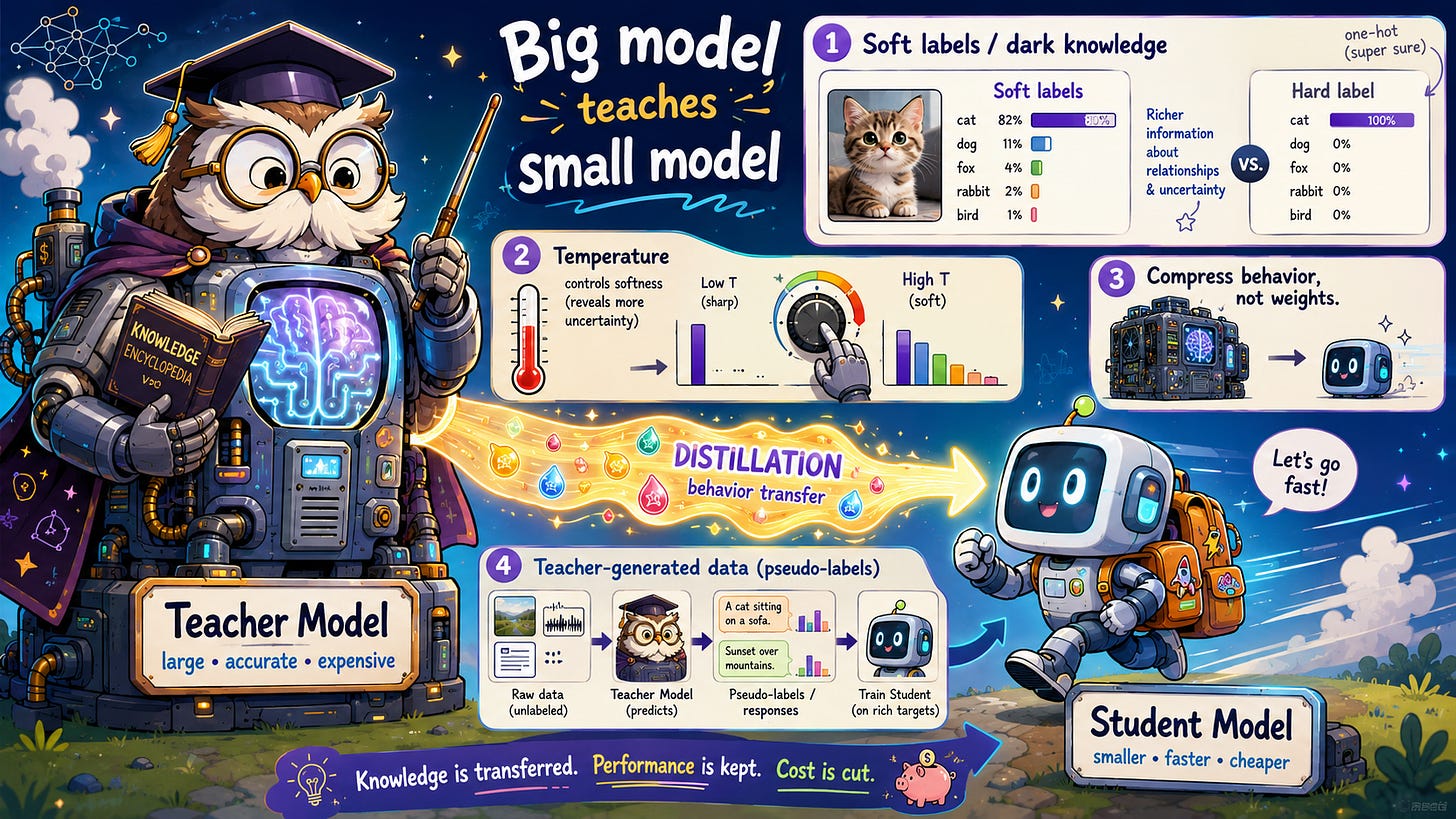
Knowledge distillation trains a smaller, cheaper model to learn from a larger model's predictions rather than training directly on raw data. The approach involves having a high-capacity teacher model generate outputs that a smaller student model learns to replicate, combining both the original dataset and the teacher's interpretations. This enables deployment of faster and cheaper models that retain more capability than they would achieve through standard training alone.

TLDR
·
3 weeks ago
This article argues that technological progress has stagnated, with society having exhausted major innovations and left only engineering drudgery, while AI is currently useful mainly for software engineering rather than constituting broad progress. The author cites examples like a founder spending 3 hours manually fixing AI's debugging work after the system spent days in circles, and notes that AI-powered enterprise tools show unclear value beyond token costs. The shift going forward requires founders to become skilled operators tackling hard problems like enterprise complexity and hardware supply chains, rather than commoditized software solutions.

Google Research
·
3 weeks ago
Google introduced TabFM, a foundation model that applies zero-shot in-context learning to tabular data classification and regression tasks, eliminating the need for manual hyperparameter tuning and feature engineering. The model was trained on hundreds of millions of synthetically generated datasets and evaluated on TabArena spanning 51 datasets with up to 150,000 samples, consistently outperforming tree-based algorithms like XGBoost. TabFM will be integrated into Google BigQuery as an AI.PREDICT SQL command, allowing users to generate predictions on new tables in a single forward pass without machine learning expertise.

Together AI
·
3 weeks ago
Together AI published nine research papers at ICML 2026 spanning AI agent development, model reasoning techniques, and inference optimizations across the full ML stack. Key results include DSGym evaluating data-science agents across 1,000+ tasks, Aurora achieving 1.25× speedup through adaptive speculative decoding in production, and ParallelKernelBench establishing the first multi-GPU kernel generation benchmark with 87 workloads. These advances enable faster inference, better reasoning without verifiers, and more efficient use of GPU resources for frontier AI systems.
OpenAI Blog
·
3 weeks ago
GeneBench-Pro is a new benchmark for testing AI systems on genomics and biology tasks using real-world datasets. The benchmark evaluates performance across complex scientific research problems in these domains. Organizations can now measure how well AI models handle actual genomic data rather than simplified test cases.
