
Grok Voice 3.0 from SpaceXSI outscores OpenAI and Google on speech-to-speech index
SiliconANGLE Duncan Riley ● Covered by 2 sources
SpaceXSI shipped Grok Voice 3.0 for its voice agents. It tops a speech-to-speech ranking, but OpenAI still wins one tough test.
Based on reporting by SiliconANGLE, Duncan Riley — read the original for the full story.
Summary, retelling and take written by AI under human oversight; images are AI-generated illustrations. How we work · Report an error
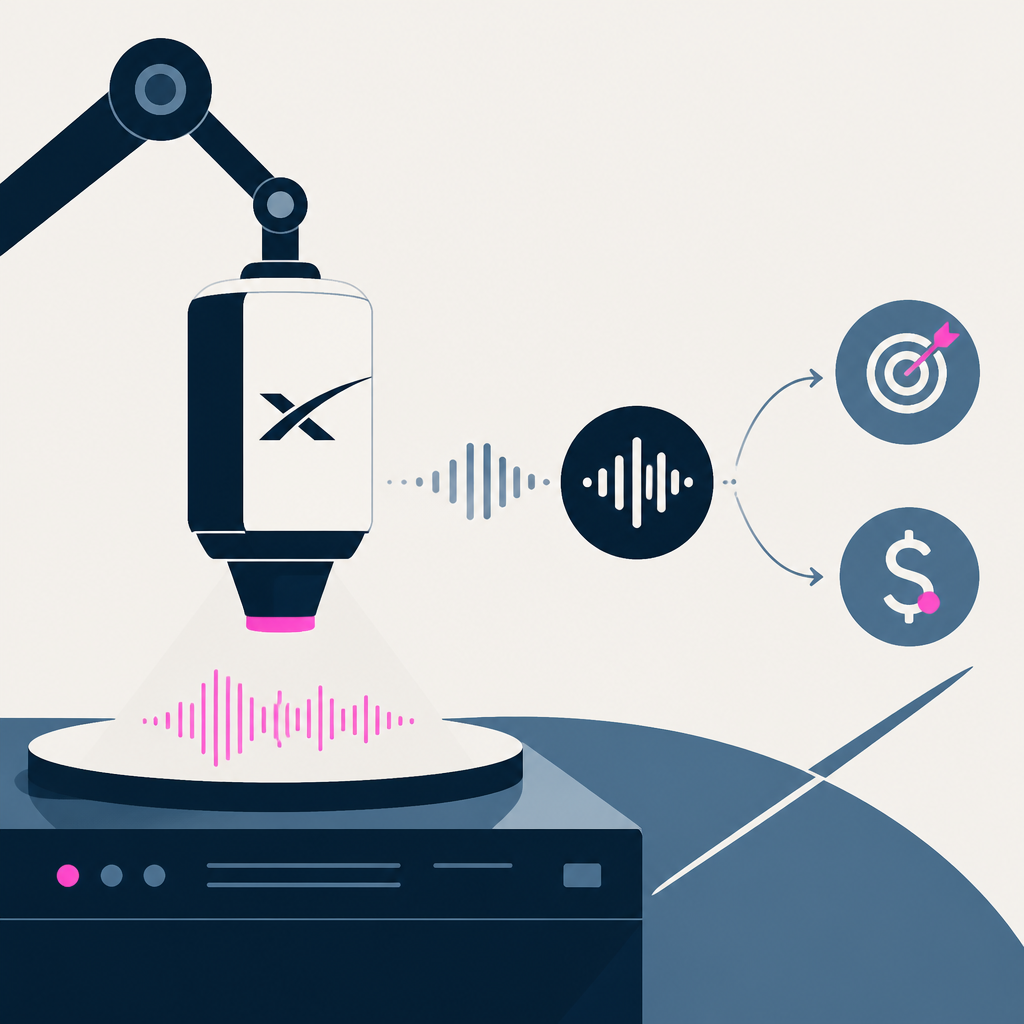
SpaceXSI has rolled out Grok Voice 3.0, the latest speech-to-speech model behind its Voice Agent API, and it is pitching the system squarely at customer support and sales calls. The company, formerly xAI, says the model is already in production across some big, noisy places where voice bots either work or embarrass themselves quickly.
Independent tester Artificial Analysis put Grok Voice 3.0 at the top of its Speech-to-Speech Index with a score of 86.9. OpenAI Group PBC’s GPT-Live-1 came next at 83.2, while Google LLC’s Gemini 3.8 Live scored 82.6. The ranking mixes reasoning tests, task success, and listener votes from blind head-to-head calls, so this is not just a popularity contest dressed up as math.
The new Grok model also posted 97% on Full Duplex Bench, which looks at how naturally a system handles pauses and interruptions. But OpenAI kept a narrow edge on Tau-Voice, the benchmark built around support calls with heavy accents and background noise: 74.5% versus Grok’s 71.6%. SpaceXSI says its model reached first audio about 40% faster on that test. Cost matters too, and here Grok Voice 3.0 is cheaper than both rivals in Artificial Analysis’ Big Bench Audio run at about 2.5 cents per task, versus 3 cents for GPT-Live-1 and 5.5 cents for OpenAI’s GPT-Realtime-2.1.
There’s a separate signal from ServiceNow Inc.’s open-source EVA-Bench, where Grok Voice 3.0 led on accuracy across more than 200 enterprise scenarios and no model did better when accuracy and customer experience were combined. ServiceNow senior director of product management Nitin Aggarwal said it “pairs top accuracy with a natural, responsive conversation.” SpaceXSI also says Tesla Inc. vehicles already generate millions of Grok Voice conversations a day, while Starlink handles about 20,000 customer calls daily in several languages, with roughly 70% resolved without a human and one in four sales calls ending in a purchase before hang-up.
The model is available now in the Voice Agent API at eight cents a minute, or $4.80 an hour, the same price as Grok Voice 2.0. Developers using the grok-voice-latest alias have already been moved over automatically, which is the nicest kind of upgrade: the one that happens before anyone can complain about it.
My take — AI-written commentary, not fact-checked reporting
This is the usual AI business trick: win the benchmark, quote the benchmark, and hope the call center sounds less like a hostage tape. The more interesting bit is that SpaceXSI is talking about real deployment and pricing, not just leaderboard confetti. That’s where voice AI will get judged, and most vendors still sound like they’ve been trapped in a subway station.
Read more about this at: SiliconANGLE
Related stories
 SpaceXAI Releases Grok Voice Transcribe 2.0: A Speech-to-Text API Claiming 2x Accuracy Over 1.0 at $0.10 per Hour
MarkTechPost · 3 weeks ago ·
8
SpaceXAI Releases Grok Voice Transcribe 2.0: A Speech-to-Text API Claiming 2x Accuracy Over 1.0 at $0.10 per Hour
MarkTechPost · 3 weeks ago ·
8
 [AINews] SpaceXAI Grok 4.6 and Grok @Bot
Latent Space · 2 months ago ·
39
Grok 4.6: SpaceXAI Pushes Back Into the Top Tier
Trending Topics · 2 months ago ·
11
[AINews] SpaceXAI Grok 4.6 and Grok @Bot
Latent Space · 2 months ago ·
39
Grok 4.6: SpaceXAI Pushes Back Into the Top Tier
Trending Topics · 2 months ago ·
11