
Microsoft Research
·
3 weeks ago
Microsoft researchers developed Memora, a memory system for AI agents that separates what is stored (rich content) from how it is retrieved (lightweight abstractions and cue anchors) to balance detail preservation with efficient scaling. Memora achieved state-of-the-art performance on LoCoMo and LongMemEval benchmarks while reducing token consumption by up to 98% compared to full-context inference and halving the memory entries needed versus Mem0. The system enables AI agents to maintain detailed project histories and context over long-horizon tasks without repeatedly re-reading entire conversation histories.

Hugging Face Blog
·
3 weeks ago
● 2 sources
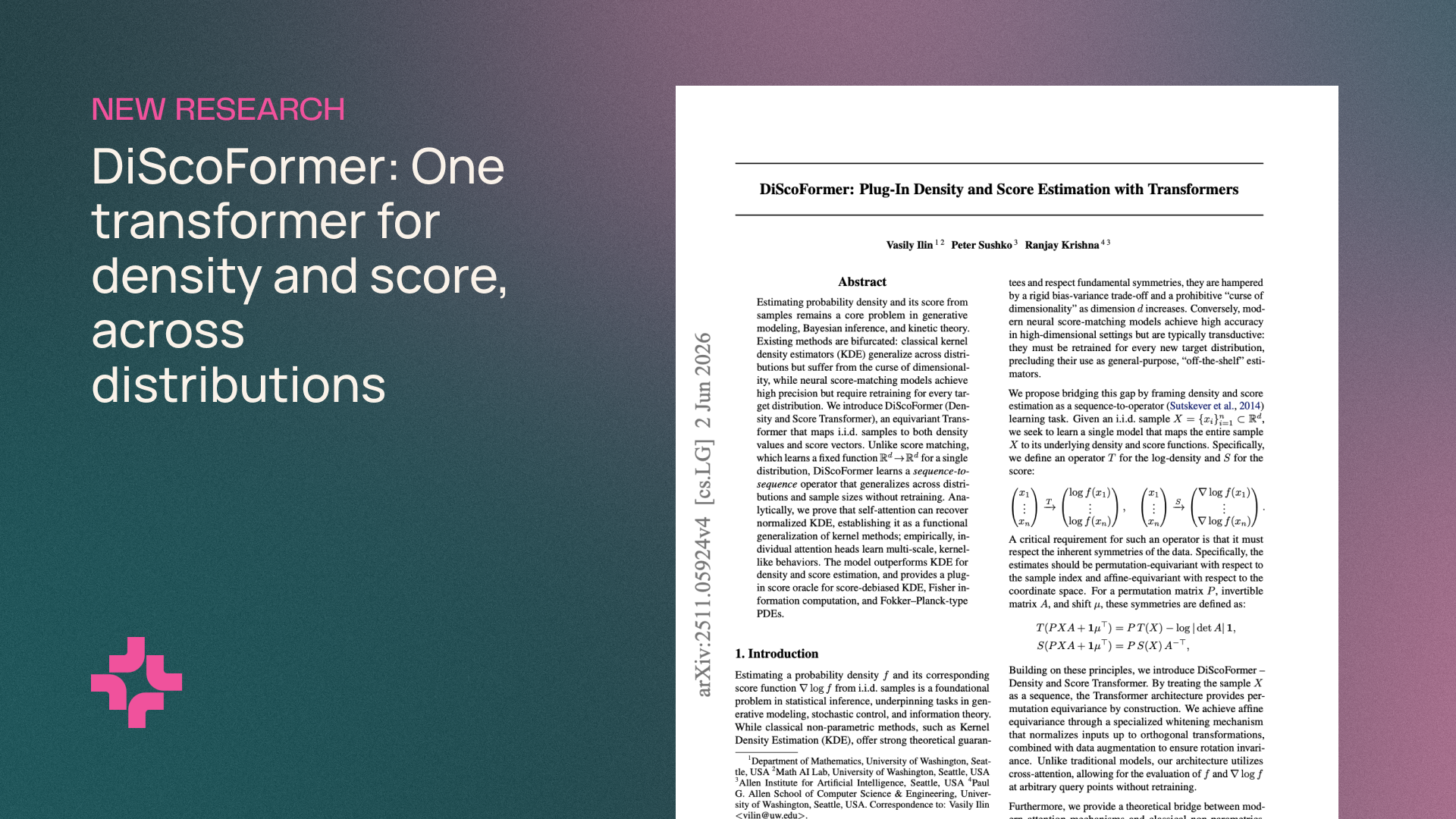
Researchers at Google DeepMind introduced DiScoFormer, a transformer model that estimates both the probability density and score (gradient of log-density) of a distribution from a set of data points in a single forward pass without retraining. In 100 dimensions, DiScoFormer reduces score estimation error by 6.5x and density estimation error by more than 37x compared to kernel density estimation while continuing to improve with more samples. The model enables a single pretrained estimator to work across different problems in generative modeling, Bayesian inference, and scientific computing, eliminating the need to retrain for each new distribution.
Allen Institute (AI2)
·
3 weeks ago
● 2 sources
Researchers introduced DiScoFormer, a transformer-based model that estimates both the probability density and score (gradient of log-density) of a distribution from data in a single forward pass without retraining. In 100 dimensions, DiScoFormer achieved 6.5x lower score error and 37x lower density error compared to kernel density estimation while continuing to improve with more samples. The model generalizes across different distribution types and could reduce computational costs for generative modeling, Bayesian inference, and scientific computing by serving as a reusable estimator.
