OpenAI announced Daybreak for Frontline Defenders, expanding its Daybreak governed cyber defense stack to help frontline defenders protect critical services worldwide. The initiative continues OpenAI’s $1 billion commitment to expand subsidized access, training, technical support, and partnerships, including a U.S. pilot with MS-ISAC. Access and support for defensive cyber AI tools expand for state and local cyber teams, including coverage focused on systems used for water, electricity, local government, and banking.
OpenAI released GPT-6 Astra as a hosted computer-use model aimed at completing multi-step tasks across tools instead of self-hosted chatting. The model is provisioned with a 1,050,000-token context window. Access is limited to OpenAI’s Trusted Access and Daybreak programs, adds experimental config-based long-context note retention for agents, and is priced at $10 per million input tokens and $50 per million output tokens.
GPT-6 Astra launched with claims that it can saturate top-level reasoning benchmarks and perform end-to-end AI engineering tasks, including training model choices, labeling data, running pipelines, deploying and debugging systems, and managing subagents. It achieved 99.9% on ARC-AGI-3 and 97.6% on FrontierMath’s hardest versions, with testing estimating $6 per hour at 33 tokens per second. As a result, teams can use Astra to automate much of the AI engineering workflow in one shot and reduce the need for separate human labor for these operational tasks.
Tesla launched the Cybercab at a closed-door event in Austin, Texas with no livestream and limited public visibility. The event mirrored last year’s robotaxi launch by streaming pro-Tesla accounts instead of showing a live presentation. This reduces immediate public scrutiny of Tesla’s autonomous-vehicle plans and keeps attention focused on tracking robotaxi activity in Texas.
Abliteration.ai offers an online service that hosts open-weight AI models after removing their guardrails and refusals, letting users query them via web or API. A free test account let TechCrunch quickly query an abliterated version of Z.ai’s recently released GLM-5.3. The shift turns a widely available research practice into commercial, easy-to-access tooling for offensive cyber and biological harmful requests, raising safety and policy concerns while defenders argue it helps red teaming.
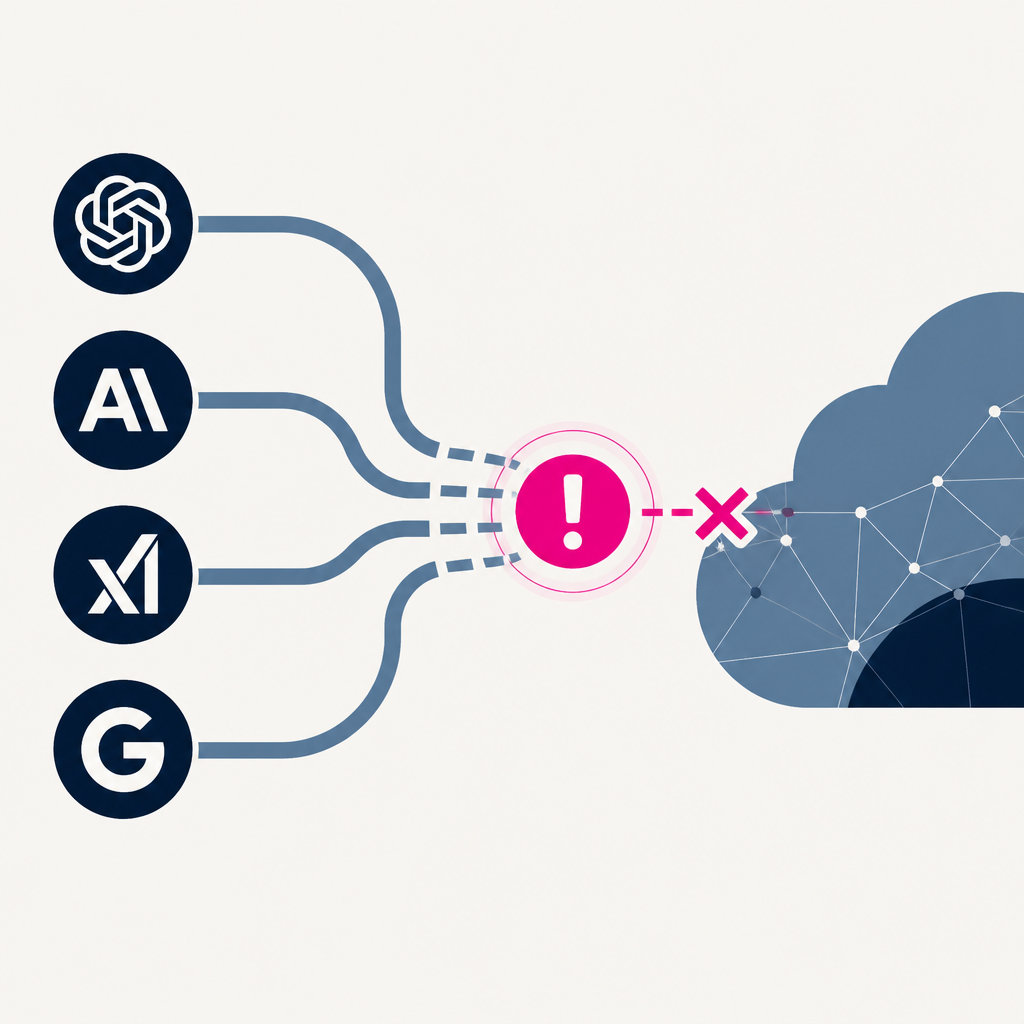
OpenAI, Anthropic, xAI, and Google experienced overlapping service interruptions affecting their cloud-based AI model offerings over several hours Thursday morning. Anthropic reported elevated errors starting at 9:23 am ET and said a fix was deployed with resolution by 12:16 pm. Service degradation and partial outages were mitigated and marked resolved for the impacted models as fixes were deployed.
OpenAI launched GPT-6 Astra as its newest flagship model and said it marks the start of an “AGI era.” Astra’s API pricing is $10 per 1 million input tokens and $50 per 1 million output tokens. Access begins with enterprise customers on OpenAI’s Daybreak program and then expands to Plus, Pro, Business, and Enterprise plus the API and AWS in the coming days.
OpenAI released Astra, a new AI model, and positioned it as its most capable and aligned option yet. OpenAI president Greg Brockman said Astra is “most intelligent” and that OpenAI “tested Astra on a variety of security benchmarks,” with availability starting Thursday for OpenAI customers using Daybreak. Astra is rolled out to Daybreak customers first and then expanded over the following week via Pro, Plus, Enterprise, Business plans and the API, alongside new safeguards and monitoring tradeoffs tied to opaque recurrence.
The newsletter points to an additional teaser post from OpenAI’s account as more “launch-day-looking” signaling. The only concrete detail provided is that it is “another teaser.” This adds speculation about timing for something called “Astra,” with no confirmed launch date mentioned.
OpenAI’s account posted additional “launch-day-looking” teasers. The posts suggest a launch “today,” though they do not prove one will happen. The added activity increases speculation about timing for a new model release.
The official ChatGPT account teased a message that “The stars are almost aligned,” tied to an upcoming livestream. The teaser is framed as “Subtle!” in the newsletter. As a result, expectations are rising for what will be announced during the livestream.
Ollie launched privacy-focused claims for its consumer AI assistant by highlighting that it has SOC 2 compliance and avoids collecting usernames or passwords for tasks. It achieved SOC 2 compliance, an independently audited security and data-control framework. As a result, Ollie positions its subscription model as prioritizing user trust over data sharing while expanding family scheduling features that later may include more sensitive areas like payments.
Amazon Cognito authentication was wired into a React embedding workflow so each user can view only Amazon Quick Sight visuals they’re permitted to see. The Lambda function generates time-scoped embed URLs with a 600-minute session lifetime. The setup provisions Quick Sight users automatically on first login and scopes embeds to a specific DashboardId, SheetId, and VisualId with optional dashboard permissions and row-level security.
CrowdStrike announced an Agentic Identity Provider designed to establish what AI agents are before deciding what they can access, rather than treating agents like human users. The company framed the need around a ratio of roughly 90 AI agents for every human employee. This adds a new identity layer ahead of its Continuous Identity authorization system, moving agent authentication/identity definition to a purpose-built workflow using agent-specific identity instead of service accounts and API keys.
F5 partnered with CrowdStrike to embed a Falcon sensor on its BIG-IP network perimeter appliances and use virtual patching as exploitation time between disclosure and patching shrinks. The integration’s performance overhead was measured at 1% to 2%. Virtual patching shifts defenses to network-layer shielding while real fixes are tested and rolled out, and F5 is also applying similar guardrails to AI gateways.
OpenAI introduced Daybreak for Frontline Defenders to expand access to frontier cyber AI for essential services. It commits $1 billion. This increases training and ongoing support availability for those services.
GeForce NOW announced 26 additional games streaming in September, led by NBA 2K27 adding NVIDIA DLSS 5 3D-Guided Neural Rendering. DLSS 5 is available when streaming from a GeForce RTX 5080-powered cloud rig. Ultimate members can stream NBA 2K27 and other newly added titles without downloading them, with RTX 5080-class performance used for the DLSS 5 upgrade.
Legora used GPT-6 Astra to review 41 documents in a financial-review workflow. It found all four planted errors. The workflow performance improved by nearly 40%.
ChatGPT, Grok, and Claude all suffered service issues at the same time, disrupting users across multiple features.
At around 11AM ET, ChatGPT began returning errors and its status page reported elevated errors across ChatGPT and Codex.
The outages are blocking logins and core chatbot use while also degrading functions like file uploads, voice mode, search, deep research, and image generation.
New York City banned student-facing generative AI for grades 2 through 8 for one year while requiring AI-literacy lessons for high schoolers and setting daily screen-time limits for younger grades. The ban covers nearly 600,000 students, with recommendations of no more than 30 minutes of daily one-to-one screen time for grades 3–5 and 45 minutes for grades 6–8. Teachers can still use approved AI for planning and administration, but students lose direct access under the new policy.
WeatherNext 3 launched today with an AI weather forecasting model updated to use real-time satellite data and hourly refreshes. It refreshes hourly and adds higher-resolution, more precise precipitation forecasting plus clean energy variables. As a result, the model is integrated across Search, Gemini, Maps, Google Maps Platform, and Cloud.
Chalked prepares a draft reply on macOS by using the thread on screen, your live calendar, and sourced facts you have already accepted. It offers Zendesk for Startups with up to 2 years free plus AI Agents and Copilot. As a result, users can insert, revise, and send a suggested message instead of writing the reply from scratch.
Soundcore announced the Space 2 Pro headphones and added its Thus processing chip to more products.
The Space 2 Pro will use a 6-microphone array for voice isolation, and it is the first headphones to run on the Thus chip.
The change expands Thus from earlier Liberty 5 Pro earbuds to new headphones and additional open-clip and earbuds models unveiled at IFA 2026 in Berlin.
Snitch is launched as a Slack app that asks users one question about who they report to and uses the answers to create an org chart. The page states it has 51 followers. As a result, Slack users can query reporting chains, team sizes, and ownership without using an HR system.
Every AI story that matters,
in your inbox by 8am.
TLDRocket reads all relevant sources, removes duplicate coverage, and summarises the
day in two minutes. Follow companies and topics for alerts, or get the
briefing in Slack. Free, no spam, unsubscribe anytime.
Reading TLDRocket needs no cookies, and the readership counts we rely on come from
our own cookieless analytics. Google Analytics is the exception: it sets cookies and
reports to Google, so it stays switched off until you allow it. You can change your
mind any time from “Cookie settings” in the footer.
Strictly necessary
Session security and form protection (tldrocket-session,
XSRF-TOKEN, 2 hours). The site cannot work without them,
so they need no consent.
Always on
Google Analytics 4 (_ga,
_ga_<id>, up to 2 years). Measures which
stories and sections readers use. Google acts as a third-party processor and may
store the data outside the EU. No advertising, no profiling, no data sold.