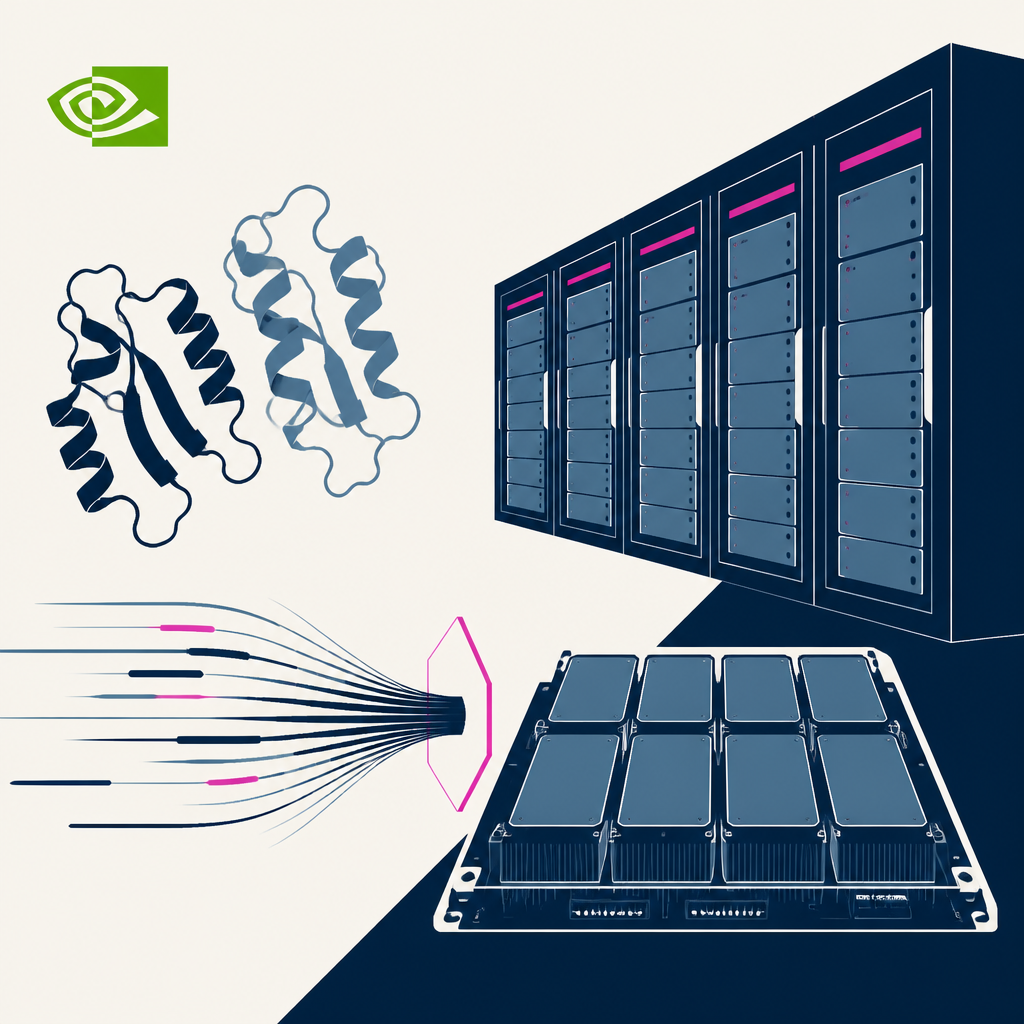
NVIDIA released BioNeMo Inference Runtime (BioIR), a Python library that speeds up supported protein-structure prediction inference on NVIDIA GPUs while keeping the standard PyTorch workflow. In a matched benchmark on 8xH100 for 1,000 human dimers, BioIR delivered 58.5K successfully folded residues per GPU-hour versus 20.2K for an open-source torch-compiled Boltz-2 implementation. The throughput improves by 2.90x on this dataset and hardware, and NVIDIA estimates energy for 1 million comparable targets drops from 35 MWh to 11 MWh (8-GPU TDP equivalent).
Nvidia CEO Jensen Huang said Nvidia expects its AI-related revenue growth to continue through next year despite rising GPU competition. He reiterated a forecast of 70% year-over-year revenue growth for next year. Nvidia’s guidance implies the company is positioning for sustained demand across AI labs and systems, including GPUs and data-center infrastructure, rather than expecting a slowdown.
Texas begins test flights under a new federal program for electric, hybrid-electric, and autonomous aircraft led by Joby, Beta, and Wisk. The first project starts today and runs for the next week. These flights create early public evidence of future routes before the governing rules are finalized.
Nvidia and Palantir announced they are applying their “sovereign AI” partnership inside Nvidia by fine-tuning a supply-chain AI model for Nvidia’s own operations. The fine-tuned Nvidia Nemotron 3.5 Lightning uses 30B parameters and it achieved 86.7% accuracy versus 55.5% for a 550B Nemotron model (about 18 times larger). Nvidia says this demonstrates specialization on a focused task and plans to extend the approach to other industries while letting customers train and run tailored versions with data and weights kept under their control.
Every AI story that matters,
in your inbox by 8am.
TLDRocket reads all relevant sources, removes duplicate coverage, and summarises the
day in two minutes. Follow companies and topics for alerts, or get the
briefing in Slack. Free, no spam, unsubscribe anytime.
Reading TLDRocket needs no cookies, and the readership counts we rely on come from
our own cookieless analytics. Google Analytics is the exception: it sets cookies and
reports to Google, so it stays switched off until you allow it. You can change your
mind any time from “Cookie settings” in the footer.
Strictly necessary
Session security and form protection (tldrocket-session,
XSRF-TOKEN, 2 hours). The site cannot work without them,
so they need no consent.
Always on
Google Analytics 4 (_ga,
_ga_<id>, up to 2 years). Measures which
stories and sections readers use. Google acts as a third-party processor and may
store the data outside the EU. No advertising, no profiling, no data sold.