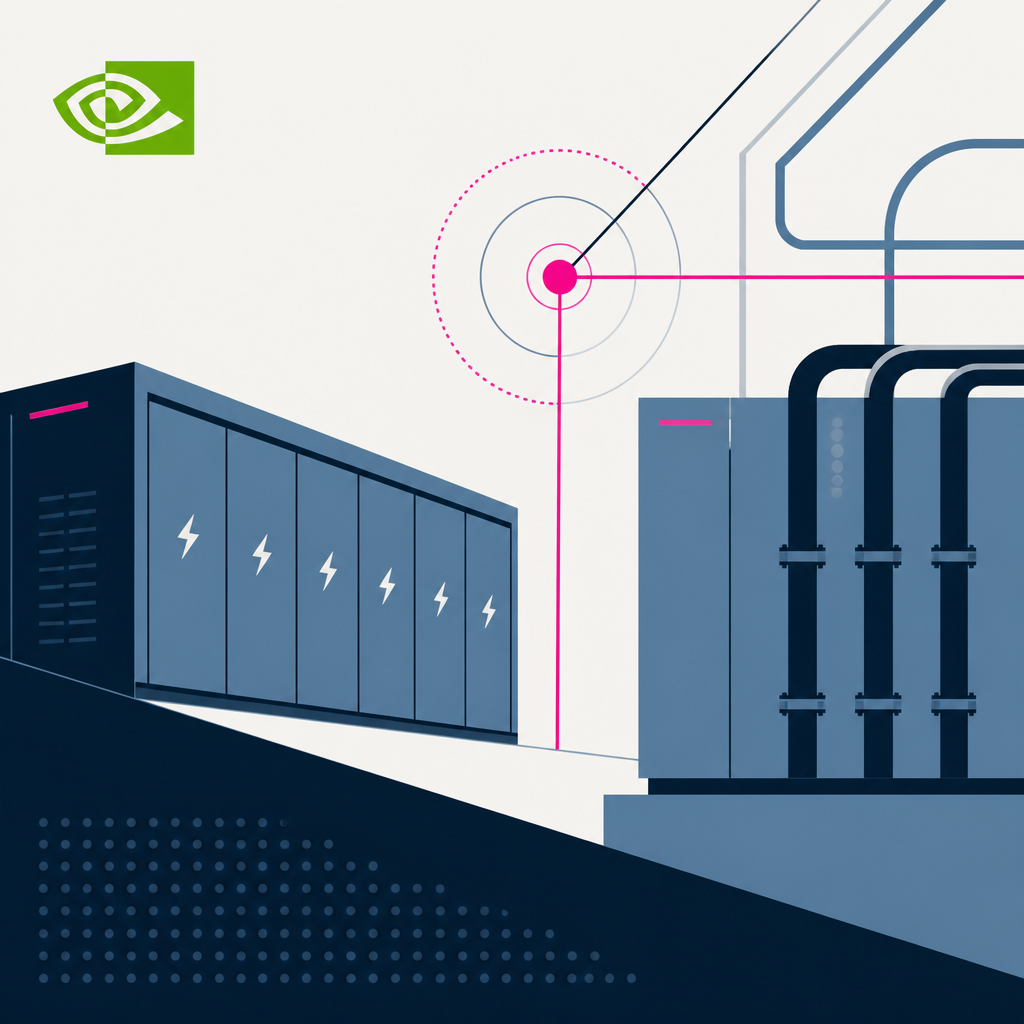
NVIDIA launched NVIDIA DSX Ready to qualify partner power and cooling products against NVIDIA DSX AI factory reference design requirements. It starts with two categories: battery energy storage systems (BESS) and cooling distribution units (CDUs). The program gives builders clearer qualified “building blocks” to reduce integration risk and helps partners demonstrate category-specific compliance.
Huawei unveiled its next Ascend AI accelerators, including Ascend 960DT for training and Ascend 960PR for inference, plus the Atlas 960E SuperPoD system that can link up to 4,096 chips as one machine. The training chip, Ascend 960DT, targets delivery in Q1 2027 with 2 PFLOPS at FP8 and 288 GB of HBM. As a result, Huawei shifts toward agent-style AI workloads with higher compute, memory, and networking demand while also positioning its multi-chip systems to narrow performance gaps versus Nvidia’s Rubin, though vendor-cited peak benchmarks still lag at chip level.
Nscale filed its IPO prospectus with the SEC and plans to list on the NYSE under ticker NSCL, with details of how its AI compute business is built on largely undelivered contracts and concentrated customer and supplier relationships. It is targeting an about $30 billion valuation, after a $14.6 billion valuation in its latest $2 billion private round. Investors’ focus shifts toward delivery conditions, funding for remaining capacity, and whether financing and prepayment-driven cash flow can sustain operations through the build-out.
NVIDIA is promoting five clean-energy companies that use NVIDIA AI tooling to speed research, operations, and grid or power system integration. ThinkLabs, which uses NVIDIA CUDA for grid digital twins, reduced interconnection application evaluation time from 30–45 days to two minutes. As a result, utilities and energy operators can iterate faster and deploy solutions sooner, ranging from faster grid interconnections and nuclear operations support to AI-assisted off-grid power and digital twins for advanced reactors and fusion systems.
Nvidia’s planned free AI model is set to expand the UAE’s reliance on U.S.-aligned software on top of Nvidia chips. The model is due by the end of the year for anyone to download for free. The UAE’s approach to AI sovereignty is likely to shift from avoiding imported models toward using Nvidia’s open weights layer alongside or instead of its own Falcon-only strategy.
Every AI story that matters,
in your inbox by 8am.
TLDRocket reads all relevant sources, removes duplicate coverage, and summarises the
day in two minutes. Follow companies and topics for alerts, or get the
briefing in Slack. Free, no spam, unsubscribe anytime.
Reading TLDRocket needs no cookies, and the readership counts we rely on come from
our own cookieless analytics. Google Analytics is the exception: it sets cookies and
reports to Google, so it stays switched off until you allow it. You can change your
mind any time from “Cookie settings” in the footer.
Strictly necessary
Session security and form protection (tldrocket-session,
XSRF-TOKEN, 2 hours). The site cannot work without them,
so they need no consent.
Always on
Google Analytics 4 (_ga,
_ga_<id>, up to 2 years). Measures which
stories and sections readers use. Google acts as a third-party processor and may
store the data outside the EU. No advertising, no profiling, no data sold.