Reflection AI launched Beam, an open-weight sparse Mixture-of-Experts model for agentic coding and long-horizon software tasks. Beam has 501 billion total parameters, with 23 billion active parameters per forward pass. The release adds new options to deploy Beam on AWS—using SageMaker JumpStart or Kubernetes-native SageMaker HyperPod Inference—and to choose BF16, FP8, or NVFP4 checkpoint formats with corresponding memory and scaling tradeoffs.
Muse launched the Muse Wonder model series on October 12 and promoted it as near Claude Fable 5.1 on agent and memory tasks, then a head-to-head test compared their outputs using OpenRouter (Muse Wonder) and Anthropic’s API (Fable 5.1). In the long-session memory test, Muse scored 25 of 25 while Fable scored zero due to cyber-category refusals that blocked much of the work. As a result, the author concludes Muse Wonder can match Fable on some agentic debugging and memory completion, but is often more expensive and Fable 5.1 is still cheaper and generally more accurate for these tests unless Fable’s safeguards block the job.
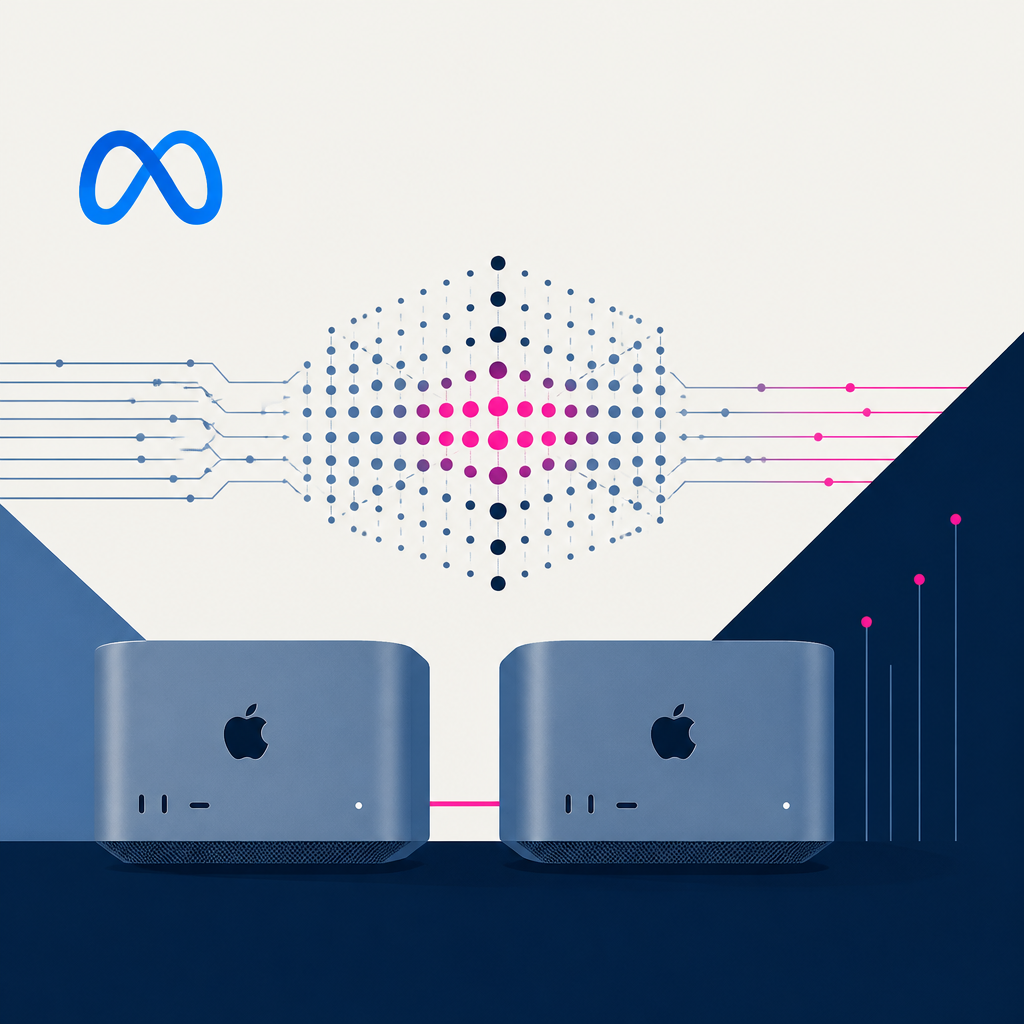
Meta unveiled Muse Spark Open, an open-weight AI model with 816 billion parameters built to run on consumer hardware. In its benchmarks, Meta reports running it on two paired M5 Ultra Mac Studios while activating 42 billion parameters per token. The release expands Meta’s open-weights options with a model architecture and hardware pairing aimed at making large-scale inference more accessible.
Meta Superintelligence Labs released Muse Spark Open, the open-weight version of its Muse Spark model, with support for text plus image, video, and audio inputs. The model is 816B parameters total and has a 1M-token context window. Developers can deploy it on multiple engines and hosted APIs, with hardware options ranging from 2 Apple M5 Ultra Mac Studios (via MLX) to data-center setups using NVFP4 on Blackwell Ultra or H200 GPUs.
AI4Bharat and NVIDIA released Nemotron-pretraining-Indic-v1 and an open GPU-accelerated synthetic data generation pipeline for 22 Indian languages. The corpus is approximately 2.8 trillion tokens and includes 2,601.0 billion native-script tokens plus 224.6 billion romanized tokens. Model builders can now reuse the data and the full prompt/quality/repair recipe to scale Indic pretraining and expect improved benchmark performance on Nemotron 3.5 Super VL after adding an Indic continued-pretraining stage.
Reflection’s new open model Beam has been released on Hugging Face as a text-only Mixture-of-Experts LLM with end-to-end inference, fine-tuning, and reinforcement-learning recipes. It has 501B total parameters with 23B active per token and a 1M-token context window, released under the Apache 2.0 license. This enables teams to run and customize a frontier-scale model on their own hardware or cloud with Beam-specific tooling and downstream support, plus a $10,000 Hub-credits prize for top shared projects.
Every AI story that matters,
in your inbox by 8am.
TLDRocket reads all relevant sources, removes duplicate coverage, and summarises the
day in two minutes. Follow companies and topics for alerts, or get the
briefing in Slack. Free, no spam, unsubscribe anytime.
Reading TLDRocket needs no cookies, and the readership counts we rely on come from
our own cookieless analytics. Google Analytics is the exception: it sets cookies and
reports to Google, so it stays switched off until you allow it. You can change your
mind any time from “Cookie settings” in the footer.
Strictly necessary
Session security and form protection (tldrocket-session,
XSRF-TOKEN, 2 hours). The site cannot work without them,
so they need no consent.
Always on
Google Analytics 4 (_ga,
_ga_<id>, up to 2 years). Measures which
stories and sections readers use. Google acts as a third-party processor and may
store the data outside the EU. No advertising, no profiling, no data sold.