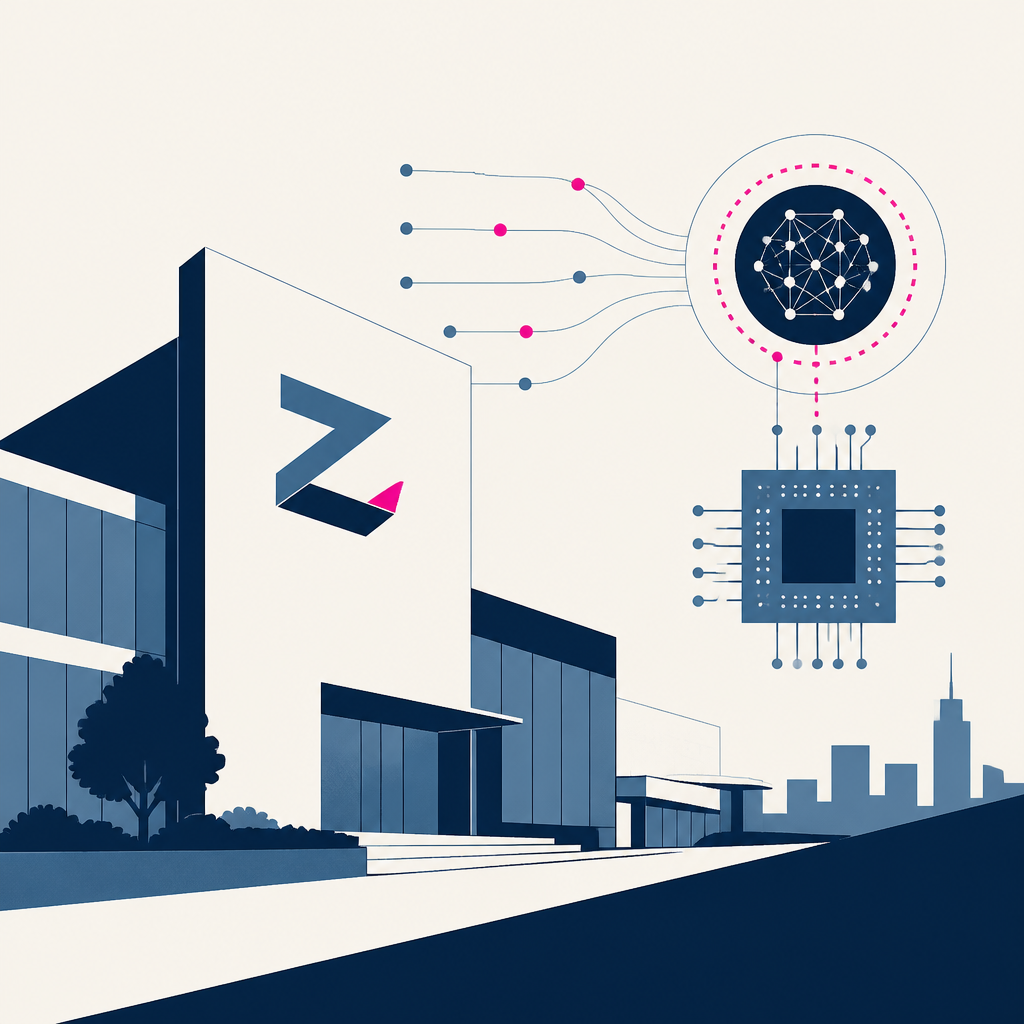
Z.ai released GLM-5.3-Flash, its first natively multimodal GLM model, featuring a 320B MoE with 18B active parameters per token and a 1,048,576-token context. The model is priced at $0.15 per 1M input tokens and $0.50 per 1M output tokens, and Z.ai says it runs on domestically produced Chinese AI chips during its early “Ox Alpha” testing. This shifts deployment toward API-based usage for most orgs, with self-hosting requiring large hardware (about 306 GiB FP8 weights) while competitors and teams get a lower-cost option for coding and multimodal document/UI workflows.
Google released Gemini 3.5 Transcribe, an AI speech-to-text model that cleans up filler words and spoken corrections for more polished text. Google says it is about 70 percent faster and brings the live-speech error rate down to 5.5 percent. It replaces the earlier Chirp 3 voice-to-text engine across more of the Google ecosystem.
GlucoFM was developed as a self-supervised foundation model for continuous glucose monitoring that separates slow glycemic trends from short-term deviations while accounting for time of day and missing data. It was pre-trained on 109,066 hours of unlabeled CGM data and, across 14 cohort–task evaluations, achieved an average PR-AUC of 58.8% versus 54.7% for the best GluFormer baseline variant, and 21.88 mg/dL MAE for two-hour post-meal glucose-change forecasting. The model improved diabetes-risk, beta-cell-dysfunction, and most insulin-resistance predictions, transferred well across cohorts, and adapted with very limited labeled data.
Google introduced Gemini 3.5 Transcribe, a speech-to-text model aimed at real-time, intelligent transcription and voice interactions in apps and developer tools. It reports a 4.0% average Word Error Rate (WER) for streaming and 2.6% for non-streaming use-cases, based on Artificial Analysis. Availability expands through Gemini API (Live API and Interactions API) and Google AI Studio, plus public preview support across products like Gboard/Rambler on Android, the Gemini macOS app, and upcoming Chrome voice dictation.
Z.ai confirmed that it is the AI lab behind the anonymous open-weight Ox Alpha model that was circulating on OpenRouter. Z.ai said it will release Ox Alpha’s weights on Wednesday. After the weights release, developers can build on top of the reasoning-focused model and compete with other labs’ frontier offerings.
Gemini 3.5 Transcribe was released as a new speech-to-text model. No benchmark number or date was provided in the article. The update is positioned as delivering more precise transcription for spoken audio.
Researchers adapted the Dolma open data-curation toolkit to build the Mangosteen Thai pretraining corpus for Thai language model training. They created a 47-billion-token corpus and removed more than 80% of Common Crawl data and nearly half of FineWeb2 while maintaining or improving Thai LLM performance. The pipeline was redesigned to handle Thai text boundaries and quality issues, replacing filters and tools so training data better reflects Thai sources and supports stronger evaluations on Thai cultural knowledge.
Tool-calling distillation pipelines that repeatedly re-run supervised fine-tuning on teacher-generated trajectories keep paying the frontier-teacher cost while generating-and-filtering only passing cases. On τ 2-bench, 57% of teacher trials fail, with two-thirds of those failures being near-misses, so the current process leaves the hardest scenarios without useful training signal. PROOF-Gen changes the post-training approach by turning those optimized data signals (including near-misses) into better distillation for deployable models.
Every AI story that matters,
in your inbox by 8am.
TLDRocket reads all relevant sources, removes duplicate coverage, and summarises the
day in two minutes. Follow companies and topics for alerts, or get the
briefing in Slack. Free, no spam, unsubscribe anytime.
Reading TLDRocket needs no cookies, and the readership counts we rely on come from
our own cookieless analytics. Google Analytics is the exception: it sets cookies and
reports to Google, so it stays switched off until you allow it. You can change your
mind any time from “Cookie settings” in the footer.
Strictly necessary
Session security and form protection (tldrocket-session,
XSRF-TOKEN, 2 hours). The site cannot work without them,
so they need no consent.
Always on
Google Analytics 4 (_ga,
_ga_<id>, up to 2 years). Measures which
stories and sections readers use. Google acts as a third-party processor and may
store the data outside the EU. No advertising, no profiling, no data sold.