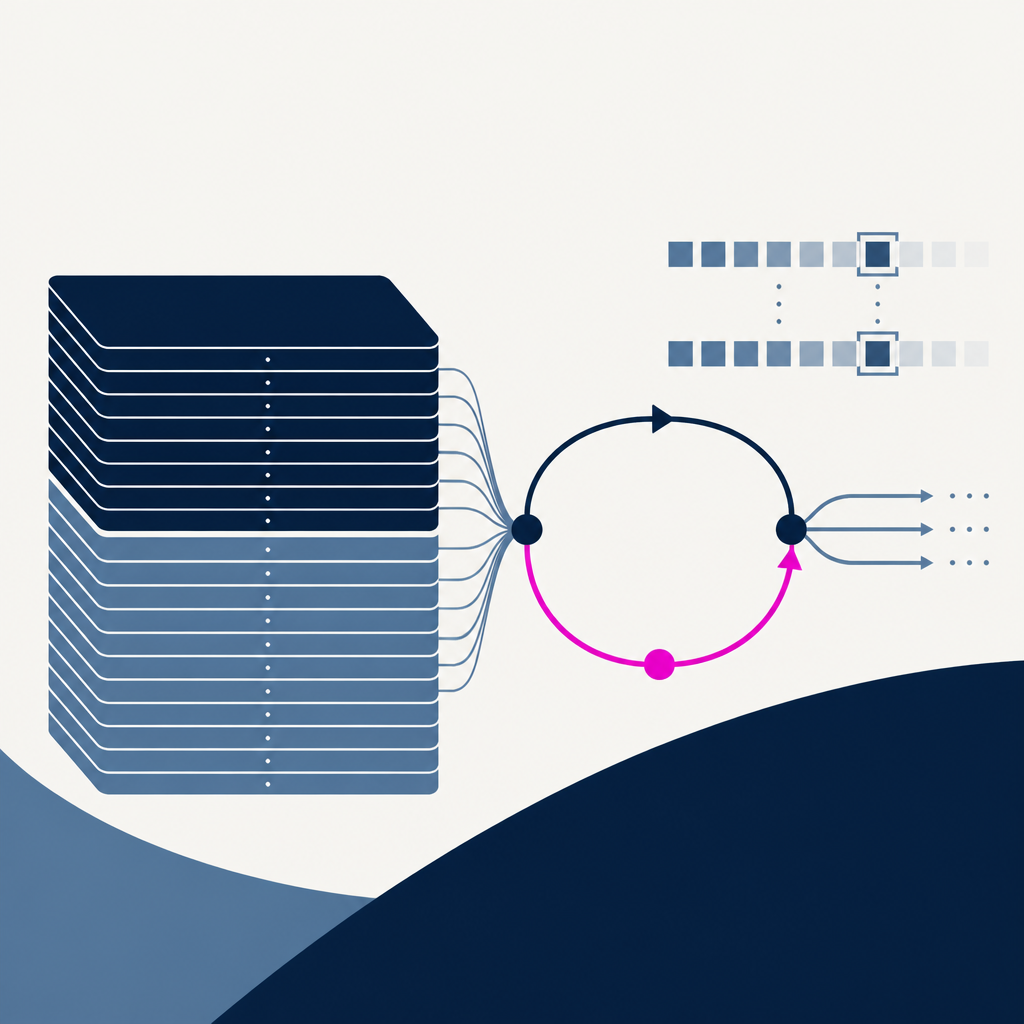
The Fly Language Model paper coupled a fixed MaleCNS connectome (as a reservoir) to a frozen 1.17-billion-parameter language backbone and trained only a 278,528-parameter readout. On 32 newly held-out conversations, negative log-likelihood dropped by 0.0222 nats per target token versus the frozen model, but a parameter-matched direct-input readout did slightly better (by +0.000488 nats per token for the fly model). The authors conclude the connectome measurably changes predictions yet does not outperform the simpler matched control, and they release conversational-training code while not releasing the archive or fitted readouts.
nftechie published a GitHub repository for a frozen-language-model setup using the MaleCNS v1.0 fly connectome and a separately trainable readout adapter. It retains 166,700 nodes and 25,582,938 directed connections while the adapter has 278,528 parameters and the adapter-only training updates next-token scoring. The project changes usage by enabling fully local training and chat via provided Python scripts (no API key or hosted inference) and saving outputs to runs directories without overwriting completed runs.
FLM (fly-language model) presents a language model idea built using fly neurons. It uses 166,700 fly neurons. The result is a tiny language model that gives imperfect replies once prompted.
Yifan Zhang at Princeton proposes a Recurrent Looped Transformer (RLT) that carries the decoder’s final hidden state and layerwise sliding-window attention cache from token t into the next token t+1, with no reset at the prompt–response boundary. The reference design uses 48 encoder and 48 decoder layers, yielding 96 logical blocks per token and a state path depth of 48t after t tokens. The write-up provides an architecture and training/serving specification but reports no measured efficiency, reasoning quality, or scaling results, leaving those validation questions open.
Every AI story that matters,
in your inbox by 8am.
TLDRocket reads all relevant sources, removes duplicate coverage, and summarises the
day in two minutes. Follow companies and topics for alerts, or get the
briefing in Slack. Free, no spam, unsubscribe anytime.
Reading TLDRocket needs no cookies, and the readership counts we rely on come from
our own cookieless analytics. Google Analytics is the exception: it sets cookies and
reports to Google, so it stays switched off until you allow it. You can change your
mind any time from “Cookie settings” in the footer.
Strictly necessary
Session security and form protection (tldrocket-session,
XSRF-TOKEN, 2 hours). The site cannot work without them,
so they need no consent.
Always on
Google Analytics 4 (_ga,
_ga_<id>, up to 2 years). Measures which
stories and sections readers use. Google acts as a third-party processor and may
store the data outside the EU. No advertising, no profiling, no data sold.