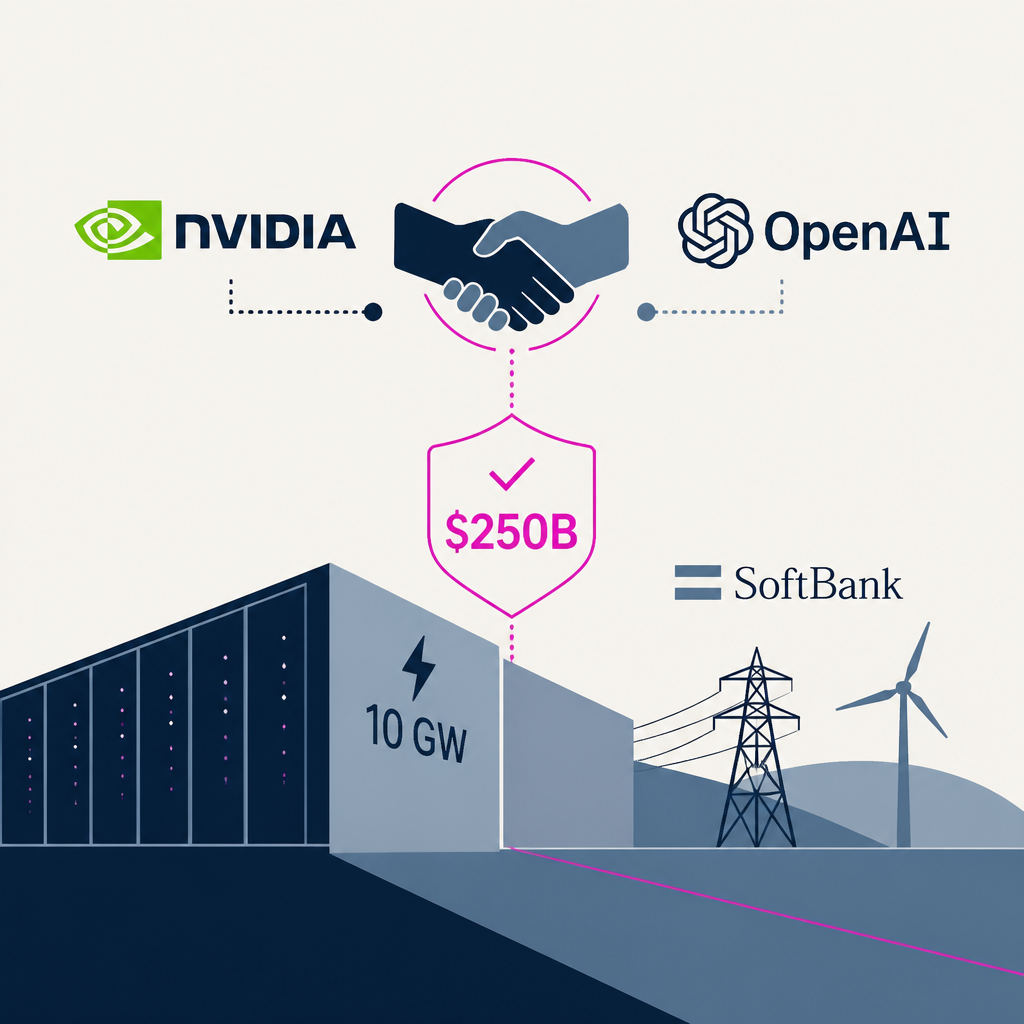
Nvidia is reportedly in talks to backstop a $250 billion loan for OpenAI's new data center campus in Ohio, which would be developed by SoftBank's SB Energy unit. The Ohio campus is expected to provide 10 gigawatts of computing capacity, with the total project cost potentially exceeding $500 billion when GPU chips are included. If the deal closes, OpenAI will have massive computing infrastructure ready for Nvidia's next-generation chips launching in 2027 and 2028, and SoftBank's planned IPO of SB Energy could gain significant investor momentum.
Verizon announced a $1 billion deal to connect Google data centers using dark fiber and revealed plans to convert central offices into AI inference data centers as part of a new "AI Connect" business initiative. The company expects to announce additional AI-related deals worth multiple billions of dollars in revenue over the coming years by end of 2026. The strategy positions Verizon to capture demand for data center connectivity and edge computing infrastructure needed for AI applications requiring low latency.
Safe Superintelligence, Ilya Sutskever's AI safety startup, announced a long-term partnership with Nvidia that includes an investment worth multiple billions. The deal grants SSI access to Nvidia's Vera Rubin GPU platform, expanding its compute resources by an order of magnitude. SSI can now scale its research into alignment and safe superintelligence without the commercial pressures that other AI labs face.
The Wall Street Journal·3 months ago·
57
● 3 sources
Nvidia is negotiating to provide a $250 billion financing guarantee for OpenAI's data-center infrastructure needs, specifically to enable OpenAI to lease a 10-gigawatt facility being developed by SoftBank's energy subsidiary. The $250 billion backstop represents the scale of computing resources needed for OpenAI's operations. The arrangement would allow OpenAI to secure massive computational capacity while Nvidia strengthens its position as the critical hardware supplier underlying major AI infrastructure projects.
Chinese RAM manufacturer CXMT debuted on the Shanghai stock exchange with shares surging 466 percent on its first trading day. The company's valuation reached $484 billion, making it the most valuable Chinese-listed firm on the exchange. CXMT aims to compete with Samsung, Micron, and SK Hynix in global memory markets as AI demand pressures device makers to find cost-effective alternatives.
Vultr is positioning itself as a cloud AI infrastructure specialist by leveraging a deep partnership with AMD's EPYC CPUs and Instinct GPUs across 33 global regions. The company claims to deliver 33% better performance at 82% lower cost than hyperscalers, targeting the inference era with distributed compute and sovereignty compliance. Vultr is shifting strategy from proprietary platforms to open composable stacks in its marketplace to compete on price-performance and serve enterprise customers with multi-year contracts.
Every AI story that matters,
in your inbox by 8am.
TLDRocket reads all relevant sources, removes duplicate coverage, and summarises the
day in two minutes. Follow companies and topics for alerts, or get the
briefing in Slack. Free, no spam, unsubscribe anytime.
Reading TLDRocket needs no cookies, and the readership counts we rely on come from
our own cookieless analytics. Google Analytics is the exception: it sets cookies and
reports to Google, so it stays switched off until you allow it. You can change your
mind any time from “Cookie settings” in the footer.
Strictly necessary
Session security and form protection (tldrocket-session,
XSRF-TOKEN, 2 hours). The site cannot work without them,
so they need no consent.
Always on
Google Analytics 4 (_ga,
_ga_<id>, up to 2 years). Measures which
stories and sections readers use. Google acts as a third-party processor and may
store the data outside the EU. No advertising, no profiling, no data sold.