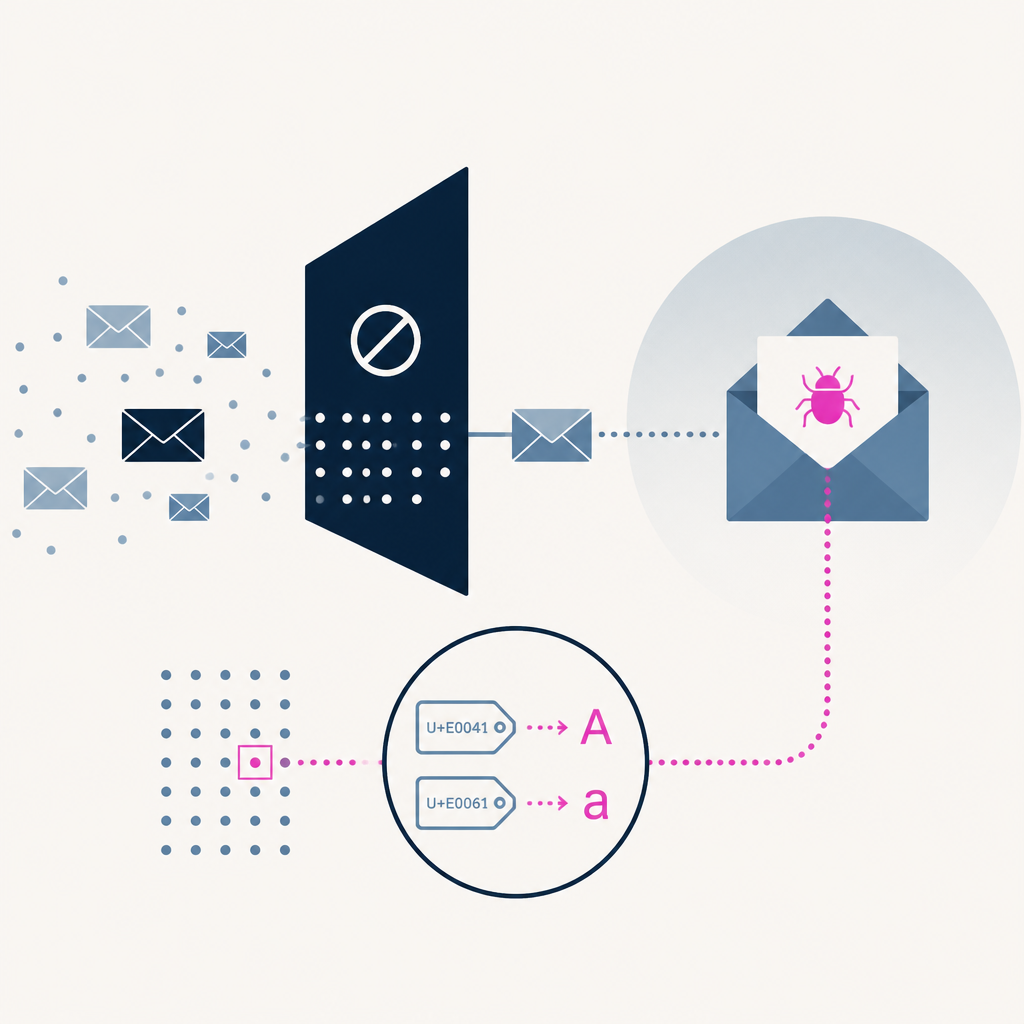
Microsoft Defender for Office 365 detected a phishing campaign that inserted invisible Unicode tag characters into email text, altering what software processes while recipients saw normal offers. The hunting signature fired on about 21,000 messages the day before the campaign started and the next day, then rose to more than 1.3 million the following day and over 2.3 million two days later. This shifts defenses toward handling Unicode tag characters in pipelines (including tokenization and normalization) so that prompt-injection-style text manipulation can’t bypass filters or confuse downstream AI/agents.
Spammers have adopted ASCII smuggling to hide malicious prompts in email campaigns designed to bypass email filters that flag mass unwanted messages. The method uses a set of 128 Unicode tags where specific points like U+E0041 map to “A” and U+E0061 maps to “a,” keeping the encoded instructions readable to computers while largely invisible to people. As a result, the technique—previously discussed mainly for making prompt-injection attacks against AI agents more stealthy—now appears in spam delivery tactics alongside filter-evasion efforts.
Infosys expanded its partnership with CrowdStrike through Project QuiltWorks to apply enterprise context to vulnerabilities discovered at scale for AI security efforts. The collaboration “now” compresses the time from vulnerability discovery to potential exploitation from hours to minutes or even seconds. This shifts onboarding and engagements toward the coalition’s customer-context approach, including newer CrowdStrike offerings like SafeMind and its red/blue team models.
Every AI story that matters,
in your inbox by 8am.
TLDRocket reads all relevant sources, removes duplicate coverage, and summarises the
day in two minutes. Follow companies and topics for alerts, or get the
briefing in Slack. Free, no spam, unsubscribe anytime.
Reading TLDRocket needs no cookies, and the readership counts we rely on come from
our own cookieless analytics. Google Analytics is the exception: it sets cookies and
reports to Google, so it stays switched off until you allow it. You can change your
mind any time from “Cookie settings” in the footer.
Strictly necessary
Session security and form protection (tldrocket-session,
XSRF-TOKEN, 2 hours). The site cannot work without them,
so they need no consent.
Always on
Google Analytics 4 (_ga,
_ga_<id>, up to 2 years). Measures which
stories and sections readers use. Google acts as a third-party processor and may
store the data outside the EU. No advertising, no profiling, no data sold.