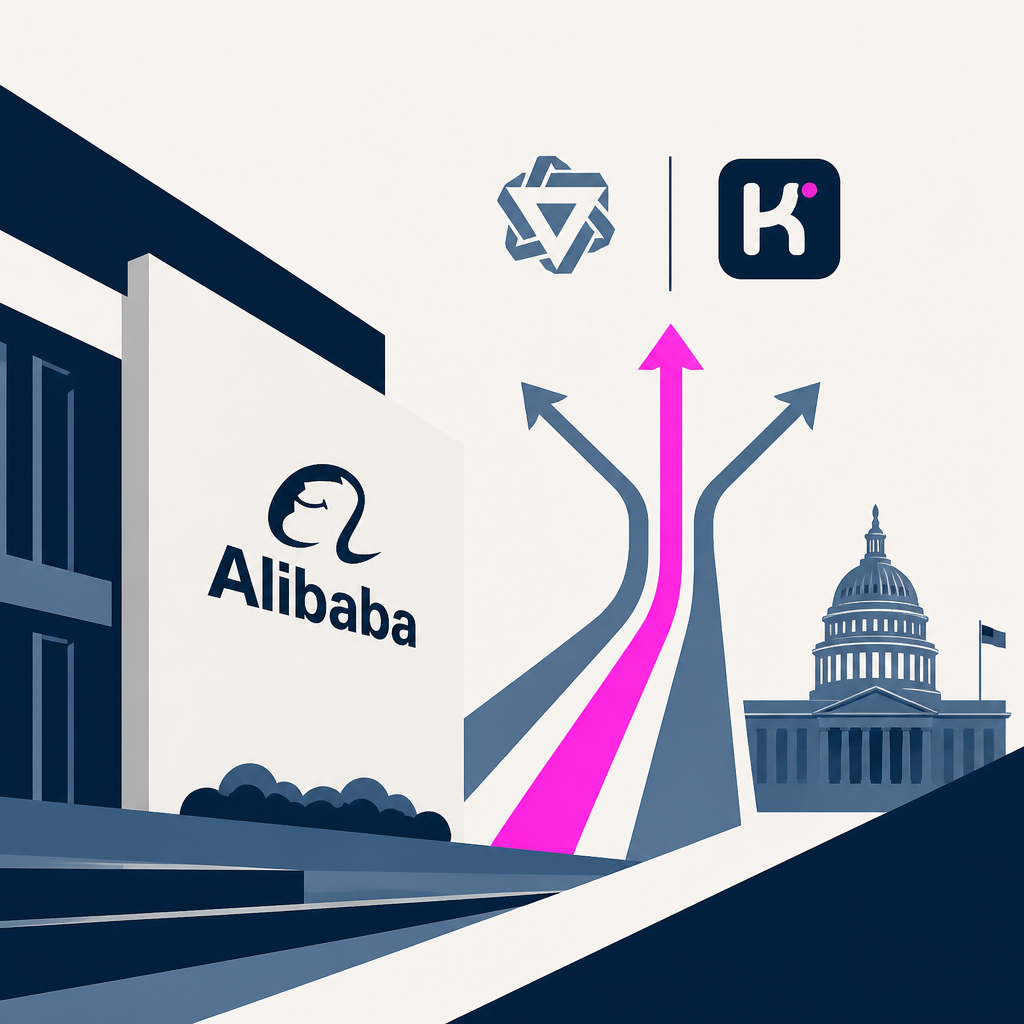
U.S. Treasury Secretary Scott Bessent announced the administration would examine Chinese open source AI models for intellectual property theft and threaten sanctions against Chinese AI companies if violations are found. The statement follows recent advances by Chinese models like Moonshot AI's Kimi K3, which are gaining capabilities and market traction against American firms like OpenAI and Anthropic. The threat represents an escalation in U.S. government efforts to maintain technological superiority, adding to existing restrictions on Chinese access to advanced AI chips and controls on model exports.
A federal judge approved Anthropic's $1.5 billion settlement with authors who sued over copyrighted books used to train its AI models. The deal provides approximately $3,000 per book to affected authors and represents the largest known copyright recovery settlement in history. Authors can now receive compensation, and AI companies face clearer financial liability for using copyrighted training data without permission.
Last Week in AI podcast episode 252 discusses OpenAI's GPT-5.6 release, SpaceX AI's low-cost Grok 4.5 model, Meta's Muse coding improvements and video generation, and policy developments including US energy grid concerns and proposed US-China coordination on AI progress. OpenAI released GPT-5.6 including variants Sol and Luna, SpaceX launched Grok 4.5 as an Opus-class coding model undercutting competitors, and Meta's Muse Spark 1.1 showed large gains on coding benchmarks. The episode covers infrastructure scaling pressures, frontier model oversight concerns, and safety research including Anthropic's interpretability work and proposals for international AI progress coordination.
The 249th episode of Last Week in AI podcast covers major developments including Anthropic cutting off access to Fable 5 and Mythos 5 following a US government order, SpaceX's $1.75 trillion IPO and subsequent $60 billion acquisition of AI coding startup Cursor, and significant market shifts with ChatGPT's market share dropping below 50% as Gemini and Claude gain ground. Key details include Anthropic seeking Google-backed data center leases, OpenAI's leaked financials showing billions in annual losses, and a Munich court ruling Google liable for false AI Overview statements. These developments reshape competitive positioning in AI infrastructure, coding tools, and chatbot markets while raising questions about government policy consistency and corporate structure in the AI industry.
UK Prime Minister Andy Burnham appointed Kanishka Narayan as the country's first cabinet-level AI minister while dismantling the Department for Science, Innovation and Technology, reallocating its 4,000 staff across other government departments. The tech ecosystem views Narayan's cabinet position as a positive development, but uncertainty remains about whether his elevation can compensate for losing DSIT's dedicated institutional structure and resources. Questions persist about how critical initiatives like the Sovereign AI Unit and AI Security Institute will maintain continuity and whether Narayan will have sufficient operational infrastructure to implement strategy effectively.
A podcast episode covering major AI developments including Anthropic's Claude Fable 5 release with significant benchmark improvements and new safety concerns, Apple's Siri AI announcement with Gemini integration, and OpenAI's confidential IPO filing amid a funding race. Google is paying SpaceX $920 million per month for GPU compute, while Bezos-backed Prometheus raised $12 billion for physical AI systems. The episode also discusses new open-source models like Gemma 4, policy calls for AI regulation with third-party testing, and disputes over music licensing settlements with generative audio companies.
The U.S. Commerce Department opted against restricting advanced Chinese AI models like Moonshot AI's Kimi K3, after briefly considering procurement bans and hosting rules. The decision came amid internal debate over whether such protections would undermine rather than help American AI development. The outcome leaves Chinese models accessible in the U.S. for now, allowing continued competition in the market.
The LWiAI podcast episode 247 covers major AI developments including Anthropic's Claude Opus 4.8 release with Dynamic Workflows, Microsoft's Scout assistant and new MAI models, and Anthropic filing for an IPO at a $965 billion valuation. Cognition raised $1 billion at $25 billion valuation, and MiniMax-M3 achieved benchmark performance matching GPT-5.5 and Gemini 3.1 Pro at 5-10% of the cost. Policy moves included Trump's voluntary AI testing framework, tighter US Nvidia export controls, China restricting AI expert travel, and expanded biodefense initiatives.
The UK appointed Kanishka Narayan as cabinet-level minister for AI under new Prime Minister Andy Burnham, elevating the role's status. The government simultaneously dissolved the Department of Science, Innovation and Technology as a standalone entity, dispersing its responsibilities across other departments. The structural change signals prioritization of AI governance while triggering departmental reorganization and the departure of several senior science and tech ministers.
Alibaba announced that Qwen 3.8 Max (2.4T parameters) will be released as open-weight, and Kimi K3 (2.8T parameters) emerged as a strong open-weight contender, ranking #1 on Frontend Web App Arena with 1326 Elo and #4 on agentic tasks. The U.S. administration is considering layered policy measures against Chinese open models, while technical voices argue that restricting open models hurts competition and security more than it helps. Model routing, world modeling for agents, and long-horizon reliability are becoming first-class infrastructure problems, with frontier models now demonstrating superhuman performance on mathematical tasks like finding a counterexample to the 3D Jacobian conjecture.
Every AI story that matters,
in your inbox by 8am.
TLDRocket reads all relevant sources, removes duplicate coverage, and summarises the
day in two minutes. Follow companies and topics for alerts, or get the
briefing in Slack. Free, no spam, unsubscribe anytime.
Reading TLDRocket needs no cookies, and the readership counts we rely on come from
our own cookieless analytics. Google Analytics is the exception: it sets cookies and
reports to Google, so it stays switched off until you allow it. You can change your
mind any time from “Cookie settings” in the footer.
Strictly necessary
Session security and form protection (tldrocket-session,
XSRF-TOKEN, 2 hours). The site cannot work without them,
so they need no consent.
Always on
Google Analytics 4 (_ga,
_ga_<id>, up to 2 years). Measures which
stories and sections readers use. Google acts as a third-party processor and may
store the data outside the EU. No advertising, no profiling, no data sold.