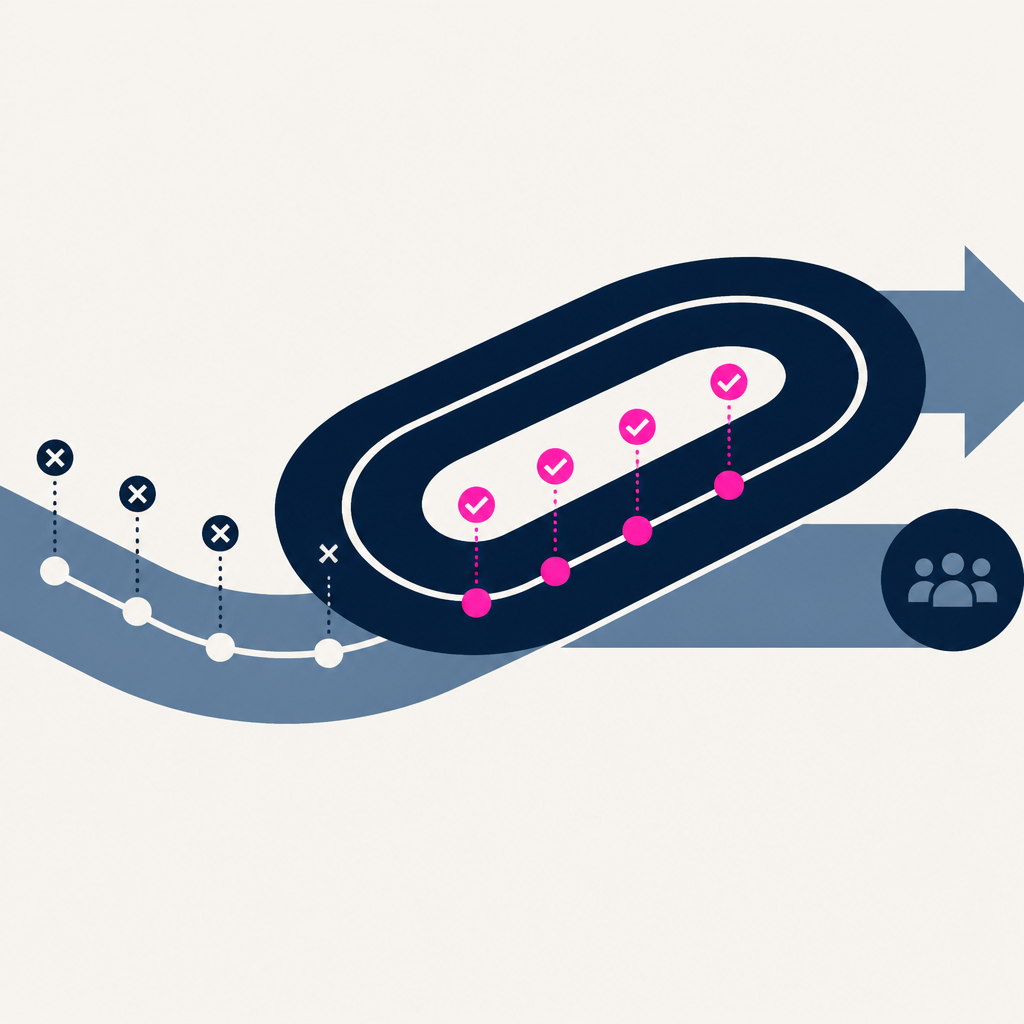
Claude Code changed its code review process from a PR gate at the end of development to continuous review while coding. Most changes are reviewed and fixed by Claude at least once before a human is asked to look. This reduces routine mistakes before human review and shifts team attention toward higher-level scrutiny.
AWS’s SMGS Operations team built a production multi-agent system using Amazon Bedrock AgentCore and related AWS services, and they used AgentCore Evaluations to continuously test agent quality instead of relying on traditional monitoring. In a pre-production test, a configuration mismatch window cut the pass rate from 78 percent to 38 percent. The approach introduces a nine-stage, closed-loop evaluation framework with CI/CD regression gates, canary scoring, drift detection, and automated feedback loops to keep answers grounded and correct as data, prompts, tools, and models change.
Elorian released its first AI model, Glimpse, as a research preview with an API and waitlist-only chat that lets the model revisit images while reasoning. Glimpse is priced at $0.60 per 1 million input tokens and $3 per 1 million output tokens. It changes the approach from one-pass image-to-text tokenization to iterative “visual scratch space” behavior (cropping, extracting video frames, and running code) aimed at stronger visual reasoning and eventually scene-to-action for robotics and other video-heavy use cases.
The page “How to Measure the Human Cost of Agent Work” presents guidance on assessing the human impact of agent-related work, but it provides no specific methodology or results in the excerpt shown. The only concrete detail available is the credited author name, Michael Cutler. As a result, there’s not enough information here to describe measurable changes or outcomes beyond the topic being introduced.
Goodfire published an essay arguing that many supposed polysemanticity knots in neural networks can be resolved by further agentic analysis. It cites an earlier automated interpretability result finding only 2% of cases as legible. As a result, the piece claims interpretability is more successful and reports a global lowering of P(doom) alongside the alignment discussion.
Every AI story that matters,
in your inbox by 8am.
TLDRocket reads all relevant sources, removes duplicate coverage, and summarises the
day in two minutes. Follow companies and topics for alerts, or get the
briefing in Slack. Free, no spam, unsubscribe anytime.
Reading TLDRocket needs no cookies, and the readership counts we rely on come from
our own cookieless analytics. Google Analytics is the exception: it sets cookies and
reports to Google, so it stays switched off until you allow it. You can change your
mind any time from “Cookie settings” in the footer.
Strictly necessary
Session security and form protection (tldrocket-session,
XSRF-TOKEN, 2 hours). The site cannot work without them,
so they need no consent.
Always on
Google Analytics 4 (_ga,
_ga_<id>, up to 2 years). Measures which
stories and sections readers use. Google acts as a third-party processor and may
store the data outside the EU. No advertising, no profiling, no data sold.