
Inside China's All-Out Push to Catch Up With American AI Chips
The Wall Street Journal ● Covered by 75 sources
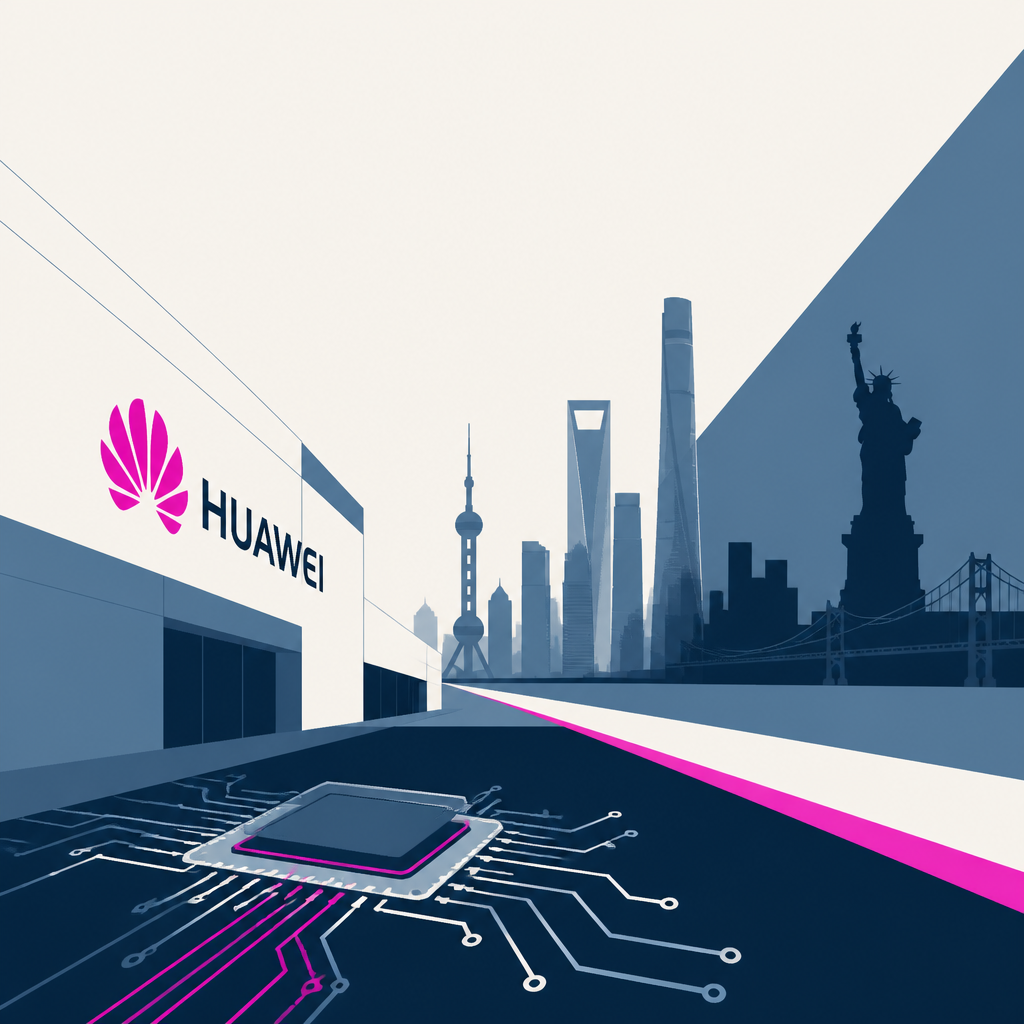
China's chip industry, led by Huawei, says it's found workarounds to build near-cutting-edge AI silicon without Western tools. It's still trailing the US, but the gap is the story everyone's watching now.
Based on reporting by The Wall Street Journal — read the original for the full story.
Summary, retelling and take written by AI under human oversight; images are AI-generated illustrations. How we work · Report an error
Huawei has become the face of China's attempt to build an AI chip industry that doesn't need permission from Washington. The company claims it has found ways around the export controls that cut it off from the most advanced chipmaking equipment, producing silicon that gets close to, but still doesn't match, what Nvidia and other US firms are shipping.
That gap matters more than a few percentage points of benchmark performance. China's AI ambitions, from military applications to the sprawling ecosystem of startups trying to compete with OpenAI and Anthropic, run on compute. Every rung further behind on chip performance is a rung further behind on how fast models can be trained and how cheaply they can be run at scale.
What's notable here isn't a single breakthrough chip but the breadth of the effort. Huawei isn't operating alone; it's the most visible node in a much larger push spanning domestic foundries, materials suppliers, and software toolchains, all trying to route around the choke points the US has deliberately built into extreme ultraviolet lithography and advanced packaging. Years of sanctions were designed to make this kind of vertical independence nearly impossible without TSMC or ASML in the loop.
The workarounds reportedly involve older lithography techniques stacked and refined to approximate what newer equipment does in a single pass, plus packaging tricks that squeeze more performance out of less advanced transistors. It's brute-force engineering rather than a leap to a new process node, and it shows in yields and costs that are still well above what US or Taiwanese fabs achieve.
Still, the direction of travel is what should worry chip export-control architects in Washington. Being close and improving fast is a different problem than being permanently locked out. China has thrown enormous state resources at this exact scenario for years, and Huawei's claims, even if inflated, suggest the strategy is producing something more than propaganda.
My take — AI-written commentary, not fact-checked reporting
I've said for a while that export controls buy time, not permanence, and this is exactly what that looks like: painful, expensive, imperfect workarounds that nonetheless close the gap year over year. Betting the entire US AI advantage on China never solving lithography is not a strategy, it's a hope. And hope is not what I'd want steering a policy this consequential.
Read more about this at: The Wall Street Journal
Related stories
 China's Xi Touts Open-Source AI and Takes a Swipe at US Dominance
The Wall Street Journal · 1 month ago ·
50
Trump administration’s AI crackdown opens door for China to close gap
CSET Georgetown · 2 months ago ·
38
China's Xi Touts Open-Source AI and Takes a Swipe at US Dominance
The Wall Street Journal · 1 month ago ·
50
Trump administration’s AI crackdown opens door for China to close gap
CSET Georgetown · 2 months ago ·
38
 China only six months behind US in AI development
The New York Times · 2 months ago ·
48
China only six months behind US in AI development
The New York Times · 2 months ago ·
48