
China only six months behind US in AI development
The New York Times ● Covered by 4 sources
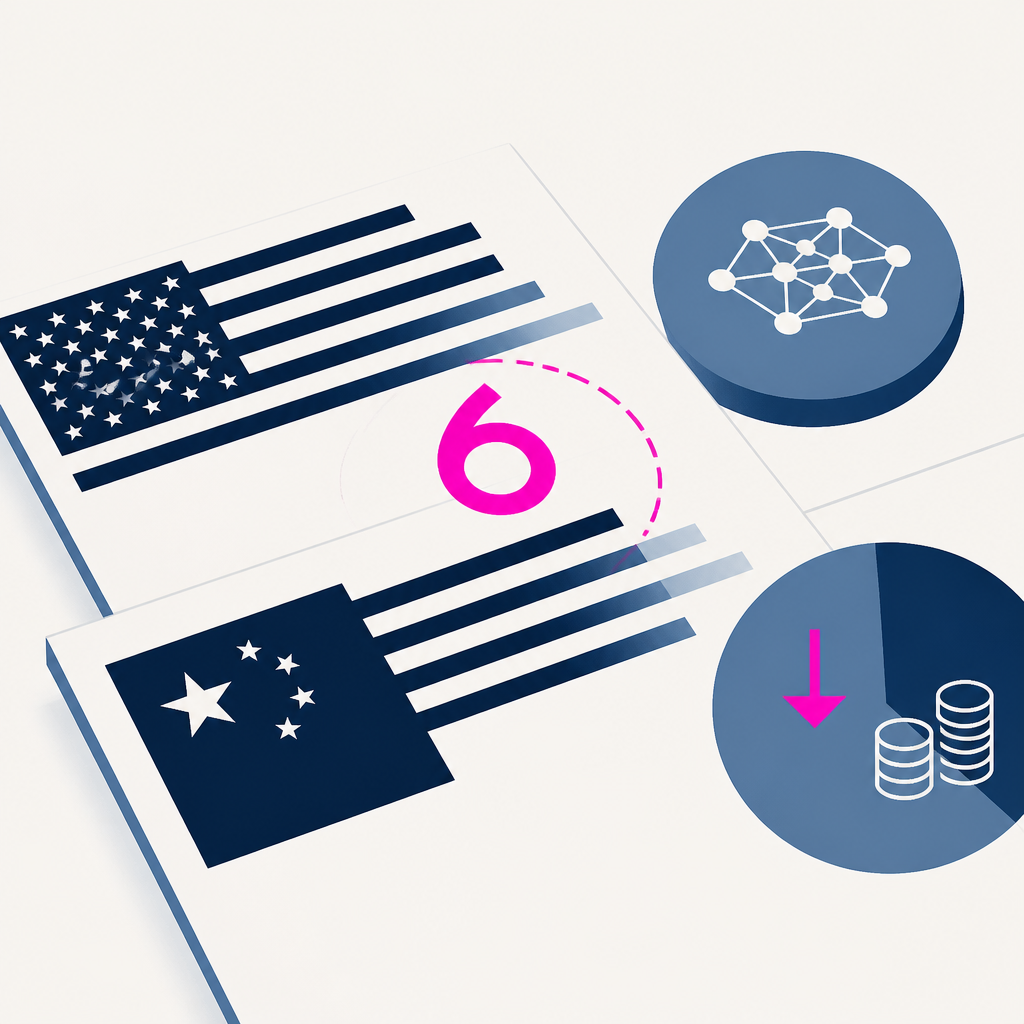
China's AI models are now running just six months behind the US, experts say. And they're doing it for a fraction of the price, some 60-90% cheaper than Anthropic or OpenAI.
Based on reporting by The New York Times — read the original for the full story.
Summary, retelling and take written by AI under human oversight; images are AI-generated illustrations. How we work · Report an error
Six months. That's the gap analysts are now putting between American and Chinese AI labs, a number that would have seemed absurd even a year ago when the conversation was dominated by export controls and chip shortages. The narrative of an unbridgeable US lead is quietly falling apart, and the reason isn't some secret breakthrough in Beijing labs. It's economics.
Chinese models are showing up with capabilities that trade blows with GPT-4-class systems and Anthropic's Claude lineup, but at a fraction of the cost, somewhere between 60% and 90% cheaper depending on which benchmark you trust. That's not a rounding error. That's the kind of price gap that reshapes who gets to build on top of these models, especially startups and enterprises outside Silicon Valley's orbit who've been priced out of frontier AI for two years.
Part of this comes down to necessity. US export restrictions on advanced Nvidia chips forced Chinese labs like DeepSeek, Alibaba's Qwen team, and others to get resourceful with training efficiency rather than just throwing more GPUs at the problem. Constraint bred a different kind of optimization, one focused on squeezing more performance out of less hardware. It's the same logic that's driven decades of engineering elsewhere: when you can't buy your way out of a problem, you get clever.
What's notable here isn't just the technical catch-up, it's the pricing strategy behind it. American labs have largely competed on capability, pushing benchmarks upward while charging premium rates. Chinese firms appear to be betting that being good enough and dramatically cheaper wins more deployments than being marginally better and expensive. If that bet pays off, the AI market's center of gravity shifts toward whoever can make the economics work for the largest number of users, not just the flashiest demo.
None of this means American labs are standing still, and six months is still six months. But the gap closing this fast, on cost structures this aggressive, should worry anyone who assumed US dominance in AI was a permanent feature of the landscape rather than a temporary lead that has to be defended.
My take — AI-written commentary, not fact-checked reporting
I've been saying for a year that the 'US is years ahead' narrative was mostly copium from people who hadn't looked at Qwen or DeepSeek benchmarks lately, and this confirms it. The real story isn't China closing a capability gap, it's that open, cheap models are about to make premium API pricing from OpenAy and Anthropic look like a luxury tax nobody has to pay anymore.
Read more about this at: The New York Times
Related stories
 China's AI startups can match the U.S.'s models. They can't yet match the U.S.'s money
Fortune ·
24
China's AI startups can match the U.S.'s models. They can't yet match the U.S.'s money
Fortune ·
24
 Faced with less compute and fewer tokens, Chinese AI labs are tightening the gap with the US by just being more efficient
Fortune ·
24
Bloomberg Intelligence: China’s leading AI models trail U.S. by about 3% on benchmarks
The Business Times · 3 weeks ago ·
45
Faced with less compute and fewer tokens, Chinese AI labs are tightening the gap with the US by just being more efficient
Fortune ·
24
Bloomberg Intelligence: China’s leading AI models trail U.S. by about 3% on benchmarks
The Business Times · 3 weeks ago ·
45