
Google Open-Sources Harness2, a Recursive Agent Harnessing Framework
MarkTechPost Asif Razzaq
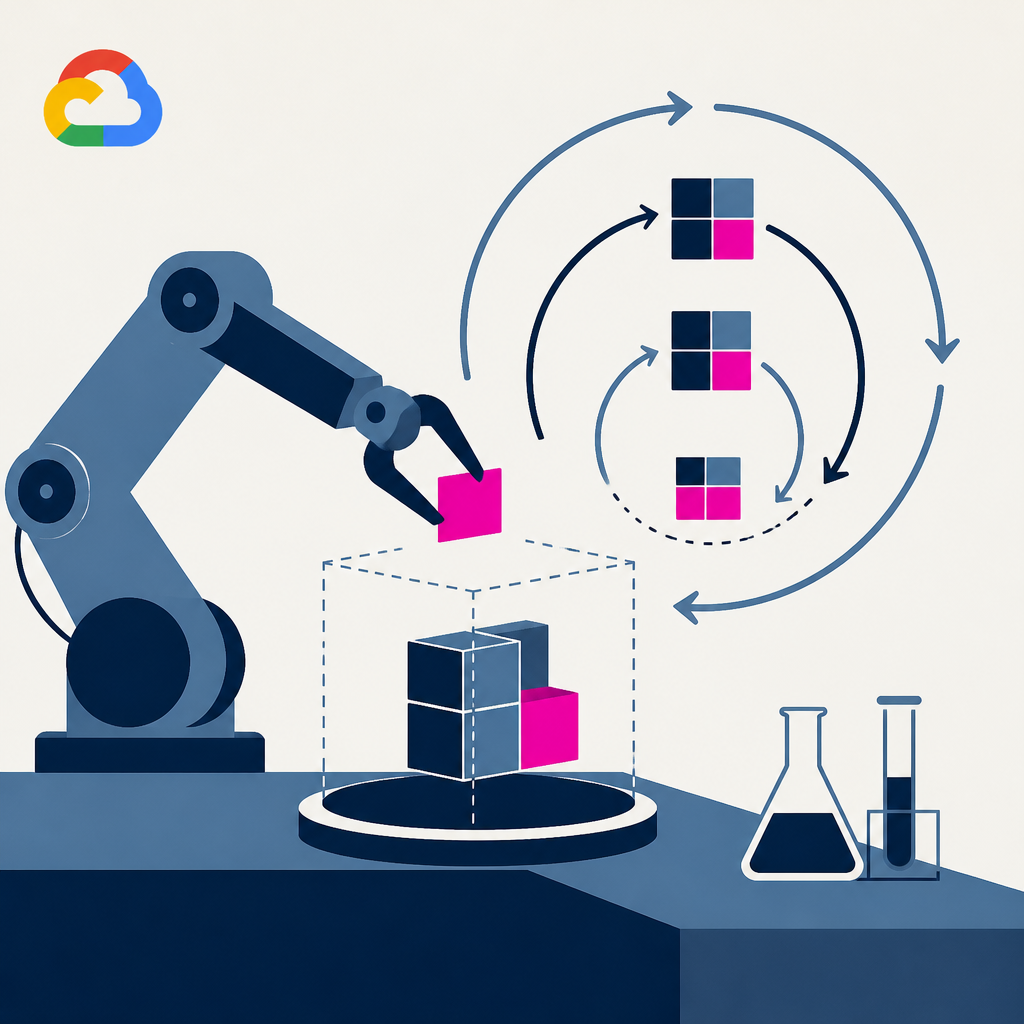
Google open-sourced Harness², a framework that tweaks an agent’s harness instead of its model. It improved all four setups on three benchmarks without changing weights.
Based on reporting by MarkTechPost, Asif Razzaq — read the original for the full story.
Summary, retelling and take written by AI under human oversight; images are AI-generated illustrations. How we work · Report an error
Google Cloud AI Research has open-sourced Harness², a framework for improving the software wrapped around a frozen model rather than the model itself. That makes it a different kind of bet: keep the weights locked, and keep nudging the prompts, tools, memory and orchestration until the agent behaves better.
Harness² ships as version 0.1.0 and exposes eight editable components as files: system prompt, guardrails, memory, tool guidance, subagents, skills, scripts and plugins. Google says the setup is meant for the open world, where tasks show up unseen and there is no clean verifier waiting to score the answer. The whole point is to work without labels or test cases.
The core trick is recursive harnessing. At the task level, the system runs once, then an editor proposes two edits: one aimed at general failures like planning or tool use, the other aimed at the current domain. Both are tested on the same task, and the composer keeps only changes supported by what actually happened. After that, another recursion layer stores the adopted harness plus an EXPERIENCE.md file so later proposals can borrow from earlier lessons.
The paper’s benchmark results suggest the approach is doing real work, though not equally for every setup. Across WorkBuddy-Bench, JobBench and Harvey’s LAB, one refinement step improved all four model-and-harness combinations tested. The biggest single gain came from GLM-5 under OpenCode on WorkBuddy-Bench, which rose from 64.2 to 75.7. The smallest was GLM-5 under Codex on JobBench, which moved only from 23.6 to 24.8.
Google also tested a larger budget, with parallel mode at k=5 pushing Gemini 3.5 Flash under OpenCode to 80.8 on WorkBuddy-Bench. And the framework is practical enough to run on Linux with Python 3.12 or 3.13 and uv, while model-backed runs need Node.js 20+, the Google Cloud CLI and a Vertex AI project. In other words: this is not a new model launch. It is an attempt to make the boring stuff around the model much less boring, and that may matter more than another round of benchmark theatre.
My take — AI-written commentary, not fact-checked reporting
This is the right kind of open-source AI work: less fireworks, more plumbing. The industry keeps pretending the model is the whole product, when the harness is often where the actual advantage lives. Freezing the weights and improving the wrapper is refreshingly unglamorous, which is usually a good sign.
Read more about this at: MarkTechPost
Related stories
 Google Research Open-Sources RRSI: AI Agents That Improve Their Own Harness Without Overfitting
MarkTechPost · 2 weeks ago ·
54
Google Research Open-Sources RRSI: AI Agents That Improve Their Own Harness Without Overfitting
MarkTechPost · 2 weeks ago ·
54